The brain uses alpha-frequency oscillations in the parietal cortex to help distinguish self from environment. In tests with 106 volunteers and the rubber hand illusion, EEG showed faster alpha rhythms made people more sensitive to millisecond timing mismatches and less likely to accept the fake hand. Using non-invasive tACS to speed or slow alpha oscillations causally altered the strength of the illusion. Results may inform treatments for conditions like schizophrenia and improve prosthetics and virtual reality.
Alpha Waves in the Parietal Cortex Define the Edge of ‘You’ — New Study Links Brain Rhythm to Body Ownership
Scientists Identify Brain Waves That Define The Limits of 'You'
At what point does your sense of self end and the outside world begin? New experiments show that a specific rhythm of brain activity — alpha-frequency oscillations in the parietal cortex — helps set that boundary.
Researchers in Sweden and France tested 106 volunteers using the well-known rubber hand illusion while recording and manipulating brain activity. In the illusion, a person’s real hand is hidden and a visible rubber hand is stroked or tapped at the same time as the hidden hand; many people then report a strange feeling that the rubber hand is part of their body.
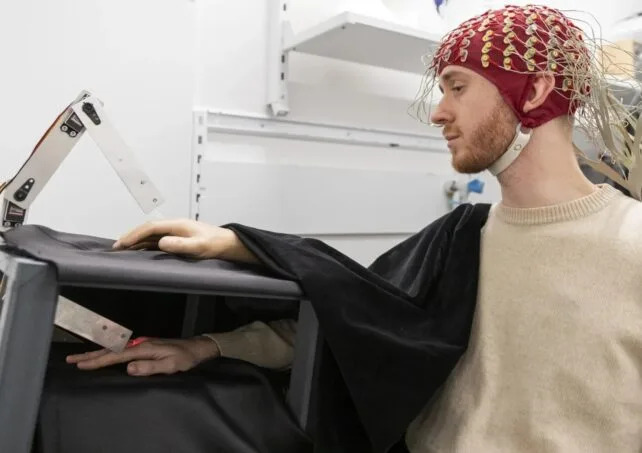
In one experiment, participants wore an EEG headset and placed their real hand out of view, with a fake hand positioned above, while two robot arms applied stimuli. (Martin Stenmark/Karolinska Institute)
What the Experiments Did
The team ran several linked experiments. In an initial set of trials, a robotic arm tapped both the participant’s real and the rubber index fingers either in perfect synchrony or with delays up to 500 milliseconds. As expected, synchronized taps produced a stronger ownership illusion, and the illusion weakened as temporal mismatch increased.
In a second experiment, electroencephalography (EEG) recordings showed that the frequency of alpha oscillations in the parietal cortex correlated with participants’ temporal sensitivity. Participants with faster alpha rhythms detected tiny timing mismatches and were less likely to adopt the rubber hand, while those with slower alpha rhythms were more susceptible to the illusion even with larger delays.

Audition now for ScienceAlert's Casting Call
Testing Causality With Brain Stimulation
To test whether alpha frequency actually influences body ownership, the researchers applied transcranial alternating current stimulation (tACS) to speed up or slow down participants’ alpha rhythms. The manipulations produced predictable changes: accelerating alpha oscillations increased temporal sensitivity and reduced acceptance of the fake hand, whereas slowing alpha made participants more likely to experience the fake hand as their own.
"We have identified a fundamental brain process that shapes our continuous experience of being embodied," said lead author Mariano D'Angelo of the Karolinska Institute. Henrik Ehrsson, also at Karolinska, added, "Our findings help explain how the brain solves the challenge of integrating signals from the body to create a coherent sense of self."
The authors note clinical and technological implications: the results may shed light on psychiatric conditions such as schizophrenia, help explain phantom-limb experiences in amputees, and guide improvements in prosthetic design and virtual reality systems to preserve or restore a sense of embodiment.
The study was published in Nature Communications.
Help us improve.