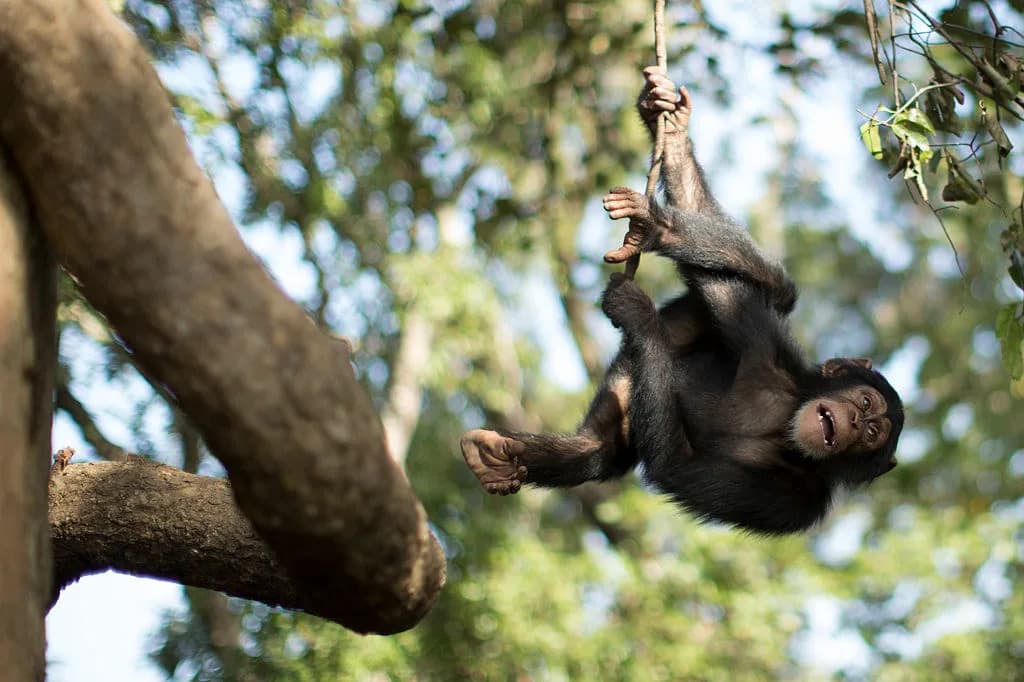
Researchers who reviewed footage of 119 wild chimpanzees in Uganda found that dramatic risky physical actions — defined as intentional drops and full-release leaps among canopy branches — are most frequent in infancy and decline with age. This contrasts with humans, where many kinds of risk-taking increase in adolescence, especially among boys. The authors argue that closer and sustained caregiver supervision in early human childhood may delay the peak of risky physical behavior until teens gain independence. The study highlights caregiving practices as a key influence on the timing of physical risk-taking across species.
Chimp Infants Take the Biggest Physical Risks — Long Before Human Teens Do
Are helicopter parents the reason human children tend to show peaks in risky behavior only during adolescence? New research suggests the timing of physical risk-taking may be shaped strongly by caregiver supervision. A University of Michigan team studied wild chimpanzees to compare how risky physical behavior develops across species.
In a paper published in iScience, researchers analyzed video recordings of 119 chimpanzees living in Kibale National Park, Uganda. They defined risky physical behavior as instances of "free flight" — deliberate drops from branches or full-release leaps between branches while the animal let go of all support. The researchers found that such behavior peaks in infancy and declines steadily with age, and the pattern was the same for males and females.
Findings
Quantitatively, infant chimpanzees (birth to 5 years) were about three times more likely than adults to perform these risky acts. Juveniles (5–10 years) were roughly 2.5 times more likely, and adolescents (10–15 years) about 2.1 times more likely than adults. The youngest individuals accounted for the greatest share of dramatic leaps and intentional drops.
Why This Differs From Humans
Humans typically show many forms of risk-taking that rise during adolescence, and males often take more risks than females. The authors suggest a key reason for the difference: human caregivers can provide close, sustained supervision early in life, limiting opportunities for dangerous physical behavior. Chimp mothers can only restrict offspring while they remain within arm's reach, so infants who are out of reach can and do explore riskier maneuvers.
"We hypothesize that a similar pattern would be exhibited in humans if oversight were relaxed earlier in childhood, as it is among chimpanzees," the study notes.
Laura MacLatchy, a co-senior author, said: "One implication of this work is that human behavior and caregiving practices may have a really big impact in mitigating the consequences of risky physical behavior in humans."
Methods and Limitations
The team relied on observational video data because experimental study of physical risk in humans is ethically constrained. As coauthor Bryce Murray pointed out, many risky activities are age-restricted or culturally variable (for example, skydiving is legally off-limits to minors in many places and adults rarely use playground equipment like monkey bars). Using chimpanzees gives researchers a comparative window on how risk-taking appears when close adult oversight is less consistent.
However, the authors caution about direct cross-species comparisons: human societies vary widely in caregiving styles and cultural norms, and modern parenting trends (including so-called "helicopter parenting") differ by region and over time. The study shows a compelling association between caregiving reach and timing of physical risk, but cultural, ecological and developmental factors also matter.
Why This Matters
Understanding when and why risk-taking peaks matters for child safety, developmental psychology and evolutionary biology. The findings suggest that caregiver supervision is an important, potentially modifiable factor shaping when risky physical behaviors emerge in childhood and adolescence.
Bottom line: In wild chimps, the boldest physical explorers are the youngest — a pattern that likely reflects differences in how closely caregivers can supervise offspring, and that helps explain why human risk peaks later, during the teenage years.
Help us improve.