Summary: DHS has revised R-1 visa rules so religious workers who hit the five-year limit must depart but can immediately apply to return, removing a prior one-year abroad requirement. The change responds to a 2023 processing shift that placed clergy into a broader EB-4 green-card queue and created lengthy backlogs. Faith leaders and immigration lawyers praised the move as reducing disruption, though thousands still face long waits for permanent residency and lawmakers have proposed bipartisan legislation to address the backlog.
DHS Eases R-1 Visa Rules, Letting Clergy Apply To Return Immediately After Five-Year Limit
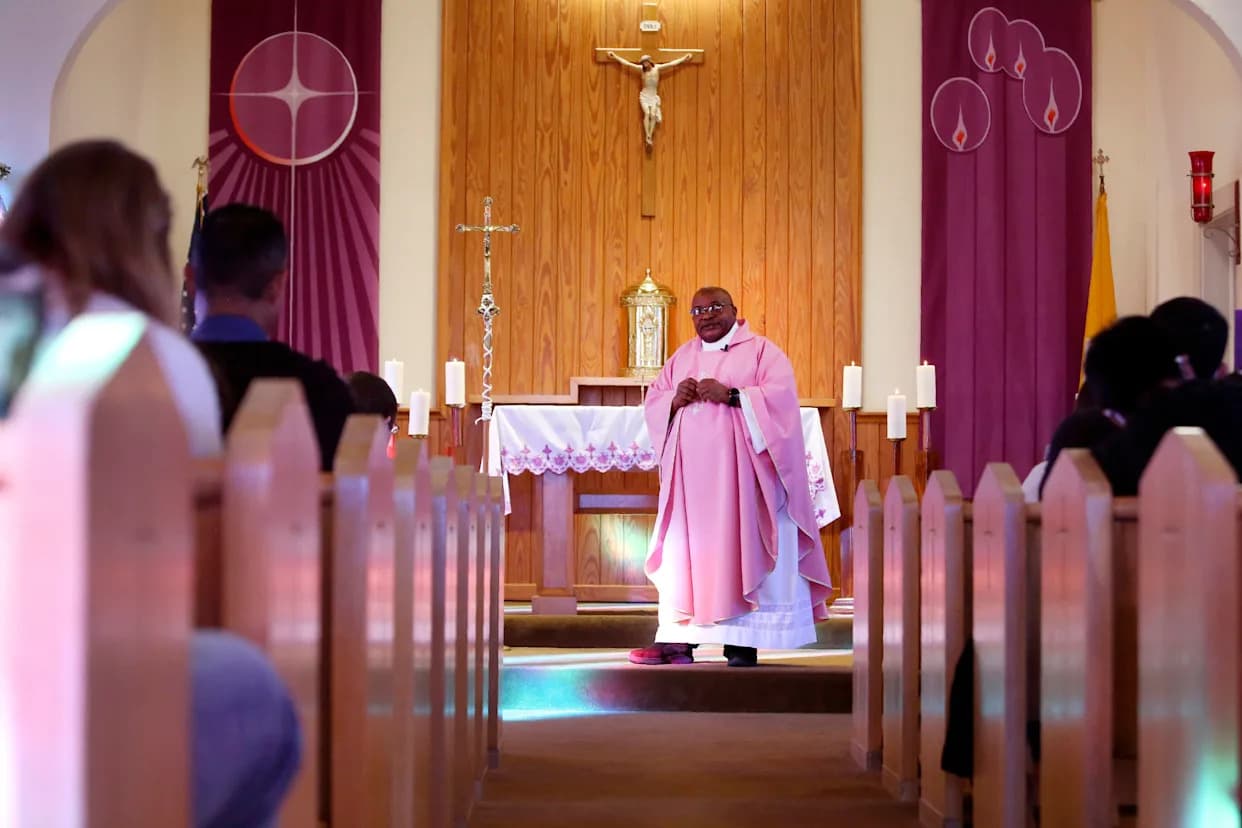
FILE - The Rev. Athanasius Abanulo, from Nigeria, celebrates Mass at Holy Family Catholic Church in Lanett, Ala., on Sunday, Dec. 12, 2021. He is one of numerous international clergy helping ease a U.S. priest shortage by serving in Catholic dioceses across the country. (AP Photo/Jessie Wardarski, File)
The Department of Homeland Security on Wednesday finalized a regulatory change to ease travel and return rules for foreign religious workers who serve U.S. congregations on temporary R-1 visas. Under the new rule, R-1 visa holders who reach the five-year maximum will still need to depart the United States, but they may apply to re-enter immediately rather than being required to remain abroad for a full year.
What the Rule Changes
Key change: The one-year abroad re-entry bar that had applied after the five-year R-1 maximum is being removed. Beneficiaries must still leave the U.S. when their R-1 time expires, but they can request return immediately — reducing months or years of disruption for congregations that rely on foreign clergy, imams, rabbis, nuns and other ministers.
Why This Matters
“We are taking the necessary steps to ensure religious organizations can continue delivering the services that Americans depend on,” DHS said in a statement, calling faith leaders “essential to the social and moral fabric of this country.”
Advocates say the change reduces the administrative and pastoral strain on faith communities that depend on foreign ministers for worship, pastoral care, language-specific ministries, and religious education.
Background: 2023 Processing Shift and Green-Card Backlogs
Historically, the five-year R-1 term generally allowed congregations enough time to file EB-4 petitions that lead to permanent residency for religious workers. In March 2023, however, the State Department began reclassifying certain groups — including some migrant minors with Special Immigrant Juvenile Status — into the same EB-4 green-card queue as clergy. That processing change created new backlogs and delayed or blocked the path to adjustment of status for many religious workers.
There are no exact public tallies, but estimates suggest thousands of religious workers are affected by EB-4 congestion or have not yet been able to file. In many cases applicants from countries with especially high demand face much longer waits because of annual statutory quotas and separate priority lines.
Lawsuit and Legislative Response
In summer 2024 the Catholic Diocese of Paterson, New Jersey, and five priests sued DHS, the State Department and U.S. Citizenship and Immigration Services, arguing the 2023 processing change would cause “severe and substantial disruption” to religious life. The suit was voluntarily dismissed in fall 2025 to allow agency rulemaking to proceed; diocesan counsel has said the new DHS rule achieves the plaintiffs’ immediate goal of keeping clergy in the United States.
Separately, in spring 2025 lawmakers in both parties introduced a bipartisan bill that would allow extensions of religious-worker visas while green-card petitions are pending — a legislative remedy aligned in purpose with the DHS regulatory fix.
Reactions From Faith Leaders And Attorneys
Lance Conklin, a Maryland immigration attorney representing evangelical churches, called the change “a huge deal,” noting it avoids the serious disruption of losing staff for a year. The U.S. Conference of Catholic Bishops described the move as a “truly significant step” to support religious services. Olga Rojas, immigration counsel for the Archdiocese of Chicago, said the change helps parishes and schools retain valued religious workers.
At the same time, advocates caution the rule is a partial fix: the underlying EB-4 green-card backlog remains a long-term challenge that likely requires congressional action to fully resolve.
Associated Press reporting. Dell'Orto reported from Minneapolis.
Help us improve.