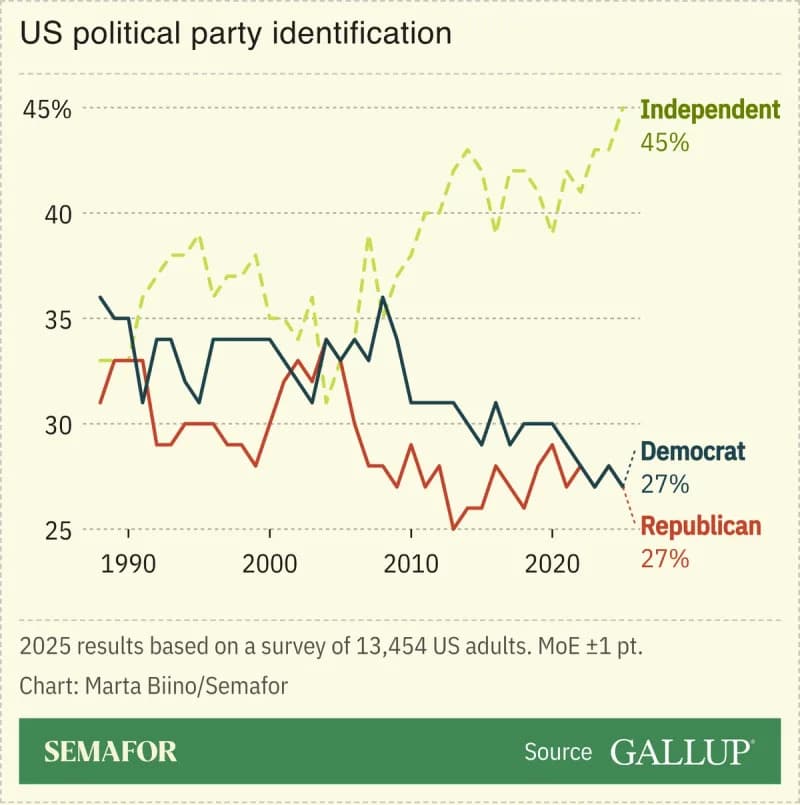
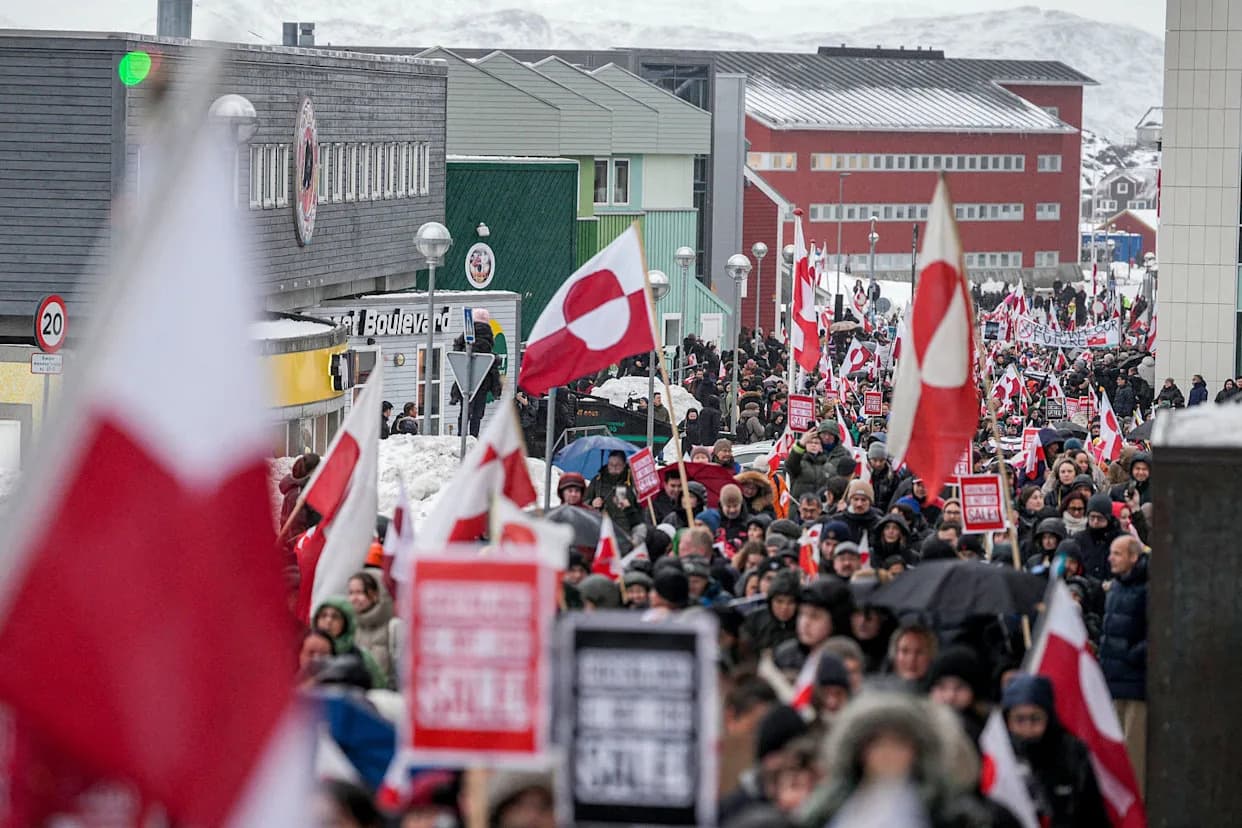
Gallup’s year‑end 2025 poll shows Democrats leading Republicans 48% to 40%, reversing a late‑2024 GOP edge. Self‑identified liberals rose to 28% — the highest level Gallup has recorded since the early 1990s — while conservatives were 35% and moderates 33%. The seven‑point conservative advantage is the smallest annual gap Gallup has measured since 1992, signaling a notable shift in American ideological self‑identification.
Gallup: Share of Americans Calling Themselves ‘Liberal’ Hits Highest Level Since Early 1990s

A year after Republicans appeared ascendant, Gallup’s year‑end polling shows the partisan and ideological landscape shifting back toward Democrats and a growing number of Americans embracing the "liberal" label.
Gallup’s national survey found Democrats leading Republicans 48% to 40% at the end of 2025 — reversing a late‑2024 snapshot in which 47% of respondents identified as Republican, roughly a four‑point GOP edge that many interpreted as evidence of a strong position heading into the 2024 election.
Alongside the partisan change, Gallup reported notable movement in ideological self‑identification. In 2025, 35% of respondents described their views as "very conservative" or "conservative," 28% as "very liberal" or "liberal," and 33% as "moderate." That seven‑point conservative advantage over liberals is the smallest annual average Gallup has recorded since it began tracking ideology in 1992 and is only the third year the conservative lead has been single digits.
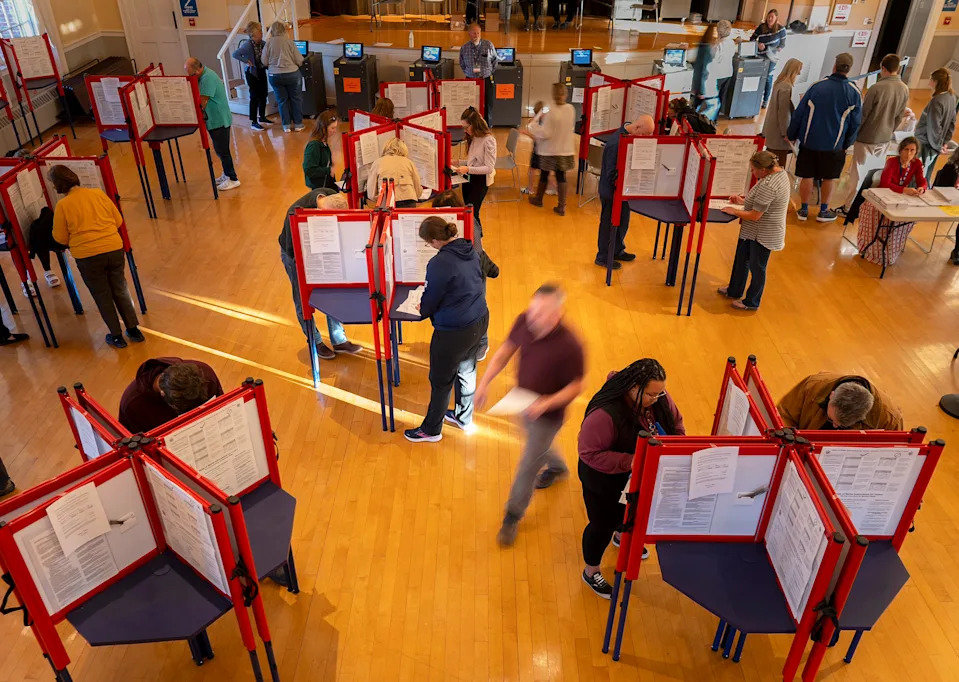
KENNEBUNK, ME- NOVEMBER 5: Voters cast their ballots at Kennebunk Town Hall on Tuesday. (Staff photo by Gregory Rec/Portland Press Herald via Getty Images)(Gregory Rec / Portland Press Herald via Getty Images)
Longer‑Term Trends
Gallup’s long‑term series shows liberal identification rising over decades while the share calling themselves moderates has declined. In 1992, just 17% of Americans identified as liberal (and that share dipped to 16% in 1996). By the end of 2025, liberal self‑identification climbed to 28% — the highest level Gallup has measured since the early 1990s.
"As usual, more Americans in 2025 described their views as 'very conservative' or 'conservative' (35%) than as 'very liberal' or 'liberal' (28%), with 33% identifying as 'moderate.' However, the seven‑point conservative advantage over liberals in 2025 is the smallest Gallup has measured in annual averages dating back to 1992." — Gallup
What This Means
While conservatives still outnumber liberals overall, the narrowing gap and rising liberal identification represent a meaningful shift in public self‑labeling that many observers did not anticipate a year earlier, when Republicans appeared to be on the rise. Whether this trend will translate into lasting political realignment or affect future elections depends on how stable these identifications prove and how they intersect with turnout and issue priorities.
Methodology note: These figures come from Gallup’s national polling and reflect respondents’ self‑reported party and ideological identification; Gallup publishes annual averages and long‑term trends dating back to the early 1990s.
Help us improve.