Researchers in the COMPACT collaboration reanalyzed CMB data and conclude that some nontrivial flat topologies—most notably twisted variants of a 3‑torus—cannot yet be excluded. The basic 3‑torus (E1) is ruled out only if it lies within the observable horizon; its twisted versions E2 (180°) and E3 (90°) remain compatible with current data. The team is now seeking a “topological fingerprint” in the CMB to confirm or eliminate candidate global shapes.
Our Universe Could Be a “Hall of Mirrors”: New Analysis Keeps Donut‑Like Topologies Alive

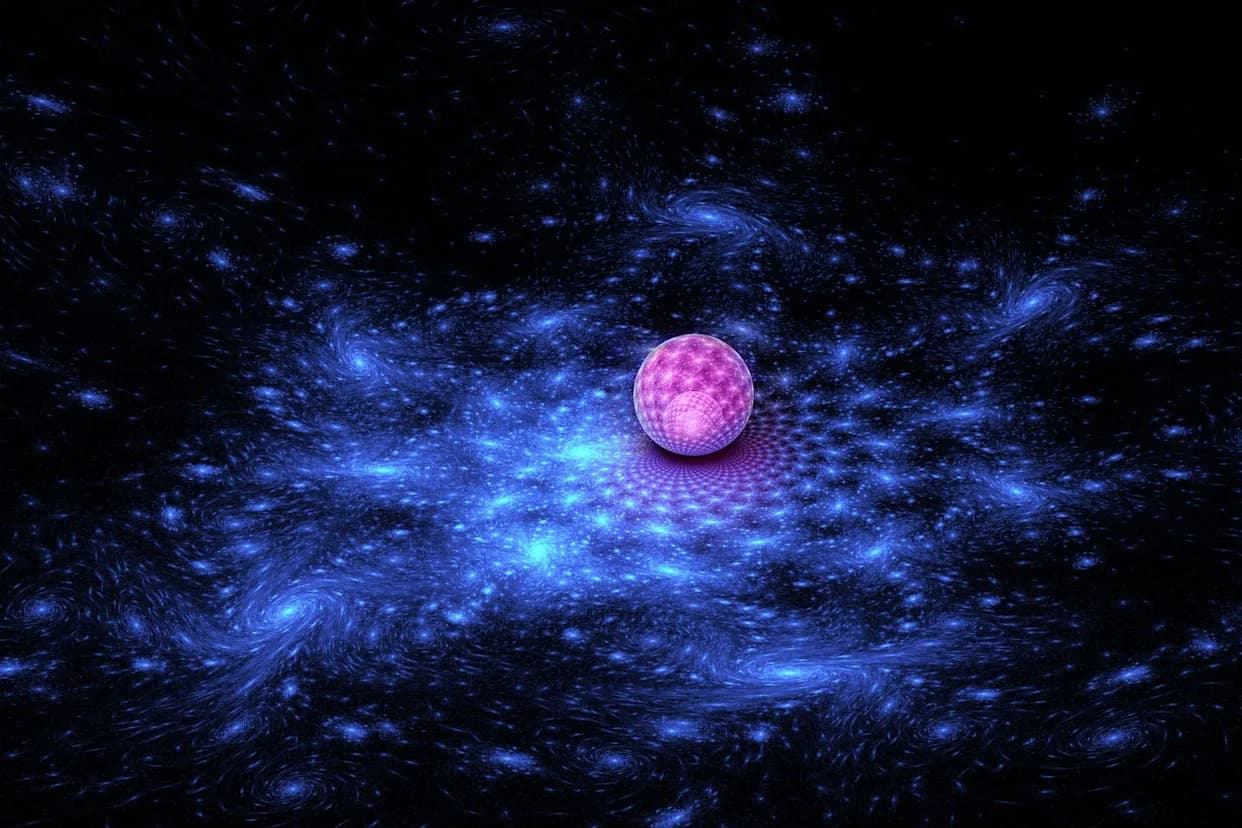
Are We Living in a ‘Hall of Mirrors’ Universe?Andriy Onufriyenko - Getty Images
Measurements show the observable universe is nearly flat on local scales, but its global topology—whether space is infinite or loops back on itself—remains unsettled. An international team called the Collaboration for Observations, Models and Predictions of Anomalies and Cosmic Topology (COMPACT) has reanalyzed Cosmic Microwave Background (CMB) data and finds that several nontrivial flat topologies, including variants of a 3‑torus, cannot yet be excluded.
What COMPACT Reexamined
Previous studies largely treated CMB maps as ruling out many “exotic” global shapes. COMPACT’s first paper, published in Physical Review Letters, challenges that view by showing that certain simple Euclidean (flat) topologies remain consistent with current CMB observations. Rather than surveying all 18 mathematically possible flat topologies, the team focused on the basic 3‑torus (labeled E1) and two twisted versions (E2 and E3).
Which Shapes Survive the Data?
The basic 3‑torus (E1)—a simple wraparound cube-like geometry—can be ruled out if its fundamental size is smaller than the observable universe (i.e., within the CMB horizon). However, two twisted variants, E2 (with a 180° twist) and E3 (with a 90° twist), remain compatible with current CMB measurements. In these twisted models, light that follows a closed loop can produce distinct but correlated views of the same region of space.
“While unambiguous indicators of topology have yet to be detected, prior searches have far from exhausted the potentially significant possibilities,” the COMPACT team writes, emphasizing that more sophisticated searches could reveal or constrain the universe’s global shape.
Why This Matters: The “Hall of Mirrors” Effect
A finite, wrapped topology would create repeated images of the same cosmic region seen from different directions—effectively a cosmic “hall of mirrors.” The absence of obvious duplicates in current surveys does not rule out such topologies if the repeated light paths exceed the distance light has traveled since the Big Bang (beyond the CMB horizon).
Next Steps
COMPACT is now developing techniques to search for a distinctive “topological fingerprint” in the CMB—statistical or pattern-based signatures that would support or reject specific topological models. Discovering such a fingerprint would be a major advance in answering whether space is infinite or has an unexpected global shape.
Bottom line: Current CMB data still permit some nontrivial flat topologies, especially twisted versions of a 3‑torus. The search for distinctive observational signatures continues.
Help us improve.