Dr Baek Jin Eon has provided a 119-page, non-computational proof showing that Joseph Gerver’s 1992 shape is the largest planar figure that can pass through an L-shaped corridor of unit width, resolving the moving sofa problem first posed in 1966. The proof was posted to arXiv in late 2024 and is under peer review at the Annals of Mathematics. Scientific American named the result one of its "Top 10 Math Discoveries of 2025." Baek began the work during military service and continued it through his PhD and postdoctoral research.
Korean Mathematician Resolves 60-Year-Old 'Moving Sofa' Puzzle With 119-Page Non-Computational Proof
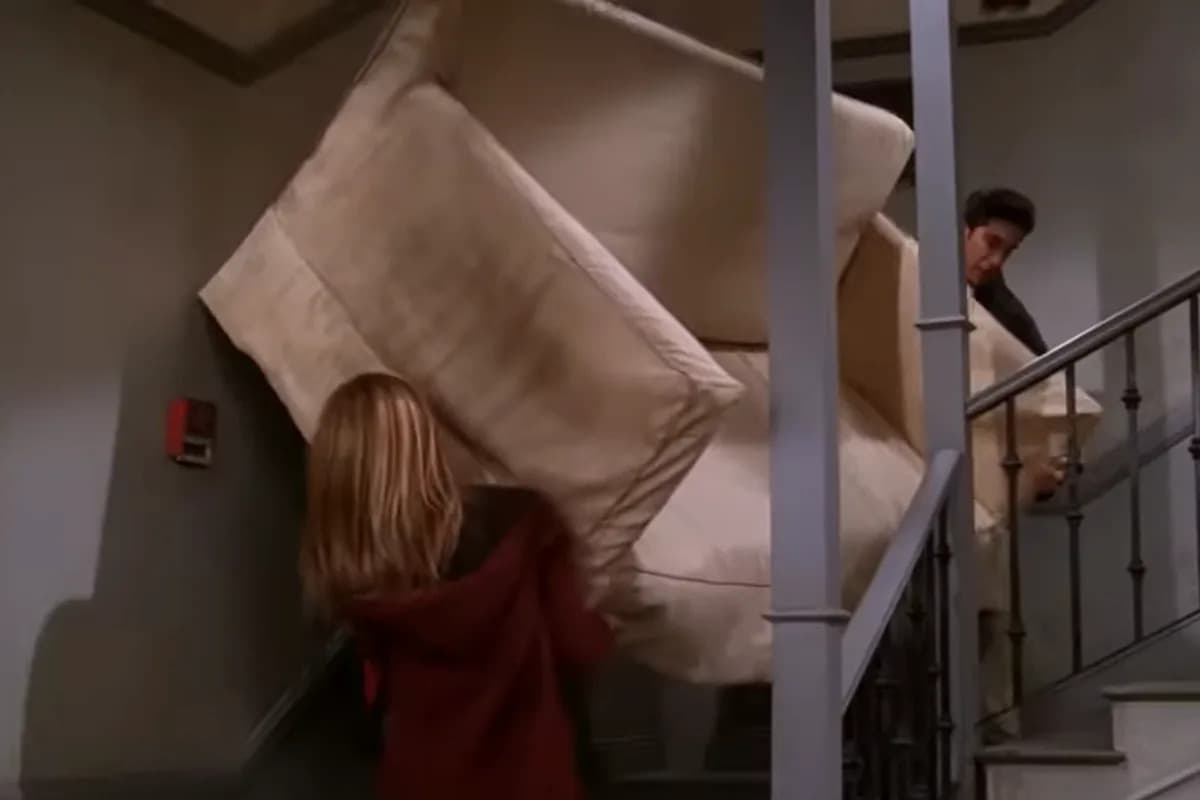
Scene from Friends showing characters struggle to move a sofa (YouTube/Still Watching Netflix)
Dr Baek Jin Eon, a 31-year-old researcher at the Korea Institute for Advanced Study, has resolved one of geometry’s most persistent puzzles by proving that no planar shape larger than Joseph Gerver’s 1992 construction can be carried through a right-angled L-shaped corridor of unit width. His 119-page proof, posted on arXiv in late 2024, ends nearly six decades of uncertainty about the so-called "moving sofa problem" and attracted global attention for achieving the result without large-scale computer assistance.
What He Proved
The moving sofa problem asks for the two-dimensional shape with the maximum possible area that can be manoeuvred around a right-angled corner in a corridor of fixed width. In 1992 Joseph Gerver proposed a complicated, curved candidate—now known as Gerver's sofa—which many suspected might be optimal. After seven years of focused work, Dr Baek showed that Gerver's sofa is indeed the maximal shape: "no sofa wider than Gerver's sofa can exist," he concludes in the manuscript.
Method and Recognition
Unlike several previous efforts that relied heavily on computational searches or simulations, Baek’s argument is built from deductive, paper-and-proof mathematics. The manuscript is currently under peer review at the Annals of Mathematics, and the mathematical community has expressed strong confidence in the result. Scientific American named the work among its "Top 10 Math Discoveries of 2025," noting the surprising absence of computer dependence in the final proof.

(SpareRoom)
Background and Impact
Baek began the project while serving as a research specialist during his mandatory military service and continued the work through his doctoral studies in the United States and his postdoctoral research in South Korea. He was selected last year for the June E. Huh Fellow programme, which supports promising mathematicians under 39. He is now turning his attention to further optimisation problems and questions in combinatorial geometry.
“You keep holding on to hope, then breaking it, and moving forward by picking up ideas from the ashes,” Baek said in an interview, reflecting on the long process of building and discarding approaches.
In Popular Culture
The moving sofa problem has long captured the public imagination and even appeared in pop culture—most famously in the US sitcom Friends, where characters struggle to carry a couch up a stairwell. Scientific American quipped that explaining Ross Geller’s shouted "Pivot!" now has a 119-page explanation.
Why it matters: The result settles a vivid and long-standing geometric optimisation question, showcases a rigorous, non-computational approach to a hard problem, and highlights a rising mathematician whose techniques may influence future work in optimisation and discrete geometry.
Help us improve.