
Metin Tolan, a German physicist, explores whether quantum mechanics can reconcile the Santa myth with physical laws. He shows that classical physics — requiring roughly 2,708 visits per second, an 82 million-kilometre sleigh trajectory and energy demands exceeding six times Germany's annual consumption — makes the traditional image impossible. As a playful solution, Tolan suggests a quantum "Santa wave" in superposition that collapses only when a present appears, preventing sightings and avoiding lethal classical constraints. The book pairs serious physics with humorous asides, like how long it would take to work off a chocolate Santa.
How Santa Could Do It: A Physicist’s Quantum Explanation For The Christmas Miracle

You think your job is stressful? In 24 hours, Santa Claus has to make 2,708 visits per second to reach 234 million households. Bernd von Jutrczenka/dpa
Every Christmas, stories and films depict Santa Claus racing around the world in a single night to deliver presents to millions of children. While classical physics makes that image look impossible, German physicist Metin Tolan argues in his book Silent Night, Hasty Night that modern quantum theory offers a playful way to reconcile the legend with physical laws.
From Skeptical Letters To NORAD
Tolan opens with cultural touchstones that questioned or reinforced belief in Santa. He recalls the famous 1897 letter from eight-year-old Virginia O'Hanlon to the New York Sun — "Please tell me the truth: is there a Santa Claus?" — and the paper's enduring, poetic reply. He also recounts a 1955 Cold War episode when a misprinted phone number directed children's calls to the U.S. Air Defence; Colonel Harry Shoup organised colleagues to answer the phones, an anecdote that eventually inspired the annual NORAD Tracks Santa tradition.
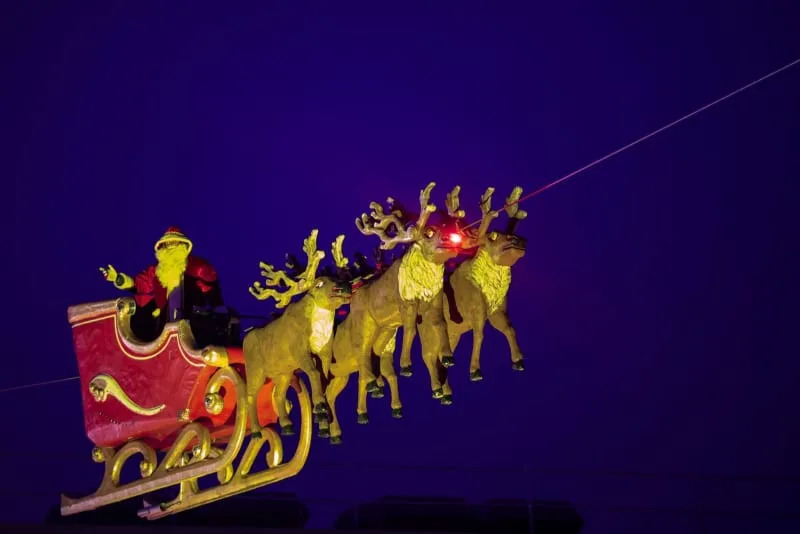
To deliver that many presents, Santa Claus would be burned up at the sheer speed he would need to hit. But there is a way it's possible, one physicist has calculated. This theory also explains why Santa Claus is never seen. Christoph Reichwein/dpa
The Classical Physics Problem
Tolan runs the numbers under ordinary physics and finds staggering constraints. Using a conservative estimate (deliveries only to Christian children under age 10 judged to be well-behaved) he calculates roughly 234 million households to visit. In 24 hours this requires about 2,708 visits per second; if Santa flew opposite the Earth's rotation he might gain about 8 extra hours and reduce the rate to ~2,000 visits per second. That pace is roughly 40 times faster than the maximum frame-rate the human eye can perceive, which partly explains why witnesses don’t see him in action.
Beyond perception, the physical demands become lethal. If each child receives a one-kilogram gift, Tolan estimates Santa's sleigh would carry in excess of 200,000 tons and travel a cumulative distance of about 82 million kilometres. Accelerating that mass would require more than six times Germany's annual energy consumption. At classical speeds, he argues, reindeer would be incinerated, and centrifugal forces when turning would crush or vaporise the sleigh and its occupant.
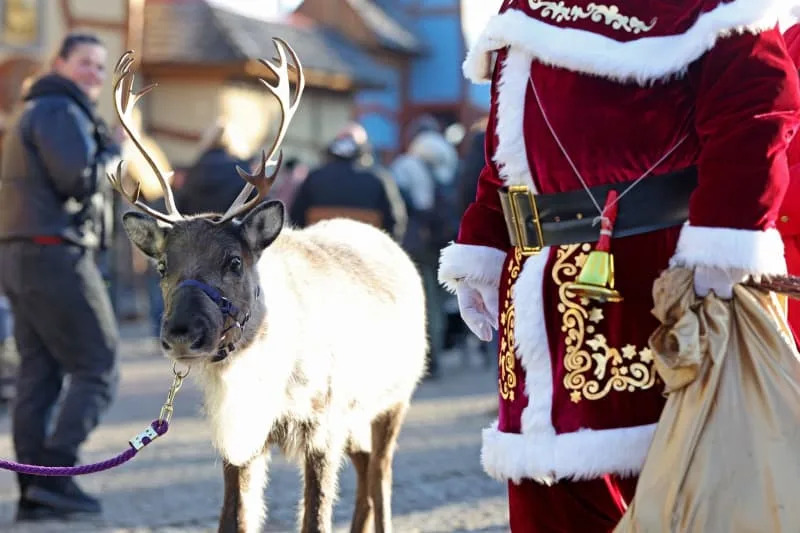
Santa Claus and his reindeers would evaporate in a fraction of a second if they were to accelerate his sleigh to the required speed needed to visit all homes on the planet in one day. Matthias Bein/dpa
A Quantum Workaround: The Santa Wave
To evade these impossibilities, Tolan invokes quantum mechanics — especially the wave nature of matter and the energy–time uncertainty principle. In quantum theory, particles can be described as waves and can exist in superpositions of many states simultaneously. Tolan playfully proposes that Santa is not a single localized being but a matter wave spread across space: a superposition of all the states in which a gift appears at a particular house.
"For Santa Claus, this means that he must be replaced by a matter wave that exists throughout space and describes all the states he can occupy at the same time."
According to quantum measurement rules, any observation collapses the wavefunction at that location. In Tolan's picture, an observation at a house produces the localised outcome — a present appears — without allowing an onlooker to witness a traversing Santa. This avoids the lethal accelerations and energy requirements of a classical sleigh and explains why Santa is never observed in transit.
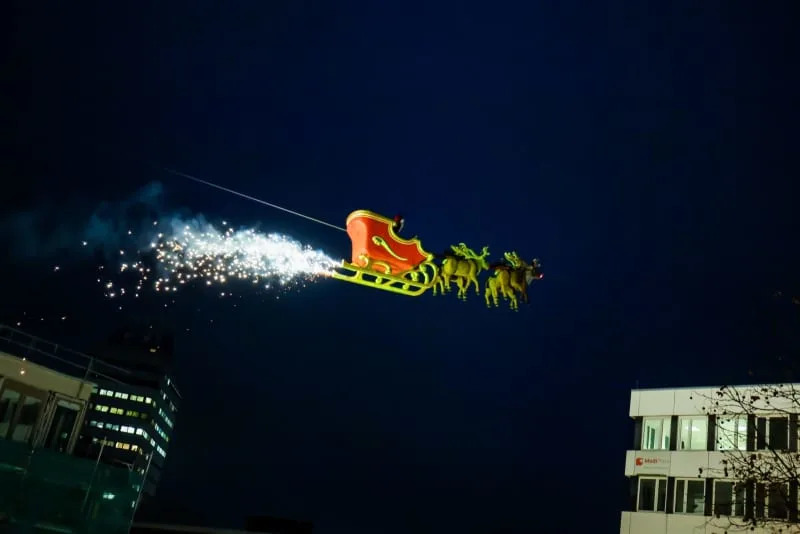
To deliver that many presents, Santa Claus would be burned up at the sheer speed he would need to hit. But there is a solution, one physicist has calculated. This theory also explains why Santa Claus is never seen. Christoph Reichwein/dpa
Playful Conclusions And Side Notes
Tolan extends the playful thought experiment with other quirky calculations: for example, he estimates that eating a 100-gram chocolate Santa equates to roughly six hours of walking or about two weeks of continuous kissing. He admits the results are largely "completely useless knowledge," but argues they make fun, scientifically grounded conversation pieces during the holidays.
Bottom line: Tolan's book mixes rigorous, accessible physics with whimsy. It does not claim to prove Santa's existence but demonstrates how modern physics — used imaginatively — can reframing an age-old cultural myth and spark curiosity about quantum ideas.


