The Large Hadron Collider will pause operations beginning in June for a multi‑year High‑Luminosity upgrade that aims to increase collision rates by about tenfold and is expected to take roughly five years. During the shutdown, physicists will analyse extensive data already collected, says CERN director‑general Mark Thomson. CERN targets resuming LHC operations around mid‑2030 while also studying a much larger successor, the proposed 56‑mile Future Circular Collider, though its nearly $19 billion cost and funding remain uncertain.
Large Hadron Collider to Pause Operations for Multi‑Year High‑Luminosity Upgrade
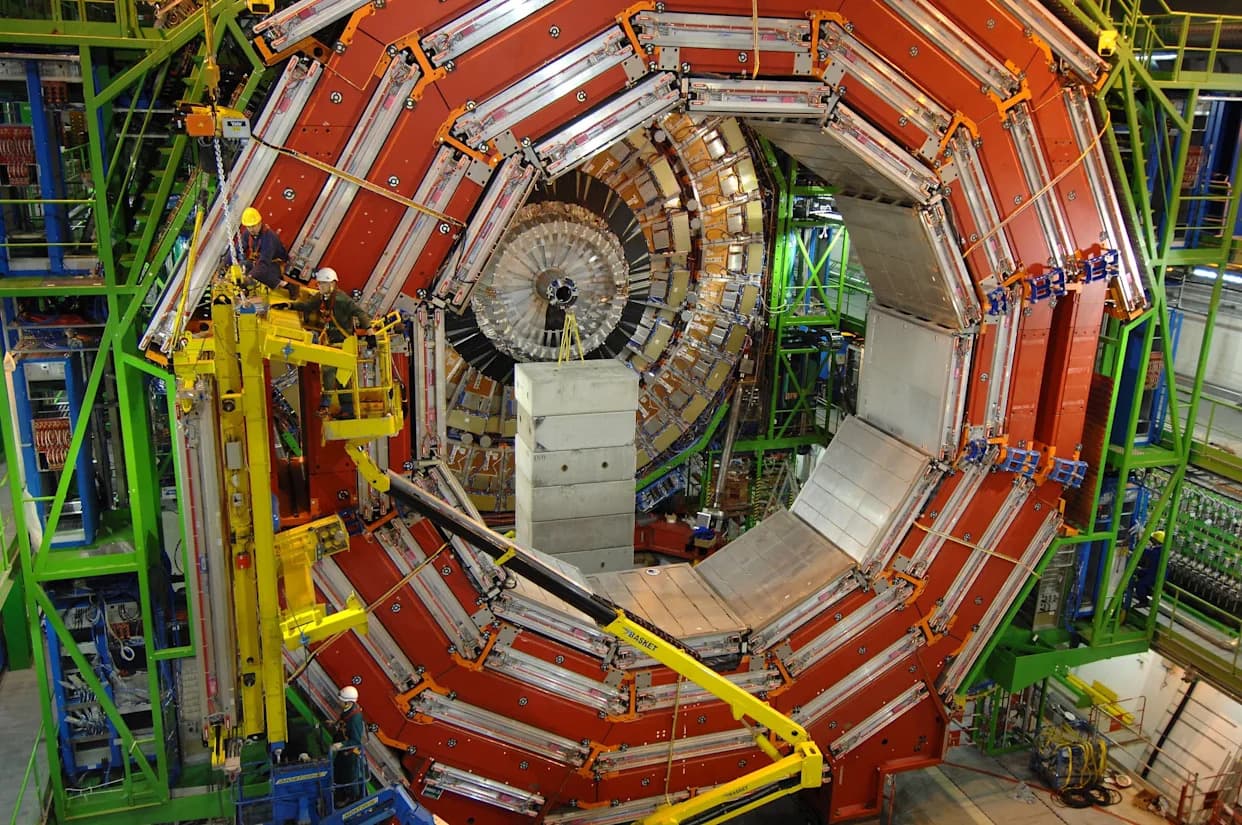
SWITZERLAND - JANUARY 25: The Large Hadron Collider, Large Hadron Collider (LHC) is a particle accelerator which will probe deeper into matter than ever - This is the next step of CERN - The workers positioned one of the CMS magnet - The CMS is the largest superconducting solenoid magnet of the world has reached full field - Weighing over 10,000 tons, the magnet of the CMS Collaboration is built around a superconducting solenoid 6 meters in diameter and 13 meters in length - It produces a field of 4 Tesla, almost 100 000 times higher than that of the Earth, and stores an energy of 2.5 GJ, sufficient to melt 18 tons of gold in Geneve, Switzerland on January 25th, 2007. (Photo by Lionel FLUSIN/Gamma-Rapho via Getty Images)
The Large Hadron Collider (LHC) will be taken offline for an extended multi‑year upgrade beginning in June so it can return as the High‑Luminosity LHC, capable of producing roughly ten times more particle collisions than it currently does. While the shutdown is temporary, CERN and many physicists are also discussing long‑term plans for successors and the machine’s eventual retirement.
What the LHC Does
Housed in a roughly 16‑mile (≈26 km) underground ring straddling the Swiss‑French border, the LHC accelerates particles to near light speed and collides them to recreate conditions similar to those just after the Big Bang. Its most celebrated achievement to date came in 2012, when experiments at the LHC provided the evidence for the Higgs boson — the particle central to explaining how other particles acquire mass.
Why the Shutdown?
Beginning in June, engineers will carry out a major refit to upgrade magnets, detectors and support systems so the collider can handle far higher collision rates. The programme, known as the High‑Luminosity LHC, is designed to increase the machine’s collision rate by about a factor of ten, enabling many more experiments and generating much larger data sets for precision measurements and rare-process searches. The upgrade is expected to take approximately five years, with CERN targeting a return to operations around mid‑2030.
Work Continues While the Ring Is Quiet
Physicists will not be idle during the shutdown. Mark Thomson, the new director‑general of CERN and a professor of experimental particle physics at the University of Cambridge, says researchers will have abundant data to analyse from current runs.
“The machine is running brilliantly and we’re recording huge amounts of data. There’s going to be plenty to analyze over the period. The physics results will keep on coming.” — Mark Thomson
Thomson also expressed enthusiasm for overseeing the upgrade work, calling it an "incredibly exciting project" and noting that it offers new scientific and technical challenges beyond day‑to‑day operation of the collider.
Planning For a Successor: The Future Circular Collider
CERN is also studying long‑term successors to the LHC. The leading proposal is the Future Circular Collider (FCC), a vastly larger ring with a proposed circumference of about 56 miles (≈90 km). The FCC concept includes an initial electron‑positron collider phase planned for the late 2040s, followed by a proton‑proton upgrade in the 2070s to reach much higher energies.
Costs, Funding And Scientific Debate
The FCC faces significant hurdles. Its estimated price tag — reported at nearly $19 billion — is beyond what CERN can fund alone, and the project would require broad international financing and political support. There is also an ongoing scientific debate about whether ever‑larger accelerators are the optimal path to answer outstanding questions such as the nature of dark matter and dark energy, or whether alternative experimental approaches might be more cost‑effective.
Despite those uncertainties, Thomson remains a proponent of large colliders, arguing that there is still room for discovery and that the FCC would be a natural progression for probing fundamental physics.
“We’ve not got to the point where we have stopped making discoveries and the FCC is the natural progression. Our goal is to understand the universe at its most fundamental level. And this is absolutely not the time to give up.” — Mark Thomson
The High‑Luminosity upgrade represents a major investment in the existing facility’s scientific output. Even with the LHC offline, the volume of data collected so far will keep researchers busy and, potentially, keep major physics results coming during the refurbishment period.
Help us improve.