China has paused near-term development of the Circular Electron Positron Collider (CEPC) after the project was left out of the 2026–2030 five‑year plan, a move likely driven by cost and shifting priorities. The CEPC, proposed at roughly 100 km in circumference, carried an estimated price tag of about $5.1 billion, though that figure is unconfirmed. The team plans to resubmit the proposal in 2030 and may instead join Europe’s Future Circular Collider (FCC) project if it receives approval first. Larger colliders like the CEPC or FCC aim to reach higher energies and probe physics beyond the LHC’s current capabilities.
China Pauses Plans for World's Largest Particle Collider — Why the CEPC Is On Hold

Close up of a tunnel inside the Large Hadron Collider at CERN. - Richard Juilliart/Shutterstock
China has put plans for the Circular Electron Positron Collider (CEPC) on hold after the project was omitted from the country's 2026–2030 five‑year plan. Proposed to span roughly 100 kilometres (about 62 miles) — far larger than CERN's Large Hadron Collider (LHC) at about 27 kilometres — the CEPC was intended to be a flagship facility for next‑generation particle physics. Officials and researchers now say the pause reflects shifting priorities, budgetary pressures and opportunities for international collaboration.
What changed? Development on the CEPC began around 2012, in the wake of the LHC's discovery of the Higgs boson. However, the project was not included in the government’s latest five‑year plan, which signals lower priority and reduced immediate funding. Wang Yifang of the Institute of High Energy Physics confirmed the change and said the research team plans to resubmit the CEPC proposal when the next planning cycle opens in 2030.
Cost and collaboration options While no official cost figure has been confirmed, independent estimates place the CEPC price tag at roughly $5.1 billion. That substantial sum helps explain why Beijing may choose to redirect funds to other priorities. Wang has also indicated that if Europe’s proposed Future Circular Collider (FCC) — a roughly 90.7‑kilometre (56‑mile) ring intended as an LHC successor — is approved before China revisits its plans, Chinese teams would likely seek to collaborate with the FCC consortium rather than build a separate domestic facility.
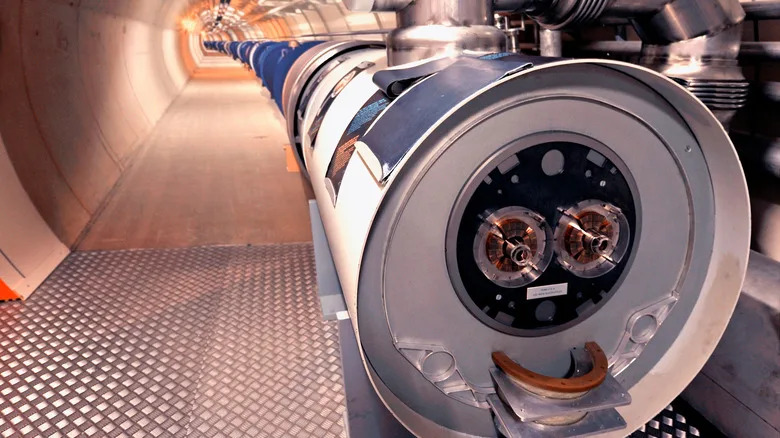
Close up of a particle accelerator tunnel at LHC and CERN. - Danuta Hyniewska/Shutterstock
Why particle colliders matter Particle colliders accelerate beams of particles in large underground rings and collide them at very high energies. Scientists analyze the short‑lived debris and patterns from those collisions to probe fundamental physics and to recreate conditions similar to the early universe. This approach led to the Higgs boson discovery at the LHC and to the creation and study of phenomena such as the quark–gluon plasma, a high‑energy state of matter that existed shortly after the Big Bang.
What bigger colliders could do Larger machines such as the CEPC or FCC would combine longer tunnels with more advanced accelerators and detectors, enabling collisions at higher energies or in novel configurations. That expanded capability could make it possible to produce heavier or otherwise inaccessible particles and to explore physics beyond the current experimental reach of the LHC.
Timelines and next steps The LHC is expected to operate into the 2040s, while the FCC — if approved — would likely move into planning and early development in the 2030s. Any construction or major international project still requires formal approval and funding commitments from CERN member states and partner nations. For now, China’s CEPC remains deferred to the next planning cycle, with the potential for renewed domestic pursuit or international cooperation depending on budget choices and global progress on projects like the FCC.
Help us improve.