
Researchers have created the first high-resolution maps of the Sun's Alfvén surface, the boundary where the solar wind escapes the Sun's magnetic field. The maps, published Dec. 11 in The Astrophysical Journal Letters, combine Parker Solar Probe measurements with data from Solar Orbiter and Wind and show the boundary expands and becomes more jagged during solar maximum. These results will improve space-weather forecasting and advance understanding of coronal heating and solar wind formation.
Mapping the Sun's Point of No Return: First High-Resolution View of the Alfvén Surface

An artist's illustration of the outer boundary of the sun's atmosphere. Data from NASA's Parker Solar Probe and other spacecraft show the shifting boundary grows "larger, rougher and spikier" as the sun becomes more active. . | Credit: CfA/ Melissa Weiss
Scientists have produced the first high-resolution maps of the Sun's Alfvén surface, the shifting outer edge of the solar atmosphere where charged particles permanently escape the Sun's magnetic hold and stream into interplanetary space.
Assembled from close-range measurements by NASA's Parker Solar Probe and supporting observations from ESA's Solar Orbiter and NASA's Wind spacecraft near the Sun-Earth L1 point, the maps reveal that this boundary expands, becomes more irregular and grows spikier during periods of heightened solar activity, such as solar maximum.
Why This Discovery Matters
Locating the Alfvén surface precisely is essential for understanding how the solar wind forms, why the Sun's corona heats up with distance, and how solar storms propagate. Better maps also improve space-weather forecasts that protect satellites, power grids and astronauts.
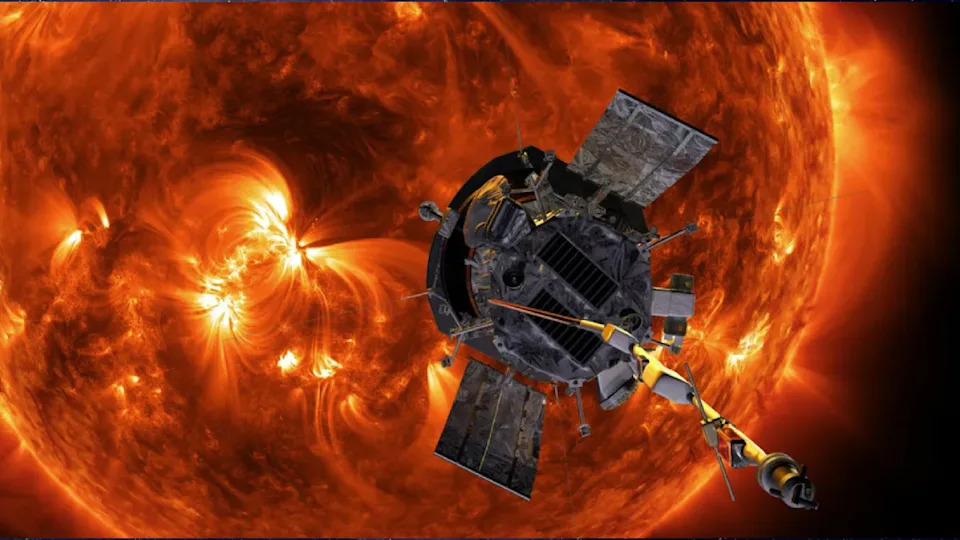
An artist's illustration of NASA's Parker Solar Probe spacecraft during one of its close flybys of the sun. | Credit: NASA/Johns Hopkins APL/Steve Gribben
How The Maps Were Made
Researchers combined Parker Solar Probe's record-close passes through the Sun's outer atmosphere with measurements from Solar Orbiter and Wind, both roughly 1 million miles (1.5 million kilometers) from Earth. Parker's SWEAP instrument directly sampled regions below the Alfvén surface, providing ground-truth validation for the mapped boundary.
Sam Badman, lead author and astrophysicist at the Center for Astrophysics | Harvard & Smithsonian, said the new maps let researchers test and navigate the Sun's boundary for the first time and observe how it evolves in step with solar activity.
Study co-author Michael Stevens, SWEAP principal investigator at the CfA, said the results show that Parker Solar Probe dives into the birthplace of the solar wind with every orbit. The work was published Dec. 11 in The Astrophysical Journal Letters.
Looking Ahead
As the Sun returns to a quieter solar minimum, Parker Solar Probe will again penetrate deep into the corona, enabling scientists to follow the Alfvén surface through a complete 11-year solar cycle. Continued observations will refine models of coronal heating, solar wind acceleration and the origins of disruptive space weather.


