Researchers using NASA's MMS spacecraft have identified magnetic "switchbacks" — sharp zigzag kinks in plasma — inside Earth's magnetosphere for the first time. The structures resemble those previously observed in the solar wind and appear when solar-origin plasma mixes with locally trapped particles. Magnetic reconnection at the boundary between different field lines likely produces the S-shaped waves and the bursts of energy that create switchbacks. This finding links solar and terrestrial plasma dynamics and may improve space-weather forecasting.
Sun-like Magnetic 'Switchbacks' Detected in Earth's Magnetosphere for the First Time

Physicists Emily McDougall and Matthew Argall of the University of New Hampshire report the first detection of Sun-like zigzag magnetic structures — called magnetic "switchbacks" — inside Earth’s magnetosphere. The discovery, based on data from NASA's Magnetospheric Multiscale (MMS) mission, could improve forecasts of how geomagnetic storms affect our planet.
Researchers identified unexpected patterns in plasma trapped by Earth's magnetic field. Portions of the plasma rotated slowly and then snapped back to their original orientation, producing sharp, zigzag-shaped kinks known as switchbacks. These signatures closely resemble structures previously observed in the solar wind, the steady stream of charged particles emitted by the Sun.
How switchbacks form
Decades of solar observations show switchbacks form when two types of magnetic field lines interact. "Open" field lines extend outward from the Sun and carry the solar wind into space, while "closed" field lines loop back toward the Sun. When open and closed lines meet, magnetic reconnection can occur: lines break and reconnect, redirecting plasma and releasing bursts of energy that kink the magnetic field into S-shaped waves.
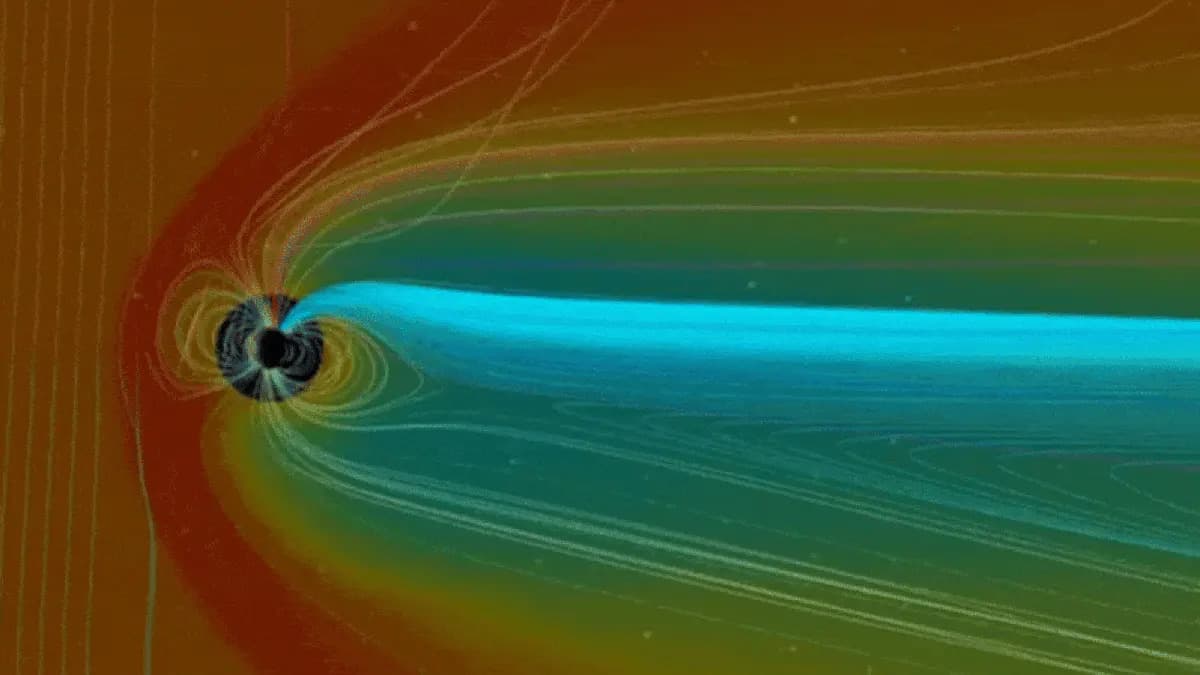
In the MMS observations, solar-origin plasma penetrated the boundary of Earth's magnetosphere and mixed with locally trapped charged particles. That mixing appears to have driven reconnection between incoming solar field lines and Earth's closed loops, producing the characteristic switchback signature inside the magnetosphere.
"This discovery provides new clues about how similar disturbances can form at the boundary between different regions of plasma," the researchers write. They add that studying these events near Earth can help researchers investigate related processes in the Sun's outer layers without sending spacecraft into extreme solar environments.
The results are published in the Journal of Geophysical Research: Space Physics and highlight a new connection between solar and near-Earth plasma dynamics. Understanding these processes may sharpen space-weather models and improve predictions of geomagnetic storm impacts on satellites, power grids, and communications.
Help us improve.