The Voyager probes, launched in 1977, became humanity’s first emissaries to interstellar space. As Voyager 1 crossed the heliopause in 2012 and Voyager 2 followed in 2018, both recorded sharp rises in plasma measurements—described as a “wall of fire”—with temperatures roughly 54,000–90,000°F. These in situ data confirm the heliosphere is distorted and dynamic, and the Voyagers continue to supply the only direct observations of this distant boundary.
Voyager 1 Struck a ‘Wall of Fire’ at the Solar System’s Edge — Plasma Temperatures Near 90,000°F

Nothing built by humans has traveled farther from Earth than NASA’s Voyager probes. Launched in 1977, the twin spacecraft are now racing outward at roughly 38,000 miles per hour and have each covered more than 12 billion miles; Voyager 1 is expected to be about a light‑day from Earth later this month.
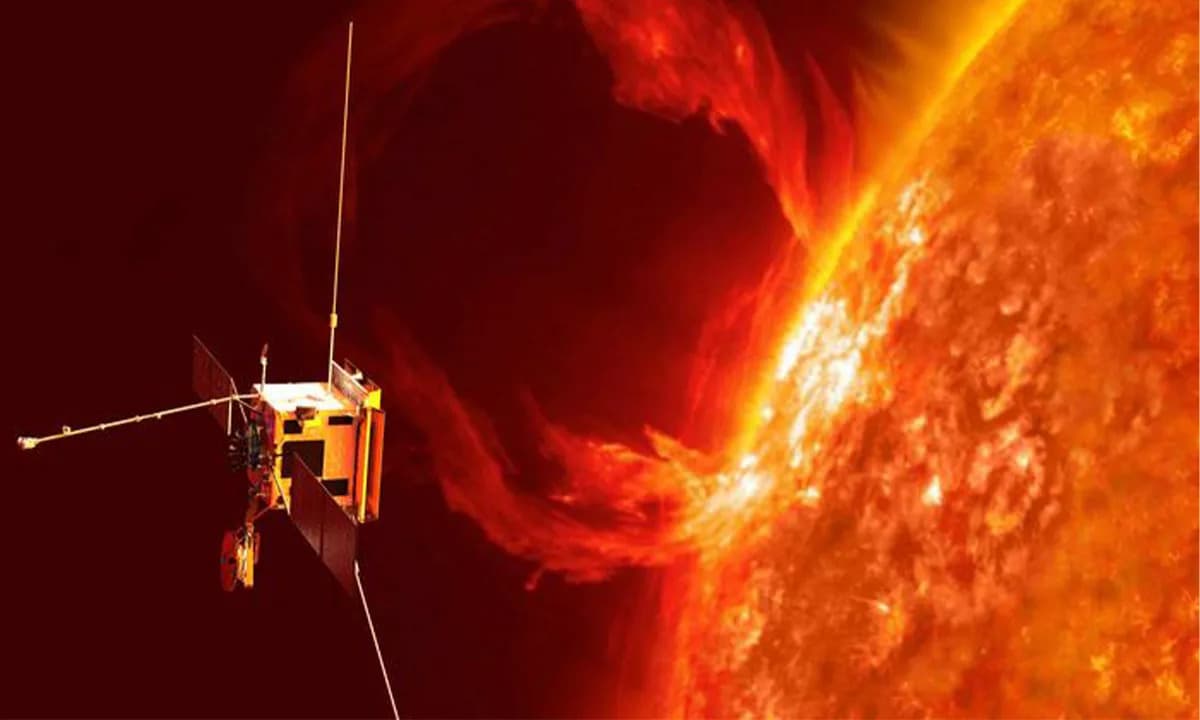
Originally sent to study the outer planets, the Voyagers’ mission evolved into a journey beyond the Sun’s sphere of influence. Engineers have repeatedly adapted operations to keep these aging craft communicating—powering down instruments, reactivating systems that were idle for decades, and changing procedures to preserve telemetry from these distant emissaries.
As both probes crossed the heliosphere’s outer boundary they recorded a pronounced spike in plasma measurements that scientists have described as a “wall of fire.” Instruments registered plasma temperatures and charged-particle signatures rising to roughly 54,000–90,000 degrees Fahrenheit as the craft traversed the heliopause, the transition region where the solar wind gives way to the interstellar medium.
What is the heliosphere?
The heliosphere is a bubble carved out by the solar wind—a continuous flow of charged particles (mainly protons and electrons) and the Sun’s magnetic field. Outside that bubble lies the interstellar medium, the thin mix of gas, dust and charged particles that fills the space between stars. The heliopause marks where the outward pressure of the solar wind is balanced by the galactic environment.
Why the boundary matters
There are different ways to define the edge of our solar system: by the orbit of the most distant planets, by the Sun’s gravitational reach, or—most commonly today—by the extent of the Sun’s magnetic and particle influence. Direct, in situ measurements from Voyager 1 (2012) and Voyager 2 (2018) provided the first clear observations of that magnetic and particle boundary.
The time gap between the probes’ crossings highlights that the heliosphere is not a simple sphere. Solar activity causes it to expand and contract, and because the solar system moves through the galaxy the heliosphere is distorted into a teardrop-like shape with a bow-shock-like feature in the direction of motion and a trailing wake—similar to a supersonic aircraft or a boat moving through water.
As the Voyagers passed the heliopause they recorded plasma temperatures on the order of tens of thousands of degrees Fahrenheit, along with changes in particle densities and magnetic-field signatures—clear evidence they had entered interstellar space.
Today the Voyagers continue to send unique measurements from this distant frontier, giving researchers the only direct, on-site data we have about how the Sun’s influence fades into the galactic environment and helping refine our picture of the boundary between star systems.
Help us improve.