
Summary: The Sun's high-resolution spectrum shows thousands of Fraunhofer absorption lines; most are identified, but hundreds remain unexplained. Incomplete laboratory line data, the Sun's dynamic atmosphere, and limitations in synthetic spectral models all contribute to the puzzle. Advances in instruments, databases (e.g., NIST, VALD), and 3D solar modeling are helping close the gap.
Missing Colors in the Sun: Why Hundreds of Solar Spectral Lines Still Puzzle Scientists

There Are Colors Missing From The Sun – And We Still Can't Fully Explain Why
One of the most striking visualizations of sunlight—an accurate, high-resolution solar spectrum compiled from Kitt Peak observations in the 1980s—reveals hundreds of dark gaps where colors should be. Those gaps are the famous Fraunhofer lines, and while most have been matched to specific elements, a surprising number remain unidentified.
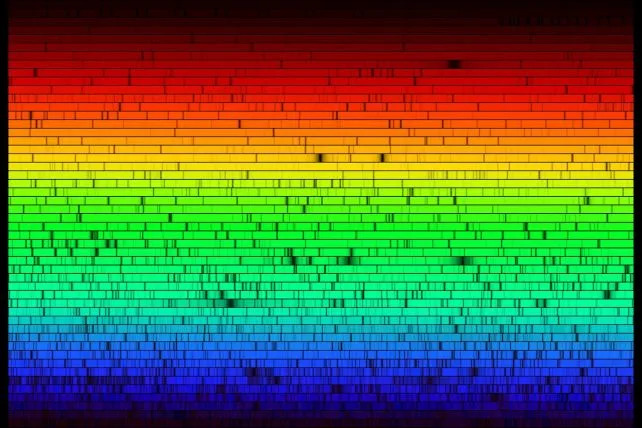
The high-resolution spectrum of the Sun recorded in 1984. (N.A. Sharp/KPNO/NOIRLab/NSO/NSF/AURA)
What Are Fraunhofer Lines?
Fraunhofer lines are dark absorption features in the Sun's spectrum first cataloged by Josef von Fraunhofer in 1814. They occur when atoms or molecules in the solar atmosphere absorb photons at very specific wavelengths. Because each species absorbs a unique pattern of wavelengths, these lines act as fingerprints that let astronomers identify elements in the Sun and other stars.
YouTube Thumbnail
Where the Mystery Comes From
Despite extensive study and high-resolution spectra, hundreds of absorption features in the solar spectrum do not match synthetic spectra produced by atmospheric models. The mismatch arises from several causes:

Subscribe to ScienceAlert's free fact-checked newsletter
- Incomplete laboratory data: Atomic and molecular line lists (from resources such as the NIST database and VALD) are large but not exhaustive. Some transitions, especially for complex atoms like the iron-group elements, lack accurate laboratory measurements.
- Solar atmospheric complexity: The Sun's photosphere and chromosphere are dynamic—driven by convection, flows, and rapidly changing magnetic fields. These processes can distort, shift, or blend absorption features, complicating identification.
- Model limitations: Synthetic spectra depend on assumptions about temperature structure, pressure, radiation transfer, and magnetic fields. Imperfect models can predict lines in the wrong strength or place.
Why It Matters
Understanding every spectral line is more than an academic exercise. Elemental abundances inferred from spectra tell us about stellar evolution, nucleosynthesis, and the chemical enrichment history of the galaxy. Because the Sun is our nearest star, it provides the best testbed for refining atmospheric physics and spectral modeling.
Progress and the Path Forward
Researchers are steadily narrowing the gap between observation and theory. Improvements include higher-resolution spectrographs, more complete and accurate laboratory measurements of atomic and molecular transitions, and more sophisticated three-dimensional models of the solar atmosphere that include magnetic fields and convection. A 2017 study examining a set of unidentified lines summarized many of these challenges and pointed to where targeted lab work and modeling improvements can pay off.
Bottom line: The Sun still holds spectral mysteries, but each unexplained line is a useful clue that drives better laboratory data, improved databases, and more realistic solar models.
Note: Never look directly at the Sun without proper eye protection.


