Laboratory analysis of samples returned by NASA’s OSIRIS-REx spaceship has revealed glucose and ribose — the RNA sugar — in material from the 4.6 billion-year-old asteroid Bennu. Ribose’s detection in a returned sample is a first and, together with previously found nucleobases and phosphates, shows the building blocks for RNA were present on Bennu. Scientists also discovered an unusual translucent "space gum" likely created by carbamate-driven reactions on Bennu’s parent body. While not evidence of life, the findings point to widespread prebiotic chemistry in the early solar system.
NASA Finds RNA Sugar Ribose and Other Life-Building Ingredients in Asteroid Bennu

Scientists analyzing samples returned from the asteroid Bennu report the detection of sugars essential to life, including glucose and — for the first time in material returned from space — the RNA sugar ribose. The discovery, made in material collected by NASA's OSIRIS-REx mission, adds evidence that important prebiotic molecules were present across the early solar system.
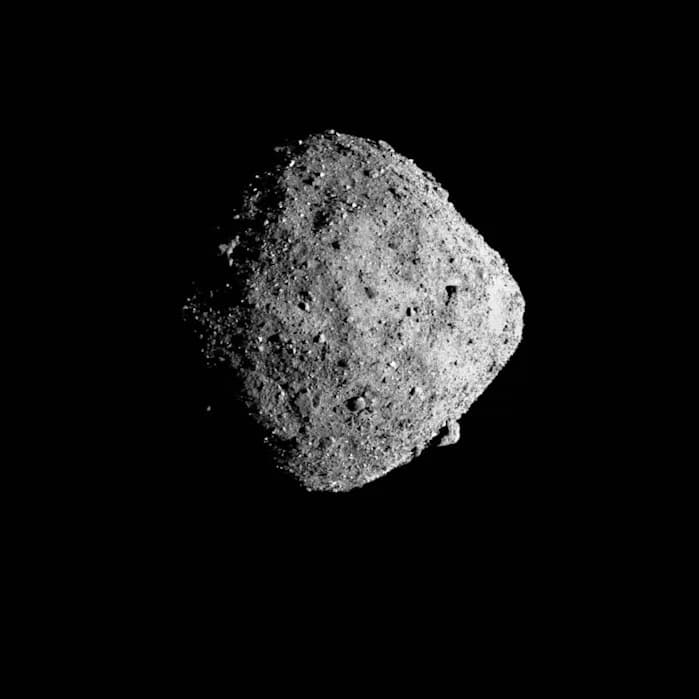
OSIRIS-REx collected samples from Bennu in 2020 and delivered them to Earth in 2023 for laboratory study. Bennu is roughly 1,600 feet (about the height of the Empire State Building) and formed about 4.6 billion years ago. Today it orbits well away from Earth, on the order of 160 million miles.
“All five nucleobases used to construct both DNA and RNA, along with phosphates, have already been found in the Bennu samples brought to Earth by OSIRIS-REx,” said Dr. Yoshihiro Furukawa of Tohoku University. “The new discovery of ribose means that all of the components to form the molecule RNA are present in Bennu.”
Although ribose had been identified previously in some meteorites recovered on Earth, its direct detection in a returned asteroid sample is a milestone. The team did not detect deoxyribose, the sugar found in DNA, an absence that may be significant: it suggests ribose could have been more abundant than deoxyribose in certain early-solar-system environments and lends support to hypotheses that primitive life may have relied on RNA chemistry before DNA-based systems evolved.
Strange new material: "space gum"
Researchers also identified an unusual translucent, rubber- and plastic-like substance in Bennu’s samples — described informally as a "space gum" — not previously observed in space rocks. Laboratory analyses indicate this flexible material likely formed on the larger parent body from which Bennu broke off.
Evidence suggests the parent asteroid experienced chemical alteration involving heat and liquid water during the solar system’s infancy. As that body warmed, carbamate compounds formed and later reacted with other molecules to produce the pliable material now seen in Bennu fragments.
“With this strange substance, we’re looking at, quite possibly, one of the earliest alterations of materials that occurred in this rock,” said Dr. Scott Sandford of NASA’s Ames Research Center. “On this primitive asteroid that formed in the early days of the solar system, we’re looking at events near the beginning of the beginning.”
These findings do not constitute evidence of life on Bennu. Rather, they strengthen the view that the raw chemical ingredients for life — sugars, nucleobases, phosphates and novel organic materials — were widespread in the early solar system and could have been delivered to the early Earth, where further chemical evolution may have led to life.
Ongoing analyses of the returned samples will refine our understanding of the chemistry that shaped the earliest planetary materials and the possible pathways from simple molecules to the complex biochemistry associated with life.
Help us improve.