Researchers at Nelson Mandela University have discovered vertebrate footprints preserved in the Wankoe Formation — cemented dunes likely about 3 million years old. These are the first recorded Pliocene vertebrate tracks described from southern Africa and include rare "pedestalled" (raised) prints. The finds complement nearby Pliocene body‑fossil sites, include plant and bone remains, and highlight promising new prospects in the search for ancient hominin traces.
3‑Million‑Year‑Old Animal Tracks Found in South Africa — First Pliocene Vertebrate Footprints Recorded in Southern Africa
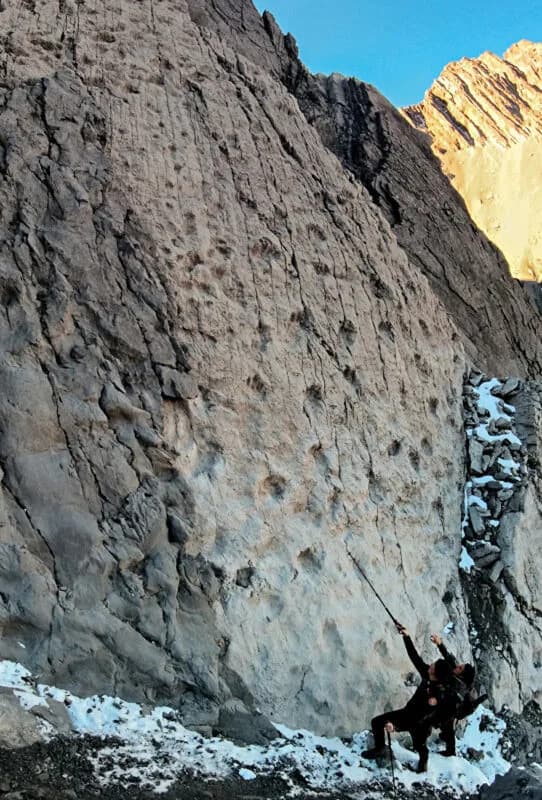
Researchers from the African Centre for Coastal Palaeoscience at Nelson Mandela University have uncovered vertebrate footprints preserved in the Wankoe Formation — cemented dune deposits inland from the Western Cape that are likely about 3 million years old. These discoveries represent the first recorded Pliocene vertebrate tracks described from southern Africa and expand our understanding of the region's ancient environments and ecosystems.
Discovery and geological context
The Wankoe Formation consists of wind‑blown sands that were cemented into rock as dunes some 30 km or so inland from the modern coast. Finding tracks there was challenging: many exposures are eroded or calcified, and much of the formation is on private land. A breakthrough came when team member Given Banda identified a likely trackway near his home. Subsequent reconnaissance in Grootbos Private Nature Reserve and neighbouring areas revealed numerous tracksites, including at least one definite trackway.
Why these finds matter
- Complements body‑fossil records: Nearby Pliocene body‑fossil localities such as Langebaanweg (the West Coast Fossil Park) preserve many extinct species. Trace fossils can reveal behaviours and species not obvious from bones alone — coastal trackways previously showed giraffe and giant tortoise presence that body fossils did not.
- Potential for hominin traces: While no primate tracks have yet been confirmed in the Wankoe Formation, the Pliocene inland surfaces are a promising target. The team has already documented more than 20 hominin tracksites on younger coastal deposits, forming the largest archive of hominin tracksites older than 40,000 years, so similar inland discoveries could be transformative.
- Rare pedestalled tracks: Many of the Wankoe prints are "pedestalled" — preserved as raised reliefs rather than depressions. This occurs when slightly cohesive sand beneath a print is compressed and surrounding loose sand is removed by wind, leaving the print standing in relief. Pedestalled fossil tracks are globally uncommon, making these finds especially significant.
Field observations and associated fossils
Further fieldwork has shown that even weathered exposures can sometimes preserve track impressions, including profiles where underlying layers were deformed by the weight of a trackmaker. The team has also recovered body‑fossil material within these deposits: preserved tree trunks, roots and bone fragments that will require detailed study.
Outlook
Although the dunes that became the Wankoe Formation would naturally have borne tracks when they were active, it is encouraging that calcification and weathering have not erased all evidence. With targeted surveys at well‑preserved exposures, many more tracksites may be discovered. For the research team, locating Pliocene hominin tracks inland now represents an exciting new "holy grail."
Author: Charles Helm, Nelson Mandela University
Help us improve.