Scientists analyzing samples returned by NASA’s OSIRIS-REx mission report evidence for the amino acid tryptophan in material from asteroid Bennu. If confirmed, this raises the number of protein-building amino acids found on Bennu to 15 of the 20 used by life on Earth. The samples were returned pristine, making terrestrial contamination unlikely, but additional tests are needed to fully verify the finding.
Tryptophan Detected on Asteroid Bennu — Evidence Grows That Space Supplied Life’s Ingredients

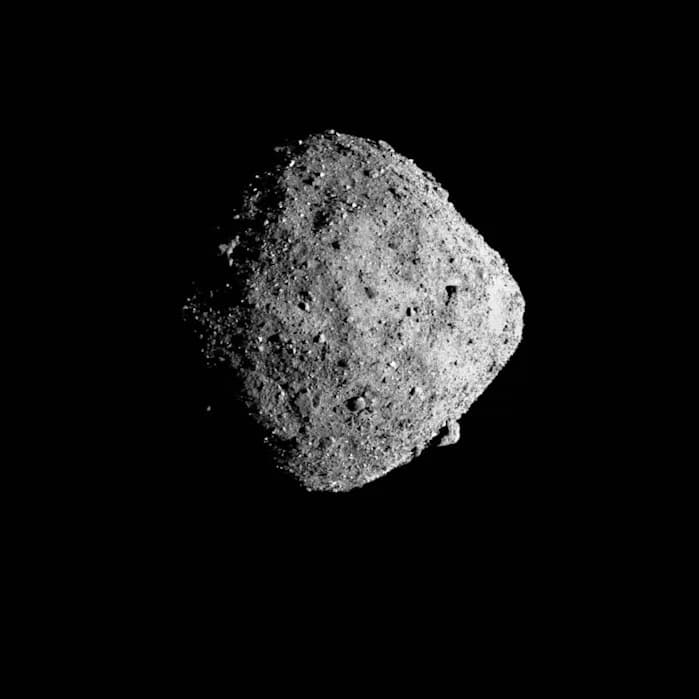
Researchers report evidence for the amino acid tryptophan in material returned from asteroid Bennu, strengthening the case that key organic molecules needed for life can form in space. The result comes from laboratory analysis of a tiny subsample from NASA’s OSIRIS-REx mission, which collected 121.6 grams of regolith and rock from Bennu in 2020 and returned the material to Earth in 2023.
Earlier studies of Bennu samples had already identified 14 of the 20 protein-building amino acids used by life on Earth, plus all five biological nucleobases. The new analysis raises the count of proteinogenic amino acids detected on Bennu to 15 out of 20 by confidently — though not yet absolutely conclusively — identifying tryptophan in a roughly 50-milligram subsample.
“Finding tryptophan in the Bennu asteroid is a big deal, because tryptophan is one of the more complex amino acids, and until now it had never been seen in any meteorite or space sample,” said José Aponte, an astrochemist at NASA’s Goddard Space Flight Center and a coauthor of the new study.
Detecting tryptophan, which is classified as an essential amino acid for humans, supports the idea that some of life’s chemical building blocks were produced naturally in the early Solar System and could have been delivered to Earth by asteroids.
Why this matters
Asteroids like Bennu preserve materials from the solar system’s formation about 4.5 billion years ago. Because OSIRIS-REx returned samples directly from the surface, scientists can study fragile salts, minerals and organics that are often altered or lost when rocks burn through Earth’s atmosphere as meteorites.
“They’re like jigsaw pieces that are not yet assembled,” said Angel Mojarro, first author of the study and an organic geochemist at NASA Goddard. “Many of the building blocks of life can be produced naturally within asteroids or comets, and finding tryptophan expands the alphabet of amino acids that are produced in space and could have been delivered to the Earth.”
Independent researchers who have worked with Bennu material consider terrestrial contamination unlikely, given the careful recovery and curation of the returned samples. George Cody, a staff scientist at the Carnegie Institution for Science who was not involved in the new study, wrote that he believes the molecules are legitimately derived from Bennu.
Bennu itself is a roughly one-third-mile-wide rubble pile thought to be a fragment of a larger parent body that broke apart between about 2 billion and 700 million years ago. Its components were forged in earlier stellar explosions and modified by impacts and solar radiation over billions of years. Bennu has orbited near Earth for about 1.75 million years and has a small, well-characterized impact probability in 2182 (about 1 in 2,700).
Scientists caution that additional analyses are needed to fully confirm tryptophan’s presence and to rule out all possible contamination sources. If confirmed, the finding will add to mounting evidence that many biologically relevant molecules can form in space and may have played a role in life’s origins on Earth.
“Because OSIRIS-REx returned these samples pristine, we’re finally seeing the fragile salts, minerals, and organics that meteorites lose on entry,” said Dante Lauretta, a coauthor of the study and professor of planetary science and cosmochemistry.
The discovery highlights the scientific value of sample-return missions and motivates further laboratory work on Bennu material and samples from other bodies, such as asteroid Ryugu. Ongoing analyses will aim to confirm the result and explore how complex organics form and survive in space.
Help us improve.