This archive presents concise summaries of opinion pieces on six themes: rising political dehumanization and the temptation of violence; the impact of prolonged K–12 school closures on enrollment; misconceptions about corporate influence after Citizens United; the premises of campaign finance reform; enforcement and racial consequences of handgun laws; and the argument that competition naturally displaces dominant firms. Each entry highlights the author's central claims and context. These excerpts offer conservative-leaning critiques across politics, education and regulation.
December 2025 Archive — Opinion Highlights: Polarization, School Closures, Corporations, Campaign Finance and Guns

This collection of opinion excerpts examines mounting political polarization, the effects of pandemic-era school closures, debates about corporate speech and campaign finance, enforcement and racial consequences of gun laws, and arguments about competition and market dominance. Each brief summarizes a longer argument by its author and highlights key claims and evidence.
Political dehumanization and the allure of violence
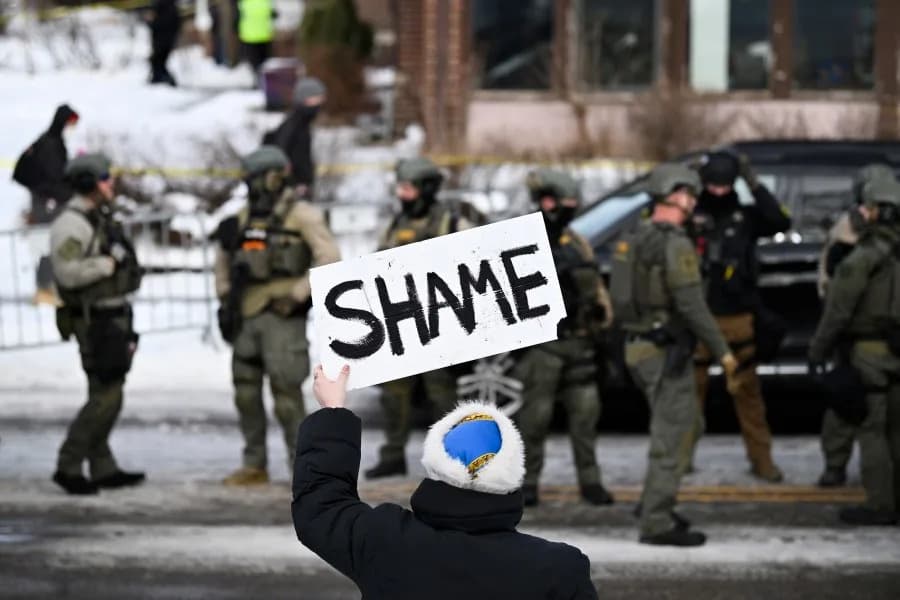
Katherine Mangu‑Ward warns that an increasing number of Americans view political opponents as less than human and see political struggle as a valid ground for violence — even if many are not personally prepared to engage in it. She argues that this mindset revives a revolutionary-romantic attraction to extreme measures, likening contemporary attitudes to a new Jacobinism. "The Dangerous Lure of Political Violence," Katherine Mangu‑Ward.
Schools, closures, and shifting enrollment
Corey A. DeAngelis describes how the coronavirus pandemic has kept a large share of K–12 students out of classrooms for months, with roughly three-quarters of the nation's 100 largest public school districts offering no in-person options this fall. He contends that this disruption has forced families to scramble for alternatives and that available data suggest public schools may lose millions of students this academic year. "COVID-19 Didn't Break the Public School System. It Was Already Broken.," Corey A. DeAngelis.
Corporations, free speech, and misconceptions
Jacob Sullum challenges dramatic depictions of corporations as faceless beasts unleashed by the Citizens United decision. He points out that corporations are associations of individuals and notes that most of the roughly six million corporations in the United States are small businesses or nonprofits, not mega-corporations like Wal‑Mart or Exxon Mobil. "You Are Now Free To Speak About Politics," Jacob Sullum.
Campaign finance reform and who controls politics
Bradley Smith critiques campaign finance regulation as premised on the idea that government must be insulated from citizen influence so it can act without pressure. He argues that many reformers effectively want political decision-making confined to an elite inside the Beltway who are deemed capable of handling it. "John McCain's War on Political Speech," Bradley Smith.
Handgun laws, enforcement, and racial effects
William R. Tonso discusses how handgun permit requirements and prohibitions are difficult to enforce because unlawful possession often goes unreported. Citing civil liberties attorney Don B. Kates Jr., he explains that uneven enforcement can result in selective application against groups unpopular with police. Tonso emphasizes that even laws without racist intent can have racially disparate effects, as minorities who distrust law enforcement may turn to illegal firearms for protection and thus face criminalization. "Gun Control: White Man's Law," William R. Tonso.
Competition, market dynamics, and dominant firms
Benjamin Rogge argues that competition is a continual process of "leapfrogging," where new ideas displace old incumbents over time. He suggests that this dynamic makes forced breakups of large firms unnecessary, asserting that innovation and market forces will restore balance without heavy-handed intervention. "Who Will Defend Capitalism?", Benjamin Rogge.
Each excerpt reflects a broadly conservative perspective on contemporary debates in politics, education, regulation and markets. Readers should treat each summary as a concise guide to the authors' arguments rather than a full substitute for the original pieces.
Help us improve.