China's Jiangmen Underground Neutrino Observatory (JUNO), a 20,000-tonne spherical detector buried near Kaiping and built for over $350 million, has been online for 86 days and is already delivering high-precision neutrino measurements. Early results show neutrino oscillation parameters measured with greater precision than previous experiments, helping to resolve long-standing questions like the "solar neutrino tension." JUNO's stability and accuracy suggest it can determine neutrino mass ordering, test the three-flavor oscillation framework, and search for new physics. The project involves over 700 researchers from 17 countries.
Giant Underground Detector JUNO Records Neutrinos with Unprecedented Precision

Neutrinos — nearly massless, electrically neutral subatomic particles often nicknamed "ghost particles" — are among the most abundant particles in the universe. They interact so weakly with matter that trillions pass through our bodies every second, making them notoriously difficult to detect.
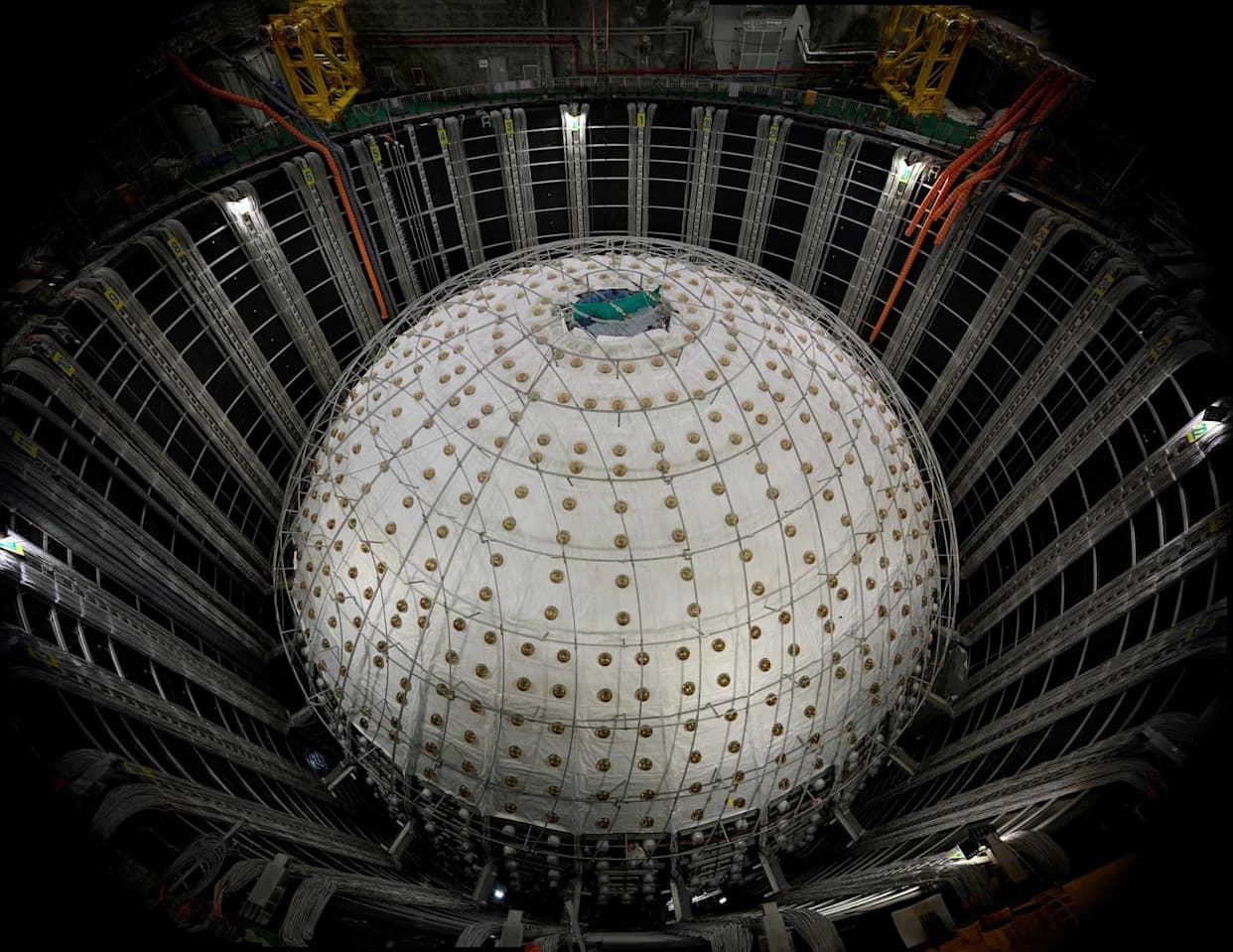
After roughly ten years of construction, the Jiangmen Underground Neutrino Observatory (JUNO) in China has come online. The instrument is a 20,000-tonne spherical detector buried beneath the mountains near Kaiping and built at a cost of more than $350 million. JUNO's primary scientific goal is to determine the ordering of neutrino masses — a key unknown in particle physics — and to study neutrino oscillations with unmatched precision.
Although JUNO has been operating for only 86 days, a preliminary analysis and a press release from researchers at the University of Mainz report exceptional early performance. The detector has measured neutrino oscillation parameters with greater precision than prior experiments combined, demonstrating excellent stability and readiness for extended data taking.
Historically, experiments first observed far fewer solar neutrinos than predicted, a discrepancy known as the "solar neutrino tension." That puzzle was largely resolved when physicists discovered neutrinos can change identity — or "oscillate" — between different flavors as they travel. JUNO's new measurements track this flavor-changing behavior with remarkable accuracy, confirming the detector is meeting its design expectations and improving constraints on neutrino properties.
"Achieving such precision within only two months of operation shows that JUNO is performing exactly as designed," said JUNO project manager and spokesperson Yifang Wang. "With this level of accuracy, JUNO will soon determine the neutrino mass ordering, test the three-flavor oscillation framework, and search for new physics beyond it."
JUNO is a large international collaboration involving more than 700 researchers from 17 countries, including teams from Italy, France, Russia, Germany and the United States. With its scale, early stability and high precision, JUNO is poised to address fundamental questions about neutrino masses and mixing and could reveal phenomena that point beyond the current Standard Model of particle physics.
Help us improve.