Summary: The "dark-dimension" hypothesis proposes that dark matter effects come from a compact fifth dimension whose gravity-carrying modes appear as unseen mass in our four-dimensional universe. This framework predicts heavy messenger states and subtle deviations in gravity that could be probed by particle experiments, precision tests of gravity, and detailed gravitational-lensing surveys. If validated, the idea would reshape our understanding of gravity, particle physics, and cosmic structure.
Could Dark Matter Live in a Hidden Fifth Dimension?

Recent theoretical work in high-energy physics raises a provocative possibility: the gravitational effects we attribute to dark matter might arise from a compact, hidden fifth dimension rather than an unknown particle inside our familiar four-dimensional spacetime.
What is the "dark-dimension" idea?
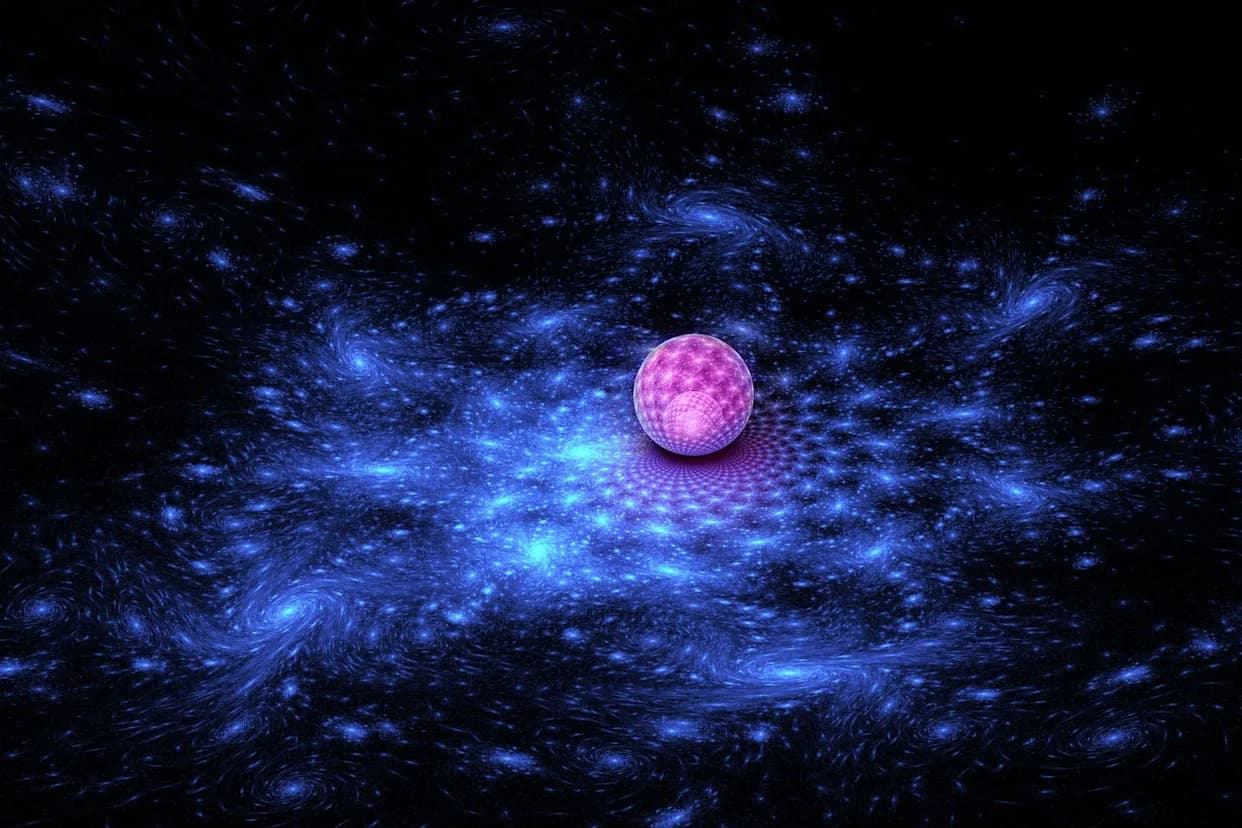
The proposal envisions an extra spatial dimension that is compact and largely inaccessible to everyday matter. Modes of the gravitational field that propagate in that extra dimension—often described in these models as heavy gravitons or Kaluza–Klein states—would appear in our four-dimensional world as unseen mass. From our perspective, those modes would act like dark matter, producing extra gravitational pull that explains observed galaxy rotation curves and the formation of large-scale structure.
How does it connect to observations?
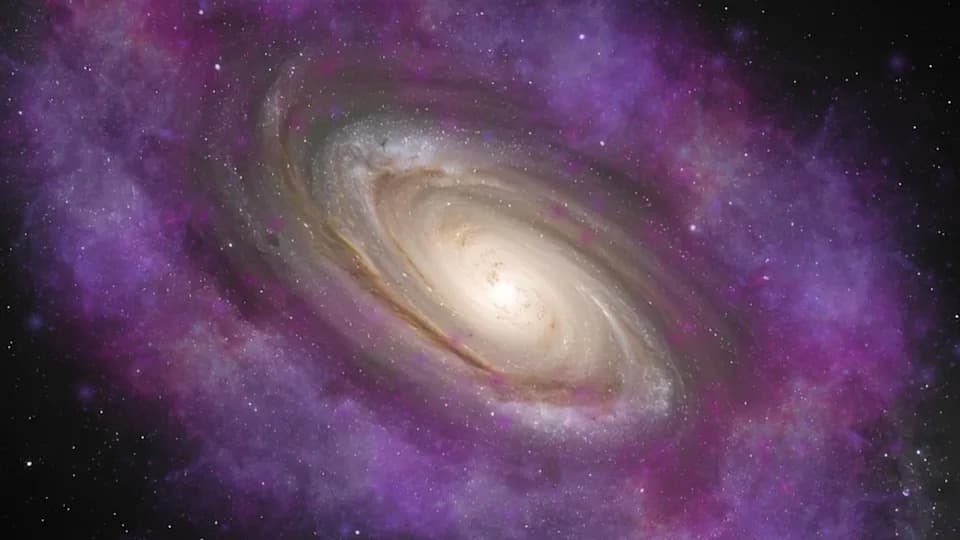
The idea offers a geometric origin for the missing mass inferred from astrophysical observations. It could account for why gravity seems much weaker than the other forces (since some gravity leaks into the extra dimension) and why light is bent by more mass than visible matter alone would predict. Key observables include gravitational lensing, precise measurements of galaxy dynamics, and the statistics of cosmic structure.
How might we test the idea?
Although still speculative, the dark-dimension scenario makes testable predictions. Possible signatures include:
- New heavy "messenger" particles or resonances that appear in particle-collider data or as missing-energy events.
- Small deviations from the expected behavior of gravity at short distances or tiny anomalies in the inverse-square law.
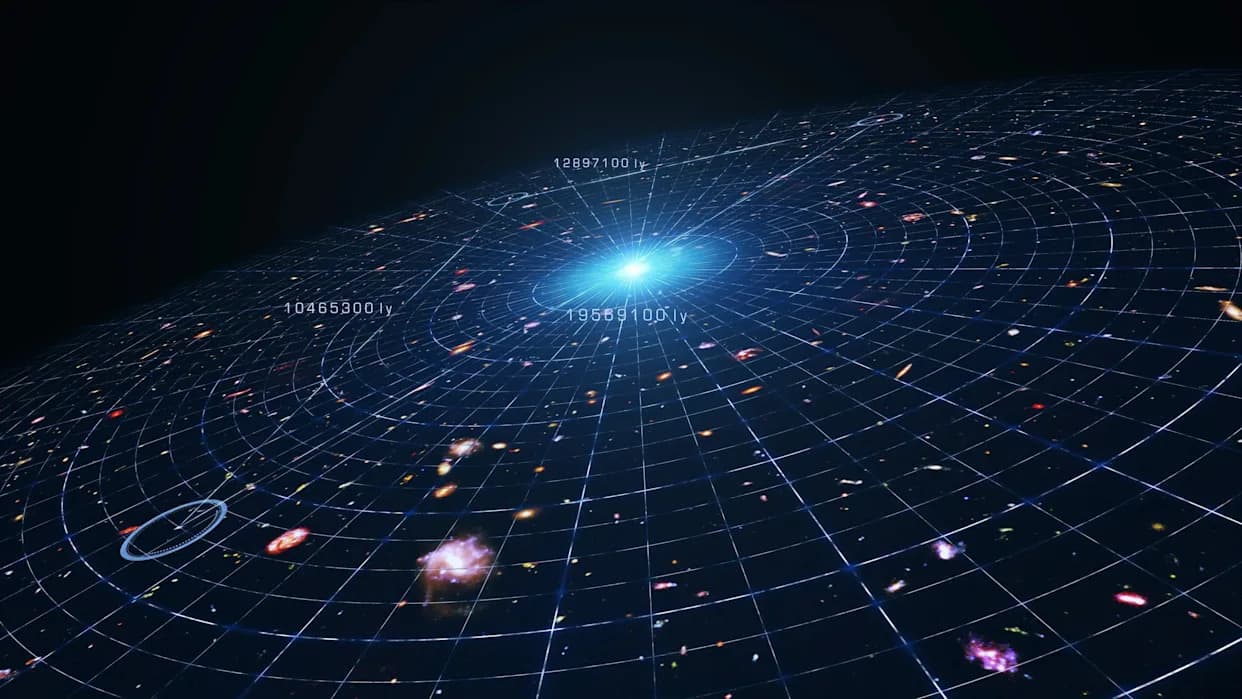
- Subtle discrepancies in gravitational lensing maps or in the detailed growth of cosmic structure compared with standard dark-matter models.
- Unusual signals in precision experiments and future observatories sensitive to weak, transient gravitational phenomena.
Why it matters
If confirmed, a hidden fifth dimension would revolutionize our understanding of gravity, particle physics, and cosmology. It would mean that what we call dark matter is not a new particle in our spacetime but a manifestation of higher-dimensional physics—requiring revisions to both theoretical frameworks and experimental strategies.
For now, the dark-dimension hypothesis is an intriguing alternative that directs researchers to specific, testable signals. Ongoing theoretical work and increasingly sensitive experiments and surveys will be needed to confirm or rule out this idea.
Help us improve.