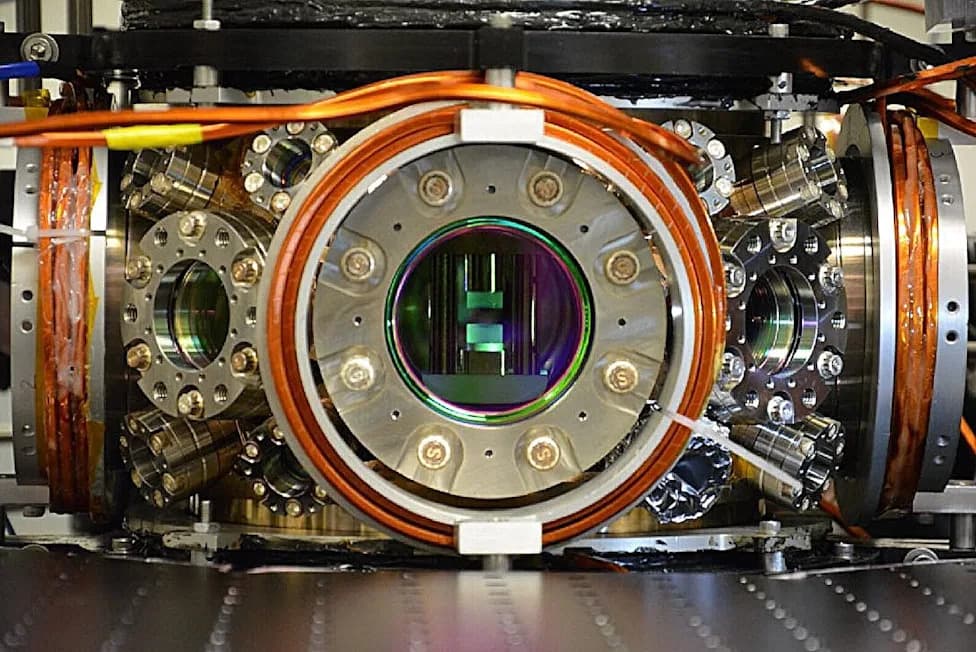
UC San Diego engineers demonstrated that shaping femtosecond laser pulses into tightly focused vector beams can reverse magnetization in Pt/Co multilayers without an external magnetic field. By reducing the effective spot size and redistributing polarization, they transitioned from helicity-dependent to helicity-independent switching and achieved deterministic reversal in stacks up to nine Pt/Co repeats when the beam was confined to near-wavelength scales. The experiment used repeated 120-fs pulses at 800 nm (1 kHz); it is a laboratory proof-of-concept that highlights beam geometry as a control knob for future optical magnetic memory.
Shaping Ultrafast Light to Flip Magnetic Memory: UC San Diego Reveals Beam Geometry Controls
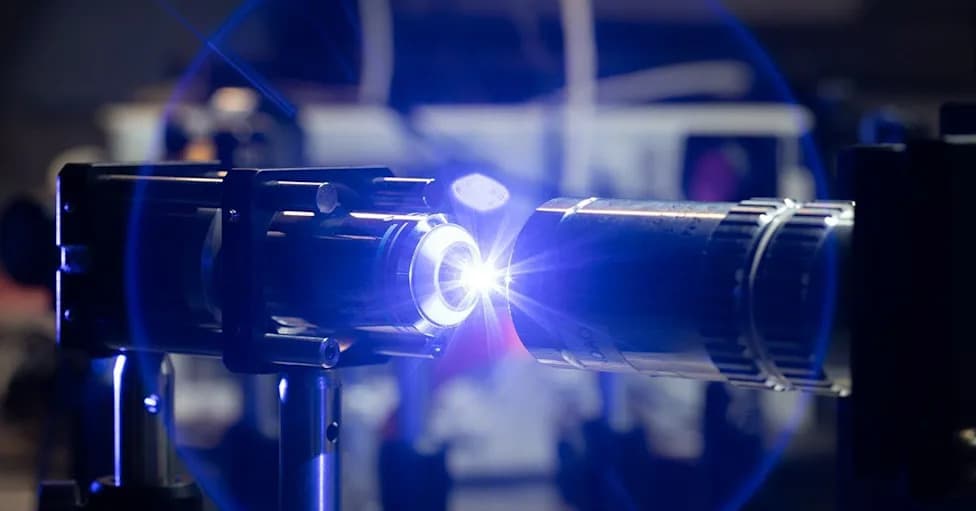
Using a specially engineered beam of light from an ultrafast laser, UC San Diego engineers demonstrate a new approach to switch magnetic information in materials without using an external magnetic field. (CREDIT: David Baillot/UC San Diego Jacobs School of Engineering)
Engineers at UC San Diego have shown that carefully shaped ultrafast laser beams can deterministically reverse magnetization in platinum–cobalt (Pt/Co) multilayers without any applied magnetic field. By shrinking the illuminated spot and redistributing polarization using tightly focused vector beams, the team switched the dominant reversal mechanism and achieved polarization-independent switching in stacks containing as many as nine Pt/Co repeats.
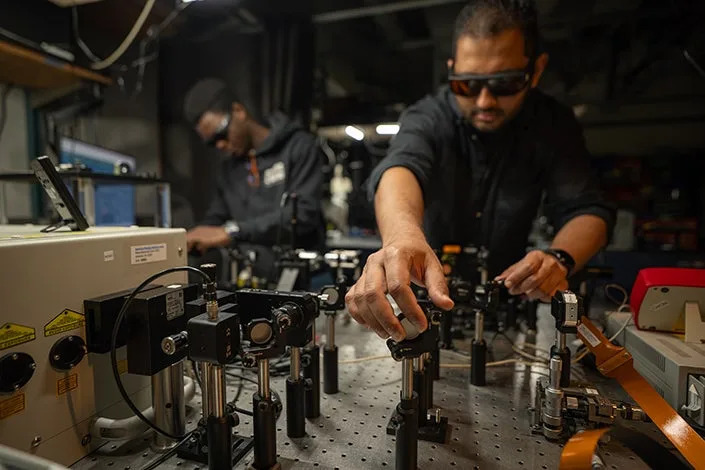
A specially designed optical system (foreground) shrinks, shapes and concentrates light from a femtosecond laser (left) in order to produce optical switching in a magnetic material. (CREDIT: David Baillot/UC San Diego Jacobs School of Engineering)
What the team did
The researchers molded femtosecond 800 nm pulses into circularly polarized vector beams and used a high-numerical-aperture optical system to concentrate and reshape the focal region. They tested thin films composed of alternating Pt and Co layers with between one and ten Pt/Co repeats and compared outcomes across different effective spot sizes.

A sample of magnetic material undergoes optical switching. (CREDIT: David Baillot/UC San Diego Jacobs School of Engineering)
Key experimental details
Using microscope objectives with high numerical aperture, the effective laser spot was reduced in some experiments from about 1.92 µm to roughly 0.96 µm. Simulations indicate a tightly focused circularly polarized vector beam can produce a focal spot up to about 15% narrower than an equivalent Gaussian beam under the same focusing conditions. The authors probed switching using repeated 120-femtosecond pulses at 800 nm with a 1 kHz repetition rate and visualized domains with a Faraday microscope.
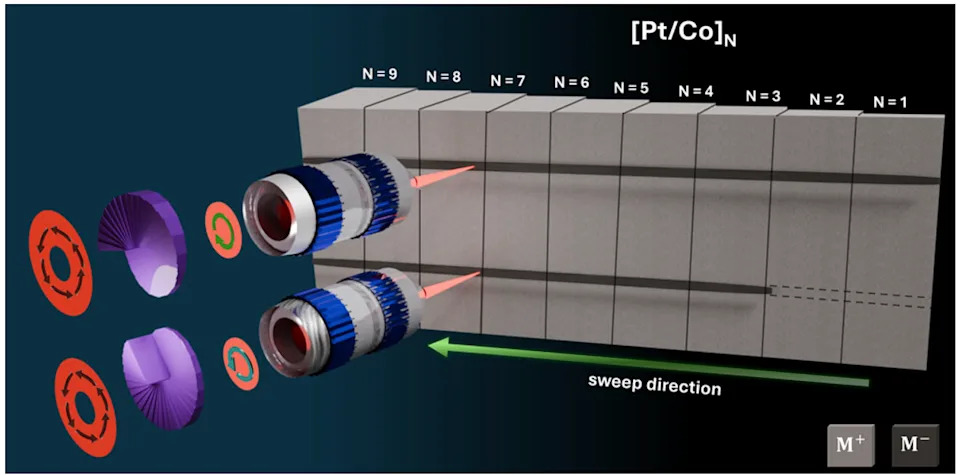
Optical beam shaping control of magnetization in [Pt/Co]N multilayers. (CREDIT: Abdoulaye Ndao et al, Nature Communications 2026)
Results and mechanism
At larger illumination diameters the films exhibited familiar helicity-dependent switching: the final magnetic state depended on the handedness (right or left circular) of the incident light, and deterministic reversal developed cumulatively over many pulses. When the beam was confined, however, that helicity dependence weakened or disappeared.
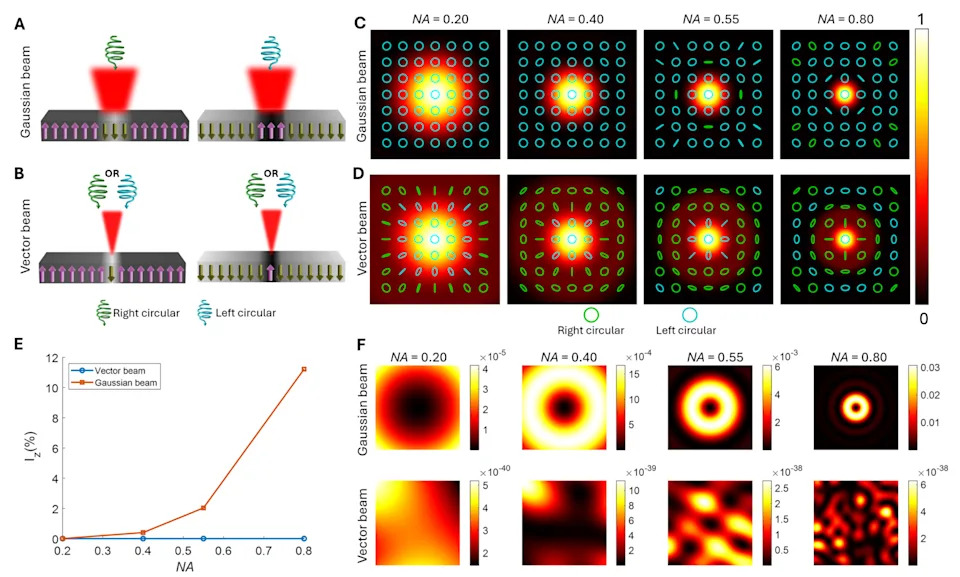
Optical control of helicity-dependent and helicity-independent switching in [Pt/Co] N multilayers. (CREDIT: Abdoulaye Ndao et al, Nature Communications 2026)
For a three-repeat Pt/Co stack the team observed helicity-independent reversal when the effective spot reached about 1.36 µm or smaller; right- and left-circular vector beams then produced essentially the same final magnetic configuration. With four repeats, helicity-independent switching appeared across all tested spot sizes. In stacks with five through nine repeats, deterministic reversal persisted when the light was focused near the wavelength scale; beyond nine repeats stripe-like domain patterns prevented uniform switching.
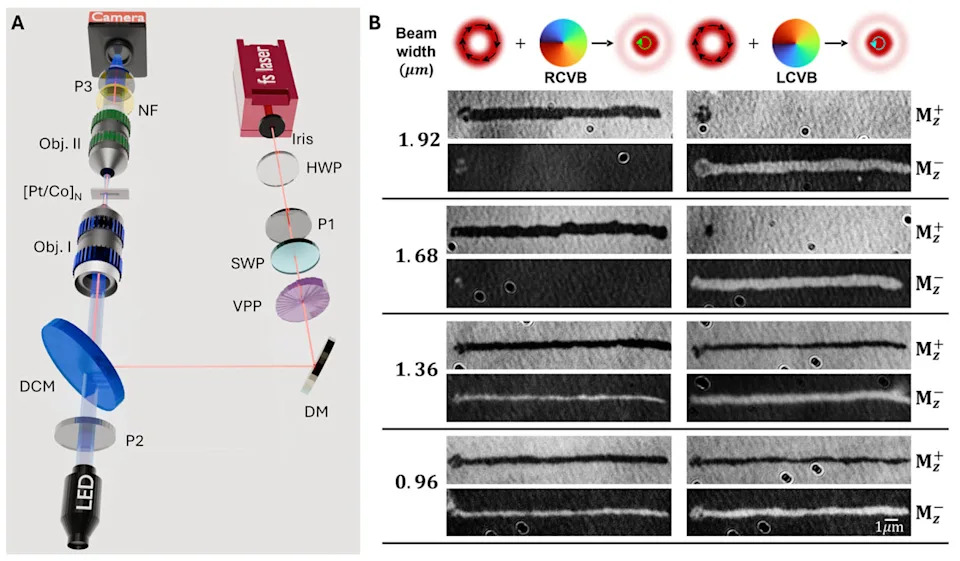
Transitioning from helicity-dependent to helicity-independent switching through optical beam shaping. (CREDIT: Abdoulaye Ndao et al, Nature Communications 2026)
The authors attribute the transition from helicity-dependent to helicity-independent switching to a combination of intense local heating and dipolar fields from the surrounding unheated film. A smaller heated region is easier for neighboring domains to stabilize after the pulse drives the local material close to its Curie temperature, enabling a single reversed domain to nucleate and persist. Unlike single-shot switching reported in some ferrimagnets, the Pt/Co films here reverse cumulatively over many pulses.
Implications and limitations
This work demonstrates that optical beam design can serve as a practical control knob for magnetic switching: by tuning beam size, focus and spatial polarization distribution researchers can change the dominant reversal pathway without redesigning the magnetic material. Increasing magnetic volume (more repeats) improves thermal stability, an attractive property for memory, and the ability to preserve deterministic switching up to nine repeats is notable.
However, this is a laboratory proof-of-concept, not a finished memory device. The apparatus relies on free-space ultrafast lasers and specialized optics, and switching here requires many pulses rather than single-shot writing. Key challenges for device integration include developing compact, on-chip light sources, nanoscale optical elements to confine light to a few hundred nanometers, and materials or geometries that switch reliably at much lower energies.
Publication: The study appears in Nature Communications and is accompanied by modeling and microscopy that link beam geometry to switching outcomes.
Overall, the results shift part of the design problem from finding new magnetic materials to co-optimizing the optical write field and magnetic stack — a potentially important route toward faster, denser magnetic storage.
Help us improve.