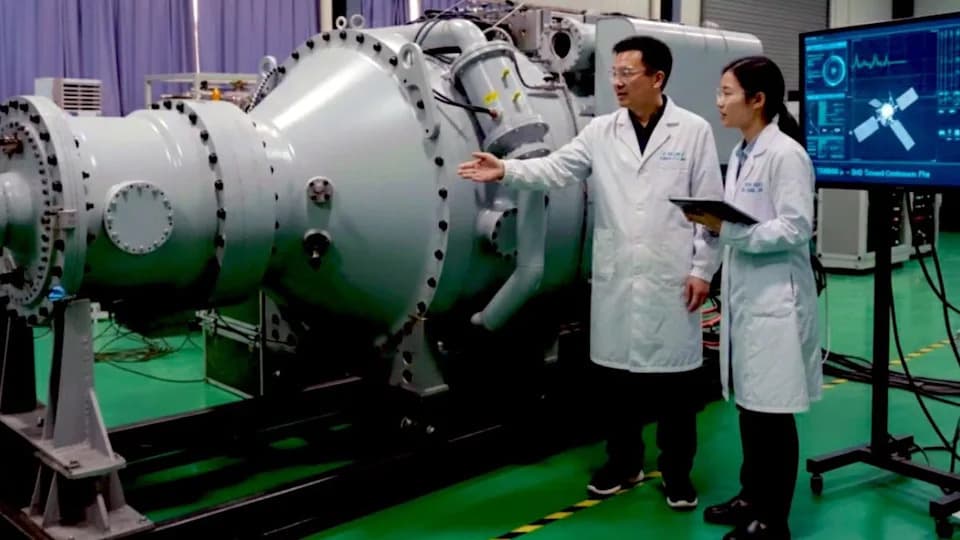
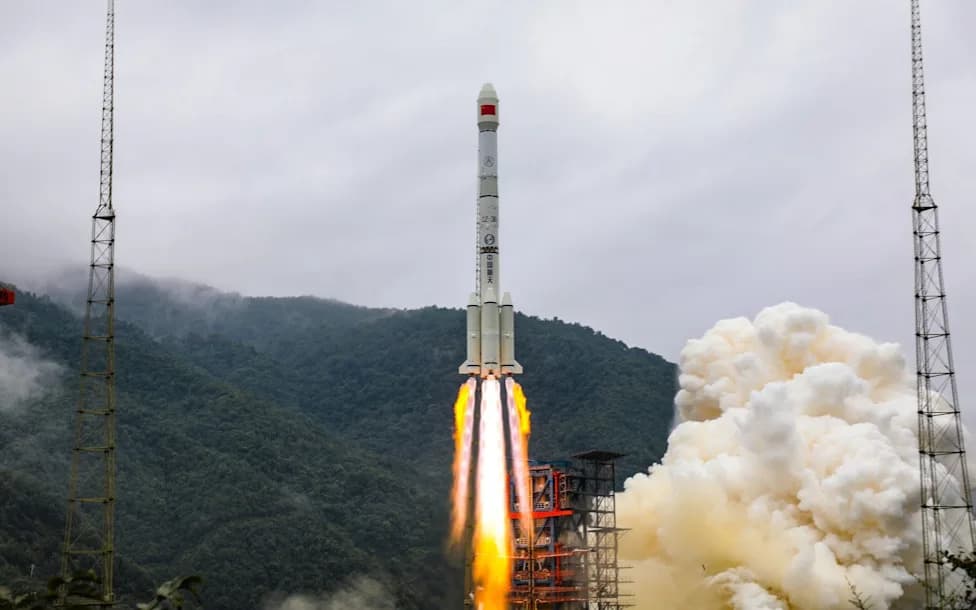
Chinese researchers at the Northwest Institute of Nuclear Technology (NINT) in Xi'an, Shaanxi Province, have reportedly developed a high-power microwave (HPM) system — the TPG1000Cs — that some outlets describe as a major threat to low Earth orbit (LEO) satellite constellations such as Starlink.
Overview
According to reporting in the South China Morning Post (SCMP) and subsequent summaries, the TPG1000Cs centers on a Tesla-style pulsed power driver that can generate bursts of microwave energy at a claimed peak power of 20 gigawatts. The system is said to be packaged in a relatively compact 4 m (12 ft), 5-ton unit that could be vehicle-mounted or, conceivably, adapted for a launch platform.
Key Technical Claims
Sustained High-Power Output: The TPG1000Cs is reported to be the first HPM system capable of sustaining a 20 GW output continuously for about one minute, far longer than previous HPM devices that typically run for seconds.
Compact Packaging: Developers claim the device fits into a 4 m, 5-ton package — roughly half the size or weight of comparable earlier systems.
Enabling Technologies: The team reportedly used a liquid insulating material identified as Midel 7131 and a dual-width pulse-forming line to increase energy density and power handling in a smaller form factor.
Tests And Performance Claims
The Chinese team reported stability and durability testing, including continuous one-minute operations that accumulated approximately 200,000 pulses with consistent performance. These results are described in secondary reporting; independent verification of the full performance envelope is not available in open sources.
Potential Effects On Satellites And Caveats
Some analysts cited in the reporting suggest that Earth-based HPM weapons at or above ~1 GW could disrupt sensitive satellite electronics or communications under certain conditions; a 20 GW device would therefore represent a substantial increase in nominal power. However, real-world effects on satellites depend on many factors not addressed by the basic power figure alone, including:
- Distance and line-of-sight between emitter and target;
- Beam focusing, pointing accuracy and antenna gain;
- Atmospheric propagation losses and ionospheric effects;
- Satellite shielding, hardening and operational redundancy;
- Legal and operational constraints on using such systems.
Because these factors materially affect whether and how an HPM system could damage or deny service from satellites, the reported 20 GW specification should be treated as an indicator of capability rather than a guaranteed operational effect on any given satellite constellation.
Strategic Implications
Separately, reporting notes Chinese simulations examining whether the People’s Liberation Army (PLA) might be able to use capabilities like HPM to interfere with or deny access to Starlink services regionally, for example in a contingency over Taiwan. Such studies reflect broader interest in space and electronic warfare, though they do not prove operational deployment or effectiveness in real-world conflict scenarios.
Sources And Verification
The primary media coverage cited is the South China Morning Post, which references work at NINT. Independent, peer-reviewed, or third-party technical confirmation of the TPG1000Cs's full claimed performance is not present in the open reporting; readers should treat the claims as reported by the developers and media rather than independently confirmed facts.
Note: This article summarizes media reports and the developers' claims and adds context about technical and operational limitations. It does not assert independently verified effects on specific satellite systems.