The Swedish cohort study of 2.7 million children (born 1985–2020) found that about 2.8% had an autism diagnosis by 2022. Although boys were diagnosed at much higher rates in early childhood, a "catch-up" effect means women are nearly as likely as men to be diagnosed by age 20. Experts say the gap likely reflects underdiagnosis of girls—due to diagnostic bias or masking—which can delay care and lead to misdiagnoses.
New Swedish Study Finds Women Nearly Catch Up To Men In Autism Diagnoses By Adulthood
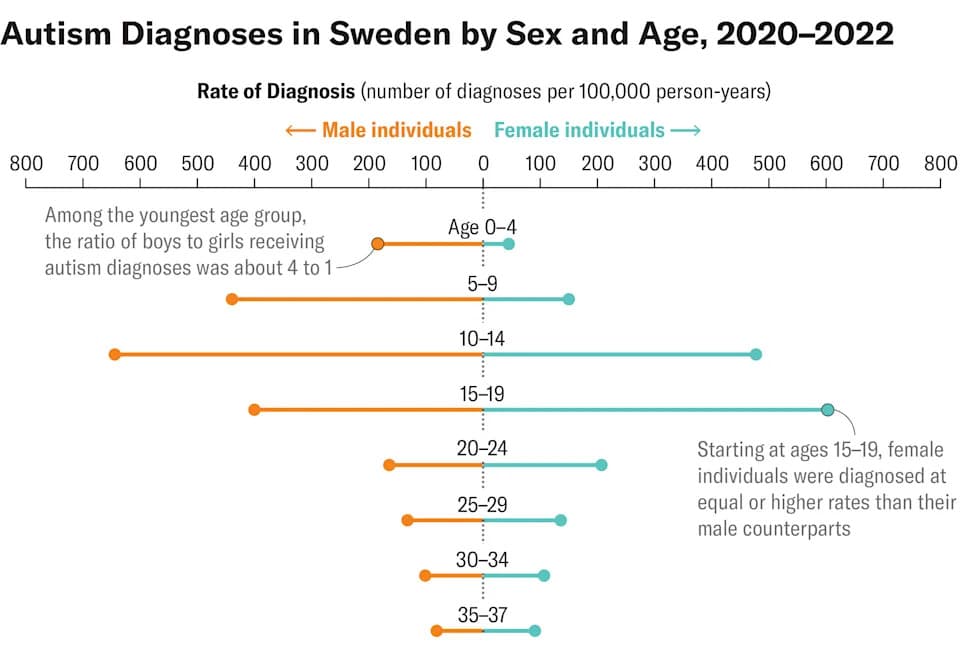
Amanda Montañez; Source:“Time Trends in the Male to Female Ratio for Autism Incidence: Population Based, Prospectively Collected, Birth Cohort Study,” by Caroline Fyfe et al., inBMJ, Vol. 392. Published online February 4, 2026(data)
A large Swedish cohort study following 2.7 million children born between 1985 and 2020 found that about 2.8% of the cohort had been diagnosed with autism by 2022. While boys were diagnosed at much higher rates in early childhood, researchers observed a clear "catch-up": by age 20, women were nearly as likely as men to have received an autism diagnosis. The paper was published online in the BMJ on February 4, 2026.
Study Details
Researchers analyzed prospectively collected national health data covering births from 1985 through 2020 and clinical diagnoses recorded through 2022. Of the roughly 2.7 million people in the cohort, ~2.8% had an autism diagnosis by 2022. The study documents that the male-to-female diagnosis ratio is large in early childhood but narrows across adolescence and young adulthood.
Expert Reaction
David Mandell, professor of psychiatry at the University of Pennsylvania, described the work as "interesting" and "well done," highlighting the 35-year observation window and extensive dataset. Gina Rippon, professor emeritus of cognitive neuroimaging at Aston University and author of The Lost Girls of Autism, called the findings "powerful" and noted the study's rigorous, longitudinal design.
“Because the analysis relies on clinical diagnoses, the reported rates for women may be conservative,” Rippon adds.
Possible Explanations and Consequences
The study does not settle why more boys are diagnosed in early childhood. Observers point to several likely contributors: systemic diagnostic biases that favour recognition of more typically male presentations of autism, and the tendency for some girls to mask or compensate for autistic traits. Patient advocate Anne Cary argued in a related BMJ editorial that diagnostic practice may miss girls, contributing to later recognition.
Delayed diagnosis can have significant consequences. People who receive a late diagnosis may face misdiagnoses (for example, anxiety disorders or ADHD), lose opportunities for early interventions, and encounter barriers to appropriate support and services.
What This Means
The new findings suggest that some girls with autism are underdiagnosed in childhood and are identified only later in life. The authors and experts say the pattern highlights the need to reexamine diagnostic screening and assessment practices so that autistic girls and women receive timely recognition and care.
Source: Caroline Fyfe et al., "Time Trends in the Male to Female Ratio for Autism Incidence: Population Based, Prospectively Collected, Birth Cohort Study," BMJ, Vol. 392. Published online February 4, 2026. Reporting: Amanda Montañez.
Help us improve.