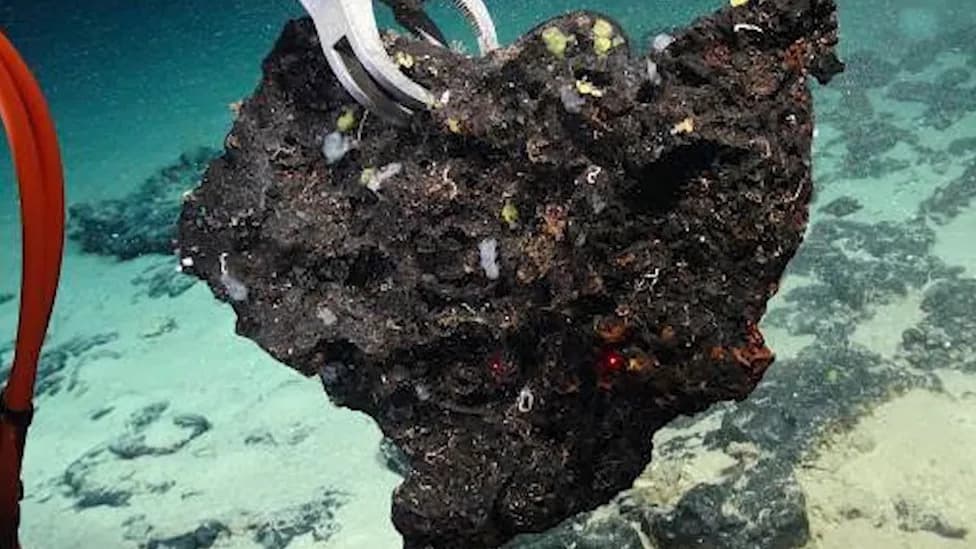
Japan has recovered sediment containing rare earth elements from about 6,000 metres during a test mission using the scientific drilling vessel Chikyu near Minami Torishima. The government said the sample will be analysed to determine exact rare-earth concentrations and called the recovery a meaningful step for economic security. The seabed in the area is estimated to hold over 16 million tons of rare earths, while environmental groups warn deep-sea mining could harm marine ecosystems.
Japan Recovers Rare-Earth‑Rich Sediment From 6,000m Deep‑Sea Test — Step Toward Reducing Reliance On China
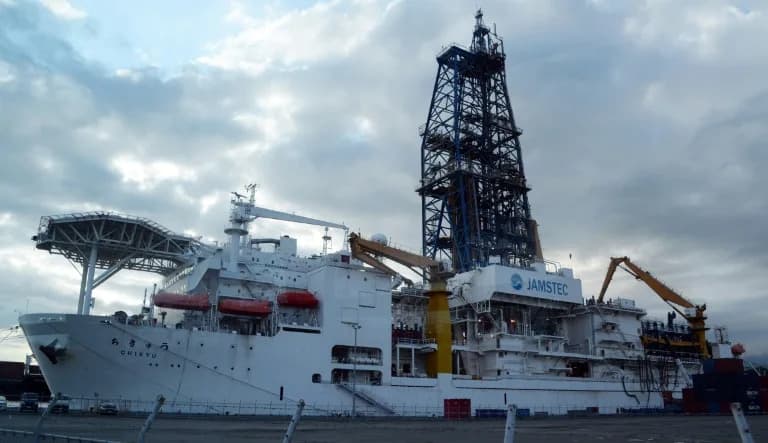
Japan's deep-sea drilling vessel Chikyu has retrieved sediment containing rare earth at a depth of 6,000 metres (TOSHIFUMI KITAMURA)(TOSHIFUMI KITAMURA/AFP/AFP)
Japan announced that sediment containing rare earth elements was successfully recovered from about 6,000 metres (roughly 20,000 feet) beneath the Pacific Ocean during a domestic test mission, part of Tokyo's wider effort to reduce dependence on China for strategic minerals.
The sample was retrieved by the deep-sea scientific drilling vessel Chikyu, which sailed last month to waters around the remote island of Minami Torishima. The government described the operation as the world's first attempt to access rare earths at that depth and said laboratory analysis will determine the precise concentration of rare-earth elements in the sediment.
"Details will be analysed, including exactly how much rare earth is contained," government spokesman Kei Sato said, calling the recovery "a meaningful achievement both in terms of economic security and comprehensive maritime development."
Minami Torishima lies inside Japan's exclusive economic zone, and Japanese media and industry sources have estimated the nearby seabed may contain more than 16 million tons of rare earths — a reserve the Nikkei business daily says would rank among the world's largest. The deposits reported by the Nikkei could include the equivalent of roughly 730 years' worth of dysprosium (used in high-strength magnets) and about 780 years' worth of yttrium (used in lasers) at current consumption rates.
Geopolitical Context
The mission comes amid growing strategic tensions with China, the dominant global supplier of rare earths. Tokyo is pursuing domestic sources after Beijing limited exports of certain "dual-use" items to Japan and has previously used its rare-earth supply chain as leverage in diplomatic disputes.
China currently supplies a large share of global rare-earth output: it accounts for almost two-thirds of mined production and about 92% of global refined output, according to the International Energy Agency.
Environmental Concerns And Regulation
Environmental groups warn that deep-sea mining could severely damage fragile marine ecosystems and disturb long-settled seabed habitats. The International Seabed Authority (ISA), which regulates activities on the ocean floor beyond national jurisdictions, is developing rules and a global code to govern deep-sea mining — though Japan's test was conducted within its own waters.
Analysts say a reliable domestic source near Minami Torishima could strengthen Japan's supply-chain resilience for key industries such as electric vehicles, wind turbines and electronics, while also becoming a strategic asset for policymakers seeking to reduce dependence on any single foreign supplier.
Next steps: The retrieved sediment will undergo detailed chemical and geological analysis to quantify rare-earth concentrations and evaluate the technical and environmental feasibility of scaling up extraction.
Help us improve.