KAIST researchers discovered an epigenetic "brake"—mediated by YAP and TAZ within the Hippo pathway—that can block PPARγ‑driven fat‑cell formation by chemically reprogramming chromatin. In mouse cells and models, releasing Hippo brakes made mature adipocytes lose key fat‑cell features and revert toward precursor‑like states. The findings clarify how adipocyte identity is regulated and may guide future metabolic‑disease therapies, though results are so far limited to mice.
KAIST Scientists Identify Epigenetic 'Brake' That Slows Fat‑Cell Formation
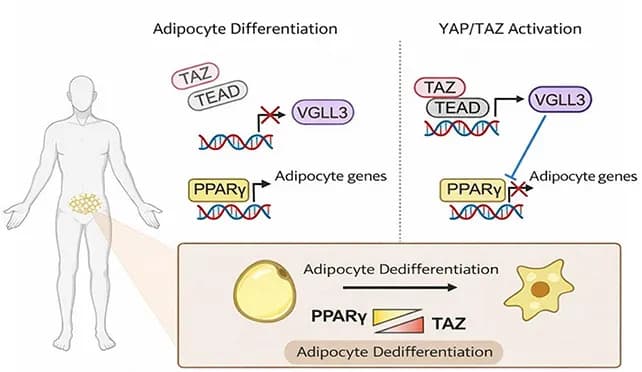
The researchers found the molecular switch that produced fat cells. (Korea Advanced Institute of Science and Technology)
Researchers at the Korea Advanced Institute of Science and Technology (KAIST) have identified an epigenetic mechanism that can suppress the formation of fat cells, shedding light on a potential new route to treating obesity and metabolic disease.
What the Study Found
The team investigated PPARγ, a well-known master regulator that activates a network of genes driving cells to differentiate into and remain adipocytes (fat cells). In experiments using cultured mouse cells and mouse models, the researchers discovered an epigenetic switch — a chemical modification of chromatin that changes gene activity without altering DNA sequence — that can block PPARγ’s fat‑making program.
How the Mechanism Works
YAP and TAZ, two proteins in the Hippo signaling pathway, were central to the mechanism. The Hippo pathway normally restrains YAP/TAZ activity (acting like molecular brakes). The study shows YAP/TAZ trigger a molecular cascade that chemically reprograms chromatin, preventing activation of PPARγ target genes that promote adipocyte identity.

Audition now for ScienceAlert's Casting Call
Key Experiments and Results
When the researchers experimentally switched off Hippo signaling in mice — effectively releasing the brakes on YAP/TAZ — these proteins became hyperactive. Existing fat cells lost many defining adipocyte features and reverted toward a precursor‑like state, though they did not fully return to stem cells. The findings were demonstrated in mouse cells and mouse models.
"This study is the first to establish that adipocyte differentiation is precisely controlled at the epigenetic level, beyond simple gene regulation," said molecular biologist Dae‑Sik Lim.
Why This Matters
Excess fat, particularly when stored in the wrong places, is linked to diabetes, cardiovascular disease and other health problems. Because mature fat cells typically shrink rather than disappear with weight loss, understanding molecular controls of adipocyte identity could point to new strategies for reducing harmful fat accumulation or altering fat‑cell behavior.
Limitations and Next Steps
These results are currently limited to mouse models and cultured mouse cells. Substantial additional research is needed to determine whether the same epigenetic mechanism operates in humans and whether it can be safely targeted for therapies. The study offers a foundation for future work toward precision treatments for metabolic disease.
Publication: Science Advances.
Help us improve.