Center City Public Charter School’s Congress Heights campus—a high-poverty D.C. pre-K–8 school—saw every eighth grader complete Algebra I and 70% achieve proficiency on statewide math tests in 2024–25. Leaders credit co-teaching, an extended summer acceleration, small classes, frequent formative checks and recorded lessons that let students review instruction. Data tracking also showed operational supports, like city-funded transportation, improved attendance, while MAP results document a steady recovery from pandemic losses.
High-Poverty D.C. Charter School Outperforms Wealthier Peers in Math — 70% of 8th Graders Proficient
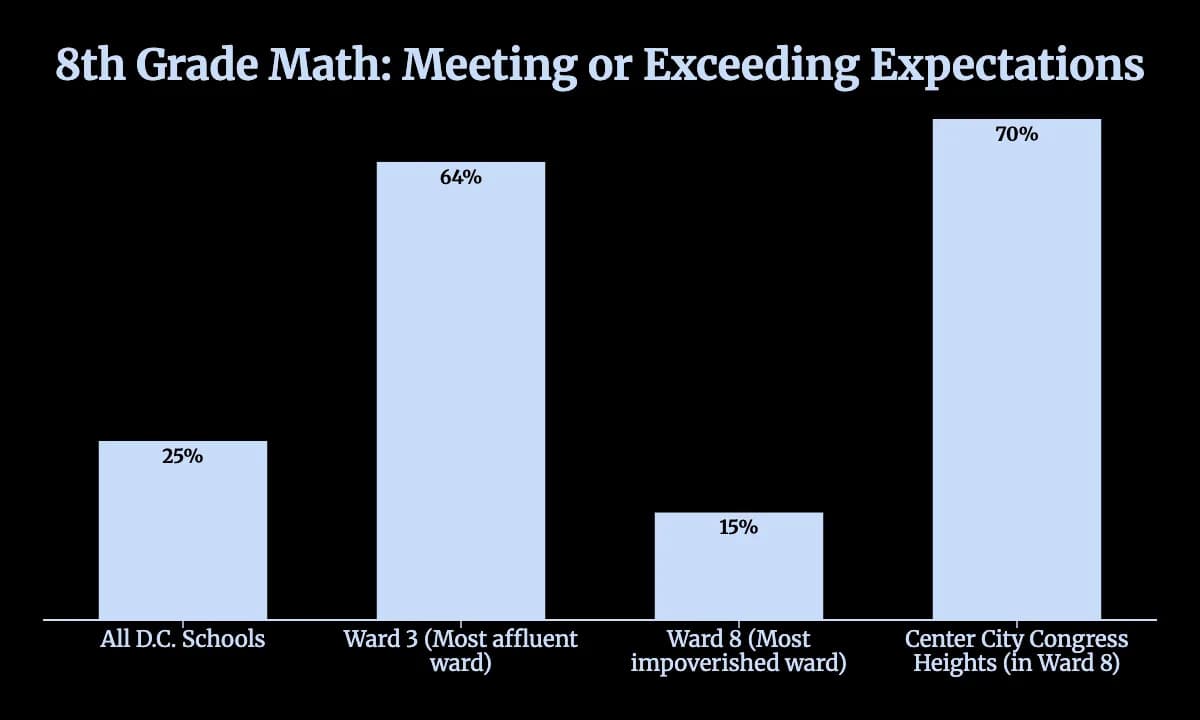
Center City Public Charter School’s Congress Heights campus, a high-poverty pre-K–8 school in Washington, D.C.’s Ward 8, dramatically outperformed peers across the city in math during 2024–25. For the first time in the campus’s 17-year history, every eighth grader completed Algebra I, and 70% of those students scored proficient on statewide math assessments.
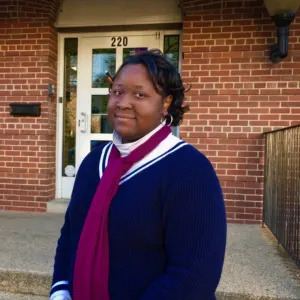
Niya White, principal of Center City Public Charter School’s Congress Heights (Center City Public Charter Schools Congress Heights)
Background
The Congress Heights campus serves 251 students; 98% are Black and roughly 60% receive government assistance for food or housing. Principal Niya White, who took leadership in 2012 when the school faced possible closure, describes the campus’s turnaround as the result of sustained instructional changes, persistent expectations and careful use of data.
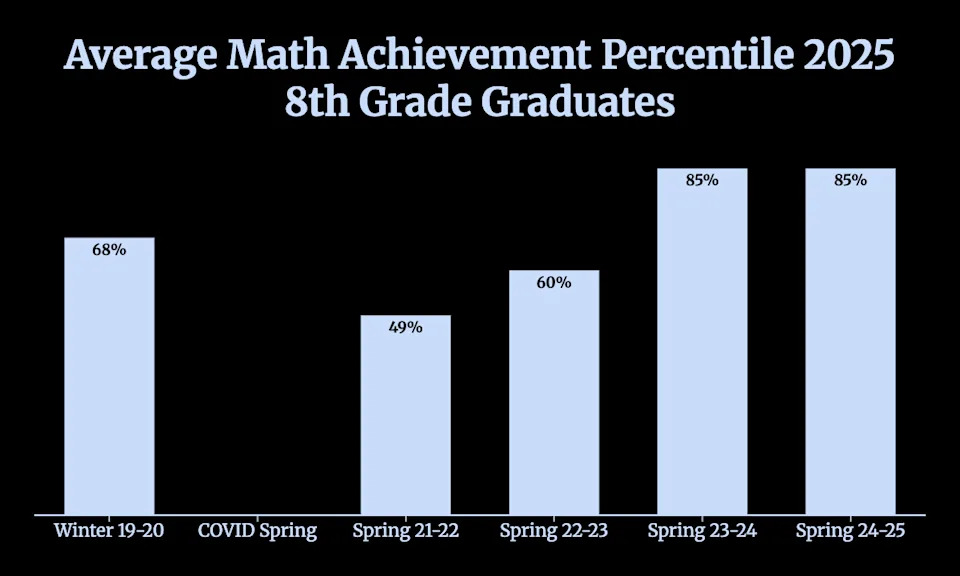
Math achievement scores for last year’s Congress Heights’ 8th graders from the winter of 2019-20 to the spring of 2024-25. (Center City Public Charter Schools Congress Heights)
Instructional Changes That Mattered
Staff credited several deliberate strategies for the gains: an extended four-week summer session to accelerate readiness, an accelerated curriculum that combined seventh- and eighth-grade standards to eliminate gaps before starting Algebra I, small class sizes (capped at 25), and a co-teaching model that places two adults in the math classroom to provide real-time differentiation.
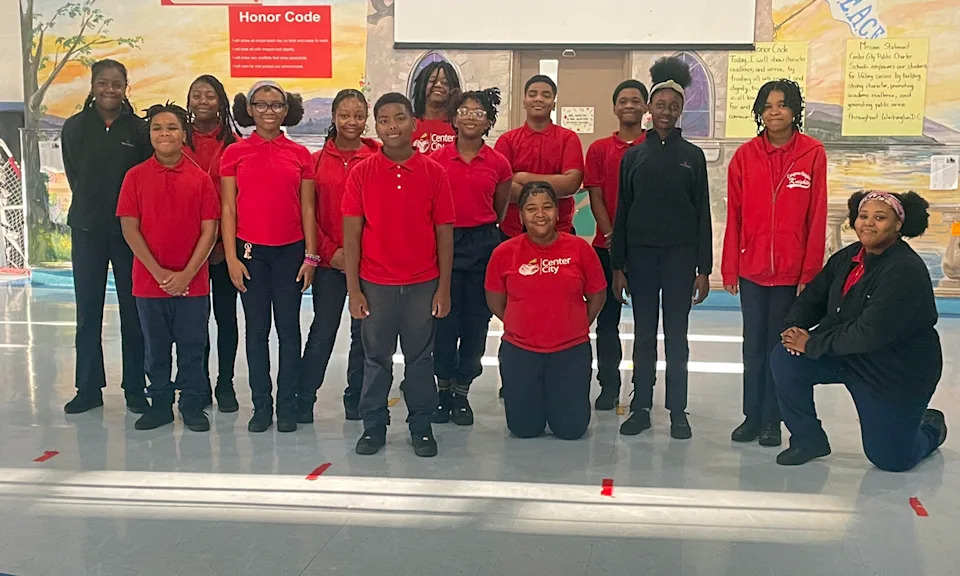
The 2024-25 Congress Heights eighth-grade class. (Center City Public Charter Schools Congress Heights)
"If we kept saying the students aren’t going to be able to do something, then we will never be able to move them forward," Principal Niya White said. "We can’t hold somebody back because they don’t have all of their multiplication facts memorized. That is not the answer or the way."
Data, Assessment and Supports
The campus uses frequent formative checks—teachers often start math lessons with two short questions—to decide whether to review or move ahead. All math lessons are video recorded so students can revisit instruction; some in-class assessments may be retaken after review and rework.

Josh Boots, founder and executive director of Empower K12. (LinkedIn)
Congress Heights tracks both academic and operational metrics. The current eighth-grade cohort’s MAP math percentiles document the recovery from pandemic learning loss: 68th percentile (third grade, 2019–20), 49th percentile (fifth grade after COVID disruptions), 60th percentile (2022–23) and 85th percentile (2023–24 and 2024–25).
Operational Interventions With Measurable Impact
In 2024–25 the campus used city-funded transportation to bring students from high-crime areas to school. Although funding covered only some eligible students, those riders attended seven more school days on average and had 12 fewer late arrivals than eligible students who did not ride.
Voices From the Classroom
Jessi Mericola, a seventh- and eighth-grade math teacher, described co-teaching as a practical way to spot and address confusion immediately: one teacher delivers instruction while the other circulates to give small-group or individual support. Student testimony reinforces the shift: 13-year-old Kennedy Morse said math went from a subject she struggled with to one of her strengths after receiving consistent guidance and supports at Center City.
Culture, Continuous Improvement and Scaling
Leaders emphasize a growth-oriented mindset: treat students as capable of grade-level work while filling gaps, give teachers planning time, and use data to detect which strategies are working. Josh Boots, founder and executive director of Empower K12, praised the campus’s data efforts and the network’s willingness to "fail forward"—test quickly, learn fast, and iterate.
The Congress Heights campus is one of six schools in the Center City charter network, which serves 1,440 students total. School leaders say the combination of higher expectations, targeted interventions, frequent assessment and operational supports produced measurable academic and attendance gains.
Help us improve.