
Denmark insists Greenland is not for sale, yet U.S. officials have discussed what a hypothetical purchase might look like. Historical offers and GDP figures provide poor benchmarks: a 1946 $100 million bid equals about $1.6 billion today, while Greenland's 2023 GDP was roughly $3.6 billion. Large mineral deposits and critical raw materials increase theoretical value, but environmental bans, Danish subsidies that fund half the public budget, Indigenous rights and the legal hurdles to transferring sovereignty make any price tag highly speculative. Analysts suggest the talk may be intended more as political leverage than a realistic acquisition plan.
Can the U.S. Buy Greenland? Why Putting a Price Tag Is Nearly Impossible

FILE PHOTO: U.S. Vice President JD Vance tours the U.S. military's Pituffik Space Base in Greenland on March 28, 2025. Jim Watson/Pool via REUTERS/File Photo
LONDON, Jan 9 (Reuters) - Despite repeated Danish statements that Greenland is not for sale, a White House spokeswoman said this week President Donald Trump and his advisers have discussed "what a potential purchase would look like." Treating that discussion as a hypothetical raises immediate and fundamental questions about how anyone could meaningfully value an autonomous territory such as Greenland.
There is no established market or accepted framework for buying and selling countries. "There's not a market for buying and selling countries," said Nick Kounis, chief economist at ABN AMRO, underscoring the conceptual problem of assigning a single price to sovereignty, people and land.
Historical Offers Provide Poor Benchmarks
Looking for historical precedents offers little guidance. In 1946 the United States reportedly offered Denmark $100 million for Greenland — roughly $1.6 billion in today's dollars — but Copenhagen rejected the proposal. Earlier U.S. land purchases, such as the $15 million Louisiana Purchase (1803) and the $7.2 million Alaska acquisition (1867), are also poor analogies: those sellers agreed to sell, and converting such sums to present-day value depends heavily on what adjustments you use for inflation, land appreciation and economic growth.
Valuation As If It Were A Company
One method would be to treat Greenland like a corporate takeover and value it by the income it could generate. Denmark's central bank estimated Greenland's GDP at about $3.6 billion in 2023, largely driven by fishing — roughly one-tenth the size of neighbouring Iceland's economy. But starting from GDP raises immediate questions: what earnings multiple would you apply, and over what timeline?
Complicating any income-based approach are the subsidies Greenland receives from Denmark. Those payments finance roughly half of Greenland's public budget, supporting hospitals, schools and basic infrastructure across a vast, sparsely populated island. Any prospective purchaser would have to reckon with the cost and political implications of replacing or reshaping that support.
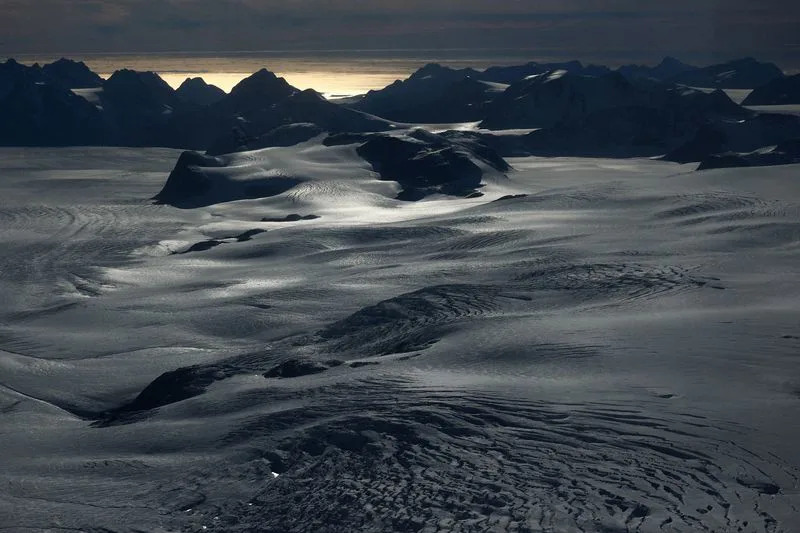
FILE PHOTO: An aerial view shows western Greenland, September 16, 2025. REUTERS/Guglielmo Mangiapane/File Photo
Resources, Regulations And Rights
Estimates of Greenland's mineral and energy potential run into the hundreds of billions of dollars, and a 2023 survey found 25 of the 34 minerals that the European Commission classifies as "critical raw materials." Reuters has reported that U.S. officials discussed taking a stake in Critical Metals Corp, which aims to develop a large rare-earths project on the island.
"Because you are adding the intangible notions of Indigenous peoples' culture, history, then you can't — there is no way to price it," said Andreas Osthagen, research director for Arctic and Ocean Politics at the Fridtjof Nansen Institute in Norway.
Two complications stand out. First, Greenland currently bans oil and gas extraction for environmental reasons, and mining projects frequently face lengthy permitting processes and resistance from Indigenous communities. Any buyer would need to factor political and regulatory constraints into a price — but how large a discount should be applied is highly subjective.
Second, the transfer of resource concessions is fundamentally different from the transfer of sovereignty. Greenland is an autonomous territory within the Kingdom of Denmark, with its own government and a population (predominantly Inuit) that has distinct legal and cultural claims. A lawful transfer of sovereignty would require agreement by Denmark and Greenland's political institutions and would likely involve complex domestic and international legal processes, including consultations with Greenlanders themselves.
Politics, Strategy And Leverage
The Trump administration has said that a range of options is on the table — rhetoric that some analysts suggest may be intended to gain leverage in broader negotiations rather than signal a concrete plan to buy the island. ABN AMRO's Kounis compared it to a negotiating tactic: putting an extreme scenario on the table to unsettle the other side and strengthen bargaining positions on unrelated matters.
A scheduled meeting between U.S. and Danish officials could clarify Washington's intentions, but experts say that converting a geopolitical idea into a lawful, politically acceptable transaction would be extraordinarily difficult.
(Reporting by Mark John and Simon Johnson; additional reporting by Ernest Scheyder; Editing by Frances Kerry)
Help us improve.


