EU leaders will join Prime Minister Narendra Modi in New Delhi as long‑running negotiations on a comprehensive EU‑India free trade agreement approach a possible conclusion. The proposed deal — referred to by Indian officials as the "mother of all deals" — aims to expand goods and services trade and include mobility measures plus security and defence cooperation. Key unresolved issues include the EU's Carbon Border Adjustment Mechanism, sectoral safety and quality standards, and agricultural protections, but officials remain cautiously optimistic ahead of the summit.
EU and India Near Landmark 'Mother of All Deals' as Leaders Meet in New Delhi
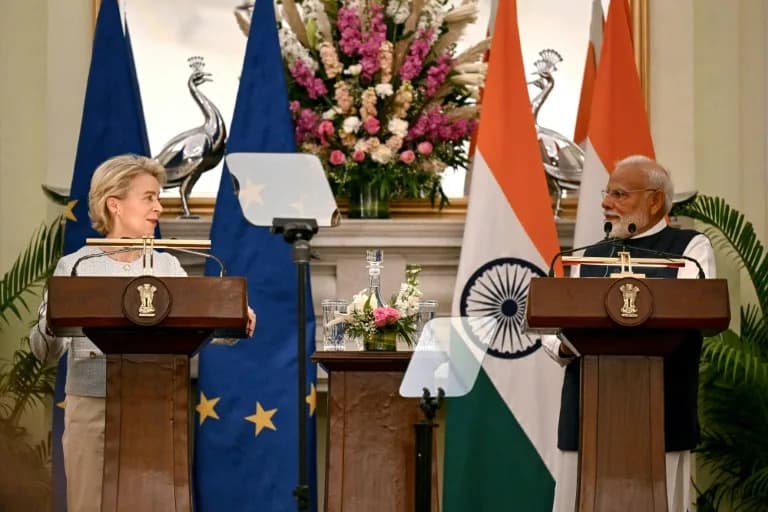
European Commission head Ursula von der Leyen and Indian Prime Minister Narendra Modi met in February 2025 in New Delhi as the two economic behemoths sought to forge closer ties (Money SHARMA)(Money SHARMA/AFP/AFP)
India and the European Union are aiming to finalise a landmark free trade agreement — described by some Indian officials as the "mother of all deals" — when EU leaders join Prime Minister Narendra Modi in New Delhi next week for Republic Day and an EU‑India summit.
Historic Push For Deeper Economic And Strategic Ties
Confronted with competitive pressures from China and the United States, New Delhi and Brussels have been negotiating a sweeping pact launched nearly two decades ago that negotiators say is now approaching a conclusion. "We are on the cusp of a historic trade agreement," European Commission President Ursula von der Leyen said this week.
Von der Leyen and European Council President Charles Michel are scheduled to attend Republic Day events on Monday and then take part in the summit on Tuesday, where both sides hope to finalise the deal.
Economic Stakes
Together the EU and India represent roughly a quarter of global population and economic output. Bilateral goods trade reached about €120 billion in 2024, with services trade at roughly €60 billion, according to EU figures — goods trade has risen nearly 90% over the past decade.
Despite growth, India accounts for only around 2.5% of total EU goods trade versus nearly 15% for China, underlining the "untapped potential" an agreement could unlock for European exporters of cars, machinery and chemicals, and for Indian exporters in textiles, pharmaceuticals and other sectors.
Key Issues On The Table
Negotiators are focusing on a small set of sticking points. Central issues include the EU's Carbon Border Adjustment Mechanism (CBAM) and its possible impact on Indian steel exports, and disagreements over safety and quality standards in pharmaceuticals and automobiles. Agriculture — especially protections for India's dairy and grain sectors — is likely to remain tightly guarded by New Delhi and politically sensitive in Europe.
The deal would also aim to include mobility arrangements to ease travel for seasonal workers, students, researchers and highly skilled professionals, as well as a security and defence component to deepen cooperation on maritime security, cybersecurity and counter‑terrorism. EU officials have suggested a defence cooperation framework could eventually open the door to joint production of military equipment if political conditions allow.
Geopolitical Context
Observers say Russia's invasion of Ukraine and past US tariff measures have increased momentum for closer EU‑India alignment. Both sides are seeking to diversify supply chains and reduce strategic dependencies — India by trimming reliance on single suppliers for military hardware and the EU by broadening its partnerships beyond the US and China.
EU and Indian officials express cautious optimism that outstanding technical and political issues can be resolved in time for the summit, while underlining that the agreement will have to balance commercial ambition with domestic sensitivities on both sides.
What Happens Next: Leaders will meet in New Delhi next week to press for a final deal; negotiators remain focused on resolving a narrow set of technical and politically sensitive issues.
Help us improve.