At Davos, Europe pushed back against President Trump's moves over Greenland, underscoring strains in the $2 trillion EU-U.S. relationship and Washington's central security role. The dispute accelerated EU plans to "de-risk" the transatlantic partnership through coalitions of the willing, tougher rules for strategic industries and stricter foreign investment conditionality. Legal tools — such as freezing Russian assets — and new legislation like "Made In Europe" requirements are part of the response. Analysts say defence dependencies will take years to address.
Greenland Standoff Spurs Europe To 'De-Risk' The Transatlantic Relationship
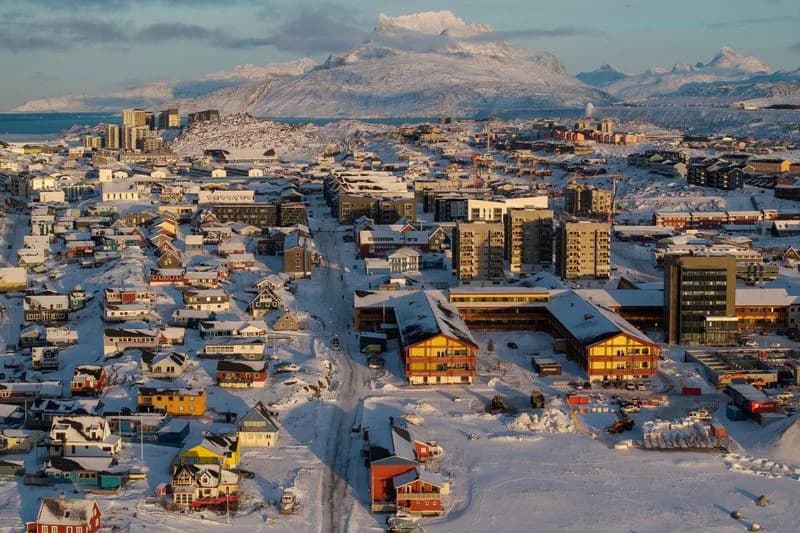
A drone view shows a general view of Nuuk, Greenland, January 15, 2026. REUTERS/Marko Djurica
DAVOS, Switzerland, Jan 23 — At the World Economic Forum in Davos, European leaders pushed back decisively against President Donald Trump's challenge over Greenland, a flashpoint that has crystallised broader concerns about the bloc's dependence on the United States.
The stakes are high: the European Union and the United States share roughly a $2 trillion annual trading relationship, while Washington remains central to NATO and a key supporter of Ukraine in its conflict with Russia. In a matter of hours at the forum, Trump publicly said he would not seize Greenland by force and then stepped back from threats to impose new tariffs on eight European states — instead praising a vague arrangement reportedly involving Dutch Prime Minister Mark Rutte.
European leaders say their firm stance — publicly declaring Greenland's status as an autonomous part of the Kingdom of Denmark a red line — helped blunt Trump's tactics. "All this shows that you cannot let the Americans trample all over the Europeans," a senior EU official said on condition of anonymity. "We did the right thing to push back, but it is not over. We will be tested constantly on issues like this."
Europe Not Seeking A Split
An emergency meeting of EU leaders urged a restart of last year's EU-U.S. trade deal process after ratification was suspended in protest over the Greenland episode. German Chancellor Friedrich Merz urged caution: "Despite the frustration and anger of recent months, let us not be too quick to write off the transatlantic partnership."
At the same time, European capitals are preparing to "de-risk" the relationship — reducing vulnerabilities without severing ties. Officials are exploring approaches modelled on the Ukraine response, where coalitions of the willing make voluntary security commitments without a single member holding veto power. "We should do more with coalitions of the willing and leave it open for others to follow," one EU official said, pointing to potential joint projects such as advancing Europe's artificial intelligence capabilities.
"The middle powers must act together, because if we're not at the table, we're on the menu," Canadian Prime Minister Mark Carney said at Davos.
Europe is also using legal levers inside the EU: in December, member states used an emergency provision to indefinitely freeze hundreds of billions of dollars in Russian assets, preventing any single country from later forcing a reversal of the move.
New European Doctrine
Economic measures are front and centre of the EU's response. Next month the bloc will launch legislation that will include "Made In Europe" requirements for strategic sectors and tougher conditionality for foreign direct investment. "Some provisions were originally conceived to reduce reliance on China but in reality they will help us to de-risk from other markets," European Commissioner for Prosperity and Industrial Strategy Stephane Sejourne told Reuters. "This will change the European doctrine on those sectors."
Rather than pivoting toward any single partner such as China, the EU is diversifying trade and partnerships: the signing of the EU-Mercosur trade pact and talks reportedly nearing a deal with India are examples. At the same time, recent data show German firms nearly halved their U.S. investments last year, a sign of commercial caution as tariff threats loom.
But analysts warn that defence remains a long-term challenge. Even with commitments to boost defence spending and repeated calls for closer European defence cooperation, it will take years for EU forces to shoulder roles now largely filled by the United States — including bolstering Arctic security.
The Greenland episode may not be the last confrontation with an increasingly transactional U.S., but it has pushed Europe to start turning words into policy: building coalitions, hardening rules on strategic industries and harnessing EU law to limit single-member blockages. Whether this translates into faster, deeper strategic autonomy will depend on political will across the 27 member states.
Additional reporting by Julia Payne and Philip Blenkinsop in Brussels; Editing by Alexander Smith
Help us improve.