EU leaders held an emergency summit in Brussels after President Trump retreated from threats linked to Greenland, welcoming the de-escalation but warning transatlantic relations were damaged. Officials said the bloc had prepared retaliatory measures worth €93 billion and temporarily paused ratification of a U.S.-EU trade deal. Leaders urged unity, respect for sovereignty and a strategy to reduce strategic dependence on the United States while keeping ties intact.
EU Leaders Reassess Ties With U.S. After Greenland Standoff as Trump Retreats
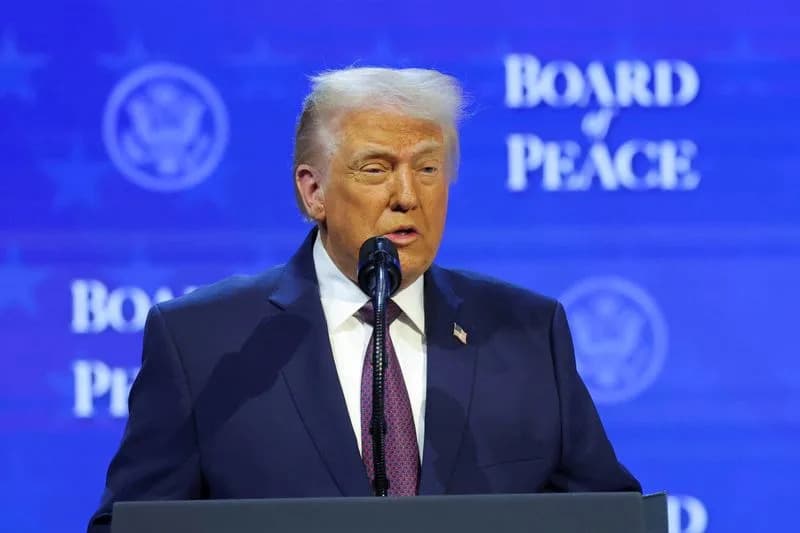
U.S. President Donald Trump takes part in a charter announcement for his Board of Peace initiative aimed at resolving global conflicts, alongside the 56th annual World Economic Forum (WEF), in Davos, Switzerland, January 22, 2026. REUTERS/Denis Balibouse
EU leaders convened an emergency summit in Brussels on Thursday evening after U.S. President Donald Trump withdrew threats tied to Greenland. Delegations welcomed the de-escalation but warned the transatlantic relationship had been damaged and pledged to remain vigilant.
Summit Reaction
Arriving for the meeting, the EU's foreign policy chief Kaja Kallas said: "Transatlantic relations have definitely taken a big blow over the last week." French President Emmanuel Macron described the past days as chaotic but welcomed the calming of tensions: "Things are quietening down and we should welcome that." He added Europe remained "extremely vigilant" and ready to use the "instruments at our disposal" if threatened again.
"We remain extremely vigilant and ready to use the instruments at our disposal should we find ourselves the target of threats again." — Emmanuel Macron
Security, Sovereignty and Strategy
Danish Prime Minister Mette Frederiksen said Copenhagen is open to discussing security cooperation over Greenland with the United States — provided Danish sovereignty is respected. "We have to work together respectfully without threatening each other," she said.
Officials stressed a deeper issue: after decades of relying on Washington for NATO defence, the EU still lacks full intelligence, transport, missile-defence and production capacities. That imbalance gives the United States substantial strategic leverage.
Trade Levers and Parliamentary Response
EU officials had prepared a package of retaliatory tariffs covering €93 billion of U.S. imports and other anti-coercion measures should Washington have imposed tariffs set to begin on Feb. 1. In protest at U.S. pressure over Greenland, the European Parliament paused work on ratifying a U.S.-EU trade deal agreed in mid-2025; Parliament President Roberta Metsola said lawmakers are likely to resume ratification once clarity is provided.
Senior parliamentarian Bernd Lange cautioned that details remain unclear: "No one knows what this so-called solution is. We would need a clear yes from Denmark and Greenland. It cannot just be an agreement between two individuals."
Looking Ahead
Leaders signalled a two-track approach: preserve a vital transatlantic relationship while accelerating efforts to reduce strategic dependence on the United States in defence and key industrial capabilities. Diplomats warned that dealing with an unpredictable U.S. presidency will likely require long-term planning and greater EU unity.
Reporting: Jan Strupczewski and Lili Bayer; Writing: Jan Strupczewski and Ingrid Melander; Editing: Gareth Jones, Andrew Cawthorne and Andrew Heavens.
Help us improve.