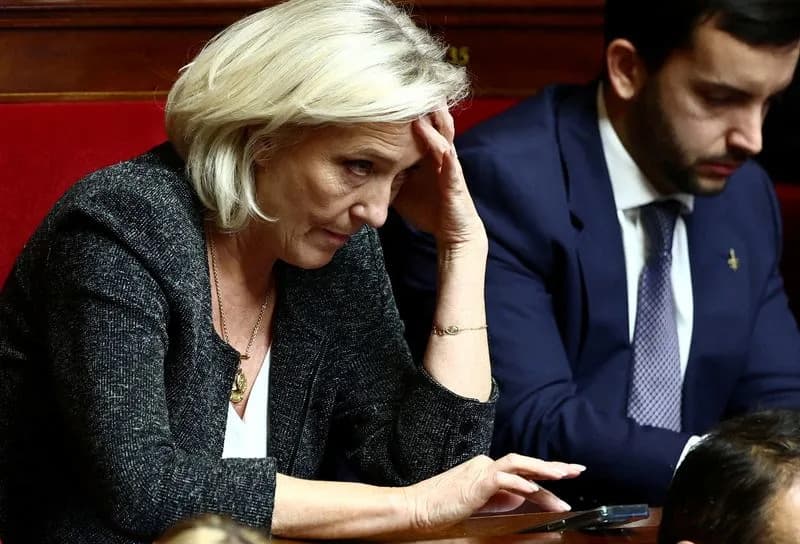
Marine Le Pen told an appeals court she made "a mistake" by allowing some EU-parliament-paid aides to carry out party work, but she denied orchestrating a deliberate scheme to siphon funds. A lower court in March 2025 convicted her of misusing European Parliament funds and imposed a five-year ban from office, two years of house arrest and a two-year suspended sentence. The appeals hearing — spanning five weeks — is expected to issue a ruling before summer and could decide whether she can run in 2027 or be replaced by Jordan Bardella.
Marine Le Pen Admits 'Mistake' Over EU-Funded Aides at Appeal Hearing, Denies Orchestrating €2.9M Fraud

Far-right leader Marine Le Pen, left, walks outside the courtroom during a short break in her appeals trial in Paris, Tuesday, Jan. 20, 2026. (AP Photo/Michel Euler)(ASSOCIATED PRESS)
PARIS — Marine Le Pen told an appeals court in Paris on Wednesday that she made "a mistake" over some European Parliament–paid aides doing work for her party, while strongly denying that she orchestrated a deliberate scheme to divert EU funds.
Le Pen, 57, is appealing a March 2025 conviction that found her guilty of misusing European Parliament funds by listing party staff as parliamentary assistants between 2004 and 2016. The lower court ordered a five-year ban from holding elected office, two years of house arrest with an electronic bracelet and a two-year suspended prison sentence.
The Paris court had concluded she was at the center of "a fraudulent system" that allowed her party to siphon roughly €2.9 million ($3.4 million) in EU funds, describing the scheme as a "democratic bypass" that disadvantaged political rivals. The five-week appeals hearing, which began last week, could reshape France's political landscape depending on a ruling expected before the summer.
Under steady questioning, Le Pen admitted on Wednesday that some people paid as European parliamentary aides "may have worked either marginally, more substantially, or entirely" for the benefit of her party — then known as the National Front. She framed that as an error of judgment rather than a premeditated fraud.

Far-right leader Marine Le Pen, left, walks outside the courtroom during a short break in her appeals trial in Paris, Tuesday, Jan. 20, 2026. (AP Photo/Michel Euler)(ASSOCIATED PRESS)
"I wouldn't say we did everything perfectly. Some criticism can be made about us. But we acted in complete good faith," Le Pen told the three-judge panel.
Pressed about hiring decisions, Le Pen acknowledged "ambiguity" over some aides' assignments and conceded that her personal assistant, though contracted as a parliamentary aide, "may have bought some flight tickets for me as president of the party, I admit it, yes." Presiding Judge Michèle Agi noted that Le Pen, who served as an MEP from 2004 and became party president in 2011, had approved those hirings.
Agi told Le Pen: "You are a lawyer, you know the law — inevitably, a signature, a contract are notions that have a meaning for you." Le Pen countered that at the time the European Parliament did not clearly warn her party that its hiring practices might breach rules and suggested that some cases — such as the contract for her bodyguard — were treated as exceptional.
If the appeals court reinstates her eligibility, Le Pen is expected to be a leading contender in the 2027 presidential race. If the conviction and ban are upheld, she has designated her 30-year-old protégé, Jordan Bardella, as the party's presidential standard-bearer.
What Happens Next
The appeals court will continue hearings through the five-week session and is expected to issue a decision before the summer. The outcome will determine not only Le Pen's political future but also the leadership and strategy of France's far-right movement in the run-up to the 2027 election.
Help us improve.