Summary: The authors argue that President Trump’s newly announced Board of Peace centralizes authority in the chairman and could serve as an instrument to extend U.S.-led influence beyond established multilateral frameworks. The Board’s charter grants the chairman broad powers, including creating or dissolving subsidiary entities and approving board decisions. The initiative’s $1 billion permanent-membership option and reported clashes with leaders such as Emmanuel Macron have intensified concerns that it may undermine the U.N. system.
Opinion: Trump's 'Board of Peace' — A Bid To Centralize Global Power
That President Donald Trump sees himself as a decisive global actor is hardly a secret. Last April he told two interviewers that in his first term he had “two things to do — run the country and survive.” Asked bluntly about a second term, he said: “I run the country and the world.”
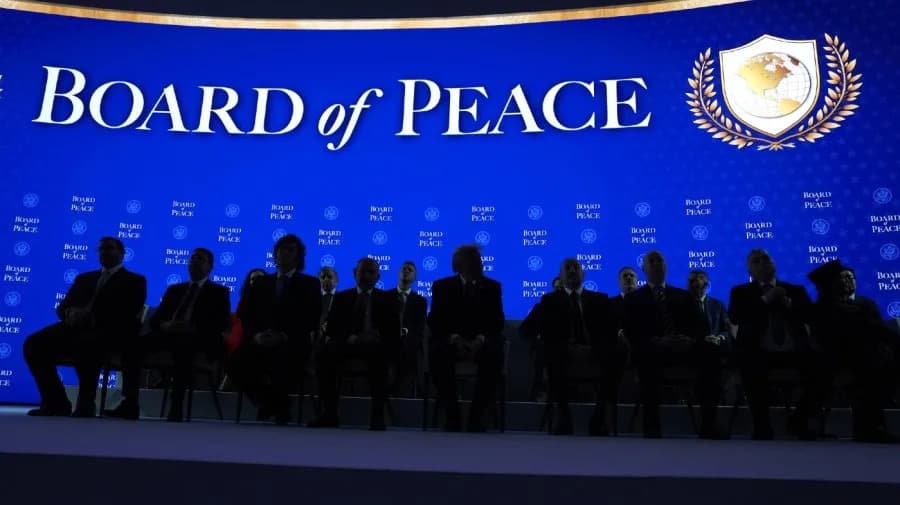
In recent weeks the president drew renewed attention after unveiling the executive committee of his so-called Board of Peace and staging a launch ceremony at the World Economic Forum in Davos, Switzerland.
The Board of Peace was initially presented as a vehicle to marshal international support for a U.S.-led plan to help reconstruct Gaza. The announced executive committee includes billionaires Steve Witkoff and Marc Rowan; Jared Kushner; figures from Trump’s political circle such as Marco Rubio and Robert Gabriel; Ajay Banga, president of the World Bank Group; and former British prime minister Tony Blair.
“My own morality. My own mind. It’s the only thing that can stop me,”
— President Donald Trump, quoted in The New York Times
But critics contend the Board is less a conventional multilateral body than an instrument to centralize authority around Trump himself. The Board’s charter, they say, concentrates decision-making power in the chairman and gives him sweeping latitude to create, modify or dissolve subsidiary entities.
What the Charter Says
The charter’s preamble frames the Board in sweeping terms, arguing that “durable peace requires pragmatic judgment, common-sense solutions, and the courage to depart from approaches and institutions that have too often failed.” It then defines the Board as “an international organization that seeks to promote stability, restore dependable and lawful governance, and secure enduring peace in areas affected or threatened by conflict.”
Among its key provisions, the charter states that the chairman “shall serve as inaugural chairman of the Board of Peace, and he shall separately serve as inaugural representative of the United States of America. … The chairman shall have exclusive authority to create, modify, or dissolve subsidiary entities as necessary or appropriate to fulfill the Board of Peace’s mission.” It also specifies that board decisions “shall be made by a majority of the member states present and voting, subject to the approval of the chairman.”
In practice, that means member votes may be held, but the chairman — in this case, Trump — retains the final approval. Observers warn that structure could enable the board to act outside, or even in opposition to, traditional U.N. frameworks.
Politics, Pay-To-Play Concerns, And International Pushback
The launch has unfolded with the spectacle and unpredictability associated with Trump’s public persona: high-stakes posturing, unscripted drama and pointed rhetoric aimed at foreign leaders. Financial incentives add another dimension: the Board reportedly offers permanent membership to entities that contribute $1 billion, while regular appointments are limited to three years.
France voiced concerns on Jan. 19 that the board could extend powers beyond transitional governance in Gaza and erode the U.N. system. According to reports, President Macron’s objections prompted a sharp response from Trump, who threatened a 200% tariff on French wines. Reuters quoted a diplomatic source calling the initiative a “'Trump United Nations' that ignores the fundamentals of the U.N. Charter.”
Broader Implications
Supporters of the Board argue that new institutions are sometimes needed when existing organizations fail to deliver results. Critics counter that concentrating authority in a single individual — and attaching financial incentives to permanent membership — risks undermining international law, multilateral norms and human-rights commitments that the U.N. was created to uphold.
The debate over the Board of Peace raises enduring questions about power, legitimacy and governance on the global stage: Who gets to decide how post-conflict reconstruction proceeds? Under what rules? And who ensures accountability when decision-making is concentrated?
About the authors: Austin Saratis is the William Nelson Cromwell Professor of Jurisprudence and Political Science at Amherst College. Ruxandra Paul is Assistant Professor of Political Science at Amherst College and an affiliate of the Minda de Gunzburg Center for European Studies at Harvard University.
Copyright 2026 Nexstar Media, Inc. All rights reserved. This material may not be published, broadcast, rewritten, or redistributed.
Help us improve.