Key point: Chief Immigration Judge Teresa Riley told colleagues they are not required to follow a federal ruling that found mandatory detention without bond hearings unlawful for many detainees. The ACLU of Massachusetts filed Riley's email in a Boston court challenge and says the message shows a systematic instruction to ignore certain federal declaratory judgments. Judges Sunshine Sykes and Patti Saris had ruled the policy unlawful; the ACLU has asked for a status conference and may seek further court relief.
Chief U.S. Immigration Judge Told Colleagues Not To Follow Federal Rulings On Bond Hearings, Documents Show
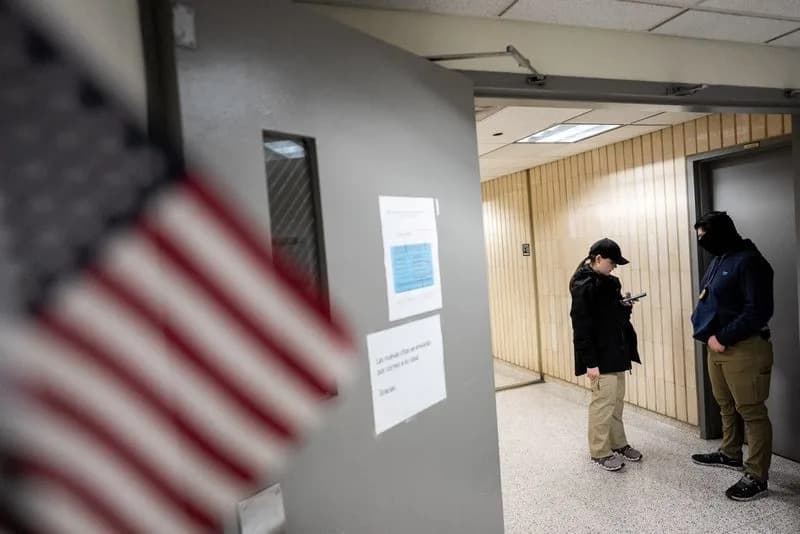
Federal immigration officers wait for respondents in a hallway to conduct targeted detainments at U.S. immigration court in Manhattan, in New York City, U.S., January 14, 2026. REUTERS/David 'Dee' Delgado
BOSTON, Jan 16 (Reuters) - The chief U.S. immigration judge, Teresa Riley, sent an email to colleagues instructing them that they are not bound by a federal court ruling that found the Trump administration may not place thousands of people into mandatory detention without first providing an opportunity to seek release on bond, according to a copy of the message filed by the American Civil Liberties Union (ACLU) of Massachusetts.
The ACLU attached Riley's email to a filing on Friday in a Boston federal court lawsuit that challenges the administration's policy of denying bond hearings to many detained non-citizens. The group said the email demonstrates that "the government has deliberately and systematically instructed every Immigration Judge in the country not to comply with final declaratory judgments."
Two district judges had ruled the policy unlawful. U.S. District Judge Sunshine Sykes in Riverside, California, and U.S. District Judge Patti Saris in Boston each concluded in separate class actions that denying bond hearings to people who were already living in the United States when detained is unlawful. Sykes' December ruling said the Department of Justice's Board of Immigration Appeals decision endorsing the administration's interpretation was "no longer controlling."
U.S. flag and Judge gavel are seen in this illustration taken, August 6, 2024. REUTERS/Dado Ruvic/Illustration
Riley's email told immigration judges that because Sykes did not include an injunction in her decision, the Board of Immigration Appeals' September ruling "remains binding precedent on agency adjudicators." That Board decision adopted a July reinterpretation by the administration expanding who qualifies as an "applicant for admission"—a category subject to mandatory detention while removal proceedings proceed.
The ACLU said that, before Riley's message, immigration courts in Massachusetts had begun to resume bond hearings consistent with Judge Saris' order. After the email circulated, the civil rights group received multiple reports that at least one immigration judge denied detainees' requests for bond hearings.
"We have asked for a status conference to update the court on this troubling development — which significantly impacts the rights of our class members — and anticipate seeking additional relief to protect the class," said Dan McFadden, managing attorney at the ACLU of Massachusetts.
The Justice Department, which oversees the immigration courts and the Board of Immigration Appeals, did not respond to a request for comment. Immigration judges are employees of the Department of Justice and are not part of the federal judiciary.
The dispute revolves around the administration's July reinterpretation of immigration law that broadened the definition of "applicant for admission" to include some people who were already in the United States when detained, a shift from the longstanding view that the category applied primarily to non-citizens intercepted at a port of entry.
Help us improve.