Researchers have sonified the Laschamps geomagnetic reversal—an event about 41,000 years ago—by combining ESA Swarm satellite data with geological records to create an eerie audio representation. Estimates suggest the field weakened dramatically during the event (estimates range from ~5% to ~25% of modern strength), and cosmogenic isotopes like beryllium‑10 roughly doubled. The reversal unfolded over ~250 years and persisted in an unusual orientation for about 440 years; modern monitoring by Swarm helps scientists understand such extreme events and their possible impacts.
Hear the Earth's Magnetic Flip: Sonification Recreates the Haunting Laschamps Reversal
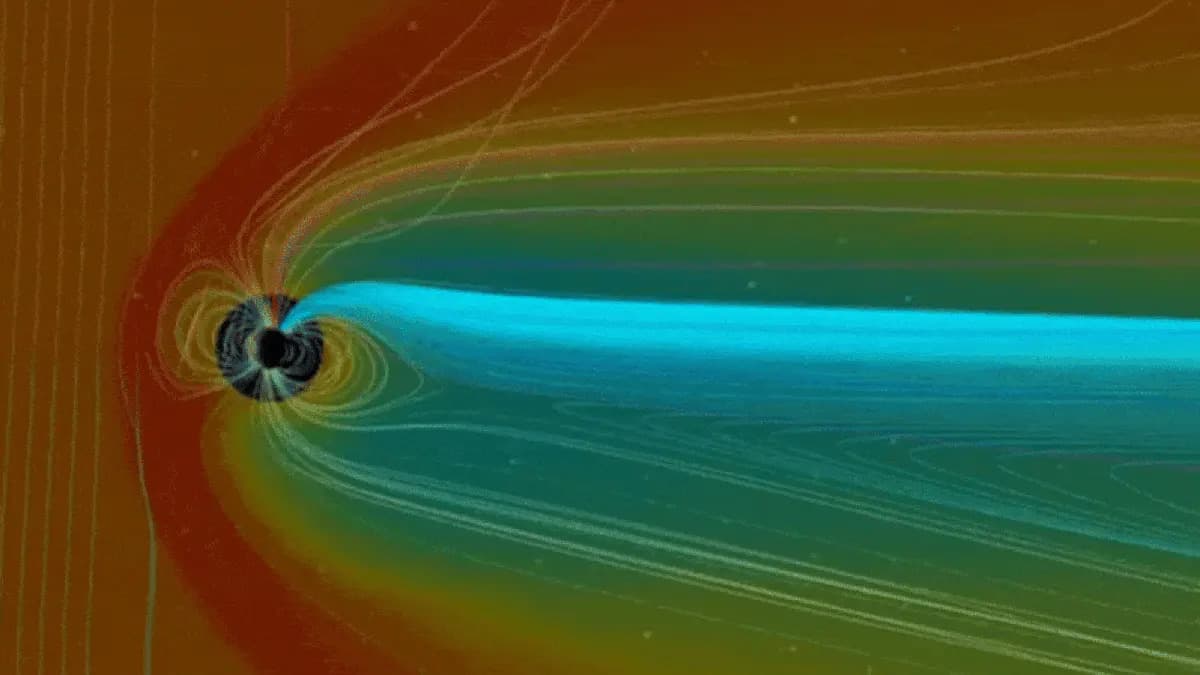
flipping field
About 41,000 years ago Earth experienced a dramatic geomagnetic polarity excursion known as the Laschamps event. In 2024, researchers translated that upheaval into an eerie audio experience by combining satellite measurements with geological records—producing a sonified rendition that sounds like creaking wood and colliding rocks.
How The Sound Was Made
Scientists from the Technical University of Denmark and the German Research Centre for Geosciences used magnetic data from the European Space Agency's Swarm satellite constellation together with records of magnetic field-line movements preserved in lava flows and sediments. They mapped changes in the geomagnetic field to natural noises, creating an unsettling soundscape that conveys how Earth's magnetic environment changed during the reversal.

Strength of the magnetic field at Earth's surface. (ESA)
Why The Magnetic Field Matters
Earth's magnetic field is generated by swirling liquid iron and nickel in the outer core and extends hundreds of thousands of kilometres into space, protecting the planet by deflecting high-energy solar and cosmic particles. Because the field is driven by dynamic flows of molten metal, its configuration and the positions of the magnetic poles continually change. Occasionally the field's polarity reverses so that compasses that once pointed north would instead point south.
What Happened During The Laschamps Event
Geologic evidence from lava flows in France and isotopic records in ice and marine sediments show that during the Laschamps interval the geomagnetic field weakened substantially. Estimates vary: some reconstructions suggest the field fell to as little as about 5% of today's strength at its weakest, while other analyses indicate it may have dropped to roughly 25%—uncertainty remains among researchers. The reversal itself appears to have unfolded over roughly 250 years and remained in an atypical orientation for about 440 years.

Convection currents of liquid metal in the outer core, driven by heat from the inner core, produce circulating electric currents that generate Earth's magnetic field. (Andrew Z. Colvin/CC BY-SA 4.0/Wikimedia Commons)
As the field weakened, more cosmic rays reached the atmosphere. This enhanced bombardment produced higher concentrations of cosmogenic isotopes such as beryllium‑10; measurements show beryllium‑10 levels roughly doubled during the event. Increased atmospheric ionization can affect the ozone layer and has been hypothesized—though not definitively proven—to influence climate, megafaunal extinctions, and human behavior such as cave use.
"Understanding these extreme events is important for their occurrence in the future, space-climate predictions, and assessing the effects on the environment and on the Earth system," said geophysicist Sanja Panovska of the German Research Centre for Geosciences.
Modern Context And Ongoing Monitoring
Since 2013, ESA's Swarm satellites have been continuously measuring magnetic signals produced by Earth's core, mantle, crust, oceans, ionosphere and magnetosphere. These observations help scientists model the geomagnetic field and anticipate its fluctuations. Recent features of the modern field—such as the South Atlantic Anomaly, a region of relative weakening that exposes satellites to higher radiation—have prompted questions about whether a full reversal is imminent. Current research indicates that such anomalies are not necessarily precursors to a complete polarity flip.

Subscribe to ScienceAlert's free fact-checked newsletter
Why Sonification Matters
Turning deep-time magnetic changes into sound makes complex datasets more accessible and emotionally resonant. The Laschamps sonification is not evidence of future catastrophe, but it does highlight how dynamic Earth’s magnetic environment can be and the value of long-term monitoring for space-weather prediction and technological resilience.
An earlier version of this article was published in October 2024.
Help us improve.