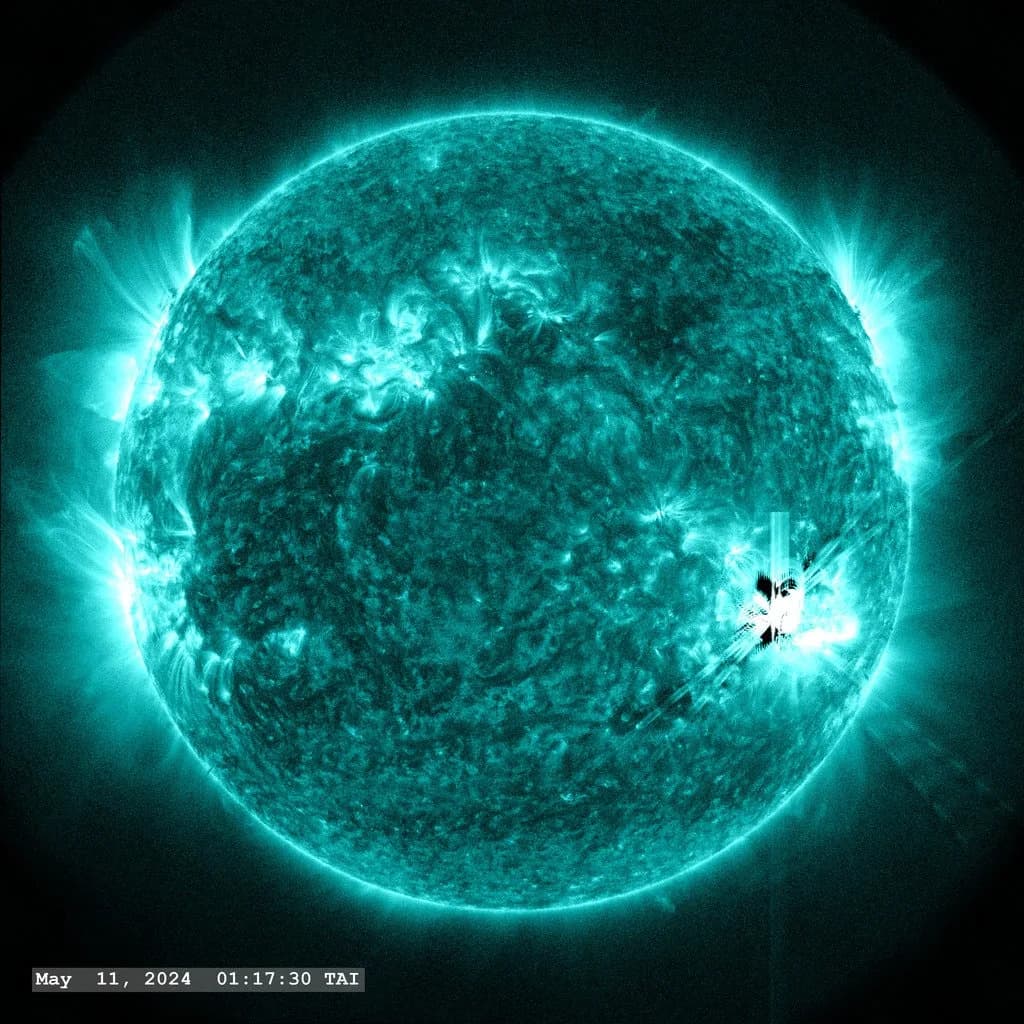
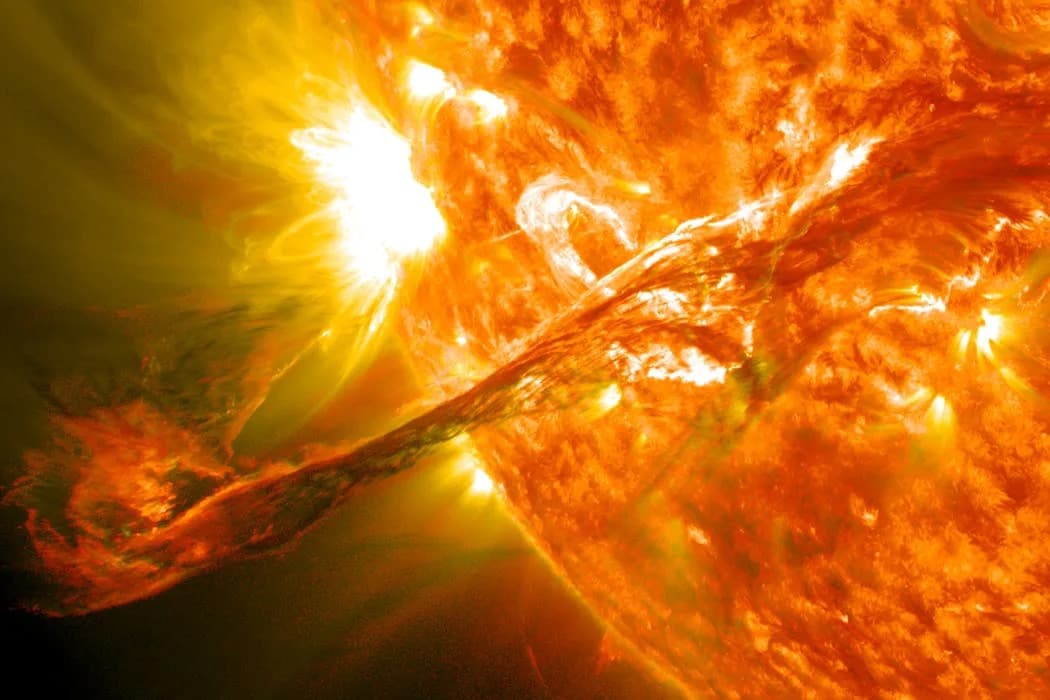
Two spacecraft tracked active region NOAA 13664 for about 90 days, producing the longest continuous image series ever created for a single solar active region. Emerging on 16 April 2024 and rotating out of view on 18 July 2024, NOAA 13664 produced powerful geomagnetic storms in May. The overlapping observations from ESA's Solar Orbiter and NASA's SDO captured the region's magnetic evolution and offer new data to improve space-weather forecasting.
Record Set: Scientists Tracked the Sun's Most Violent Active Region For 90 Days
Astronomers Just Set a Record Watching The Sun's Most Violent Region
Many people remember the May 2024 solar storm that sent auroras into regions that rarely see them. While millions watched the skies, astronomers trained spacecraft on the Sun itself and achieved a new milestone in solar observation.
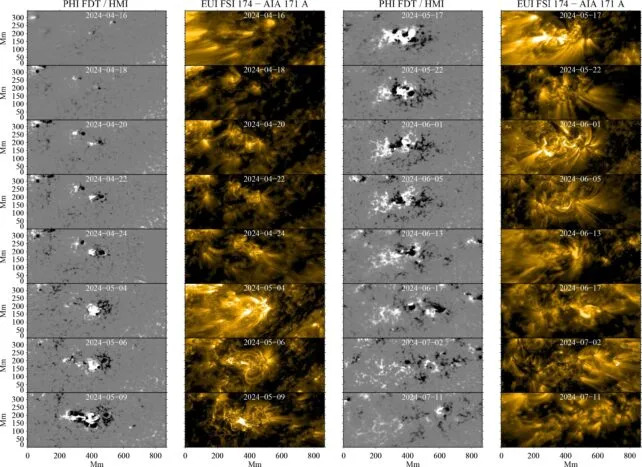
The birth of NOAA 13664 (top left of columns 1 and 2) as captured by the Solar Orbiter. (Kontogiannis et al.,A&A,2025)
Longest Continuous Observation of a Single Active Region
For roughly 90 days, two space observatories positioned on opposite sides of the Sun followed a single active region almost without interruption from its birth to its decay. That region, designated NOAA 13664, first emerged on the Sun's far side on 16 April 2024, rotated into view and produced some of the strongest geomagnetic storms in decades during May, and then rotated out of view on 18 July 2024. Observers lost sight of the region only briefly between 26 and 29 April.

Subscribe to ScienceAlert's free fact-checked newsletter
"This is the longest continuous series of images ever created for a single active region," said Ioannis Kontogiannis, a solar physicist at ETH Zurich. "It's a milestone in solar physics."
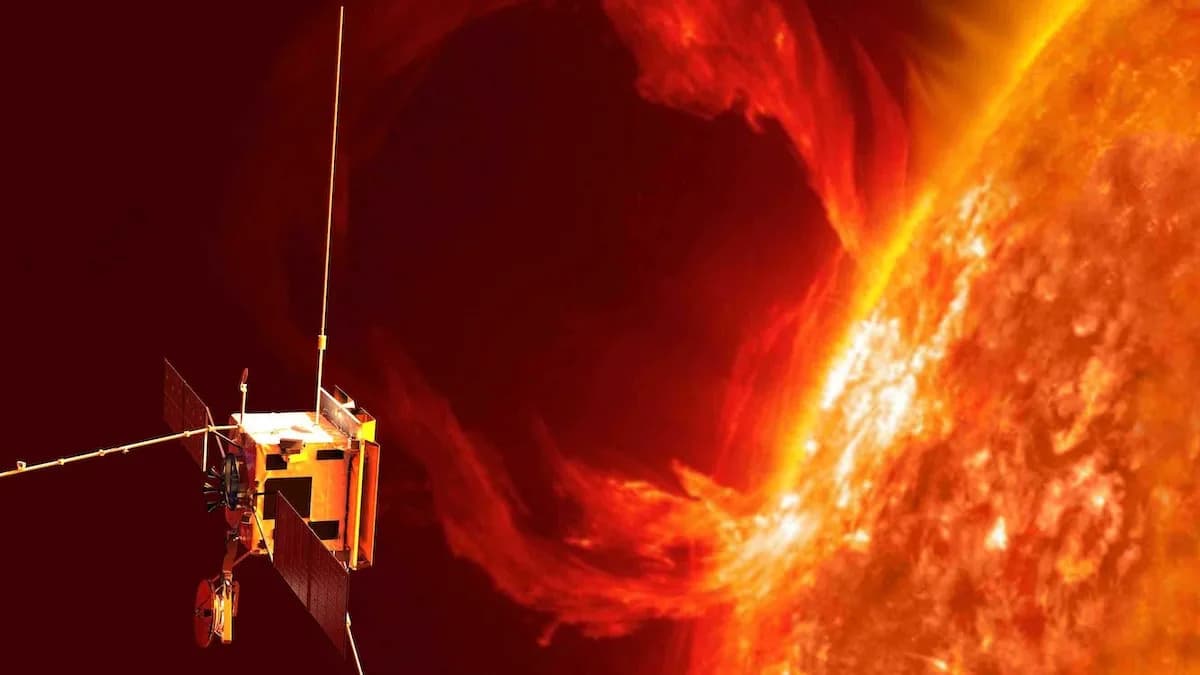
Under normal circumstances, researchers can study an active region from Earth for only about two weeks at a time because the Sun completes one rotation every 28 days. In this case, overlapping vantage points from two spacecraft created an uninterrupted record: ESA's Solar Orbiter (launched 2020) observed the Sun's far side when NOAA 13664 emerged, while NASA's Solar Dynamics Observatory (SDO) maintained continuous monitoring from near-Earth orbit.
Why This Matters
By combining these two perspectives, scientists documented how the active region's magnetic fields evolved from emergence to decay and how changes in those fields drove solar eruptions and particle emissions. Better observations of magnetic evolution improve space-weather models and forecasting, helping to protect satellites, power grids, aviation, and communications from disruptive solar storms.
The results appear in the journal Astronomy & Astrophysics. Researchers say the dataset — the longest continuous image series of a single active region to date — will be valuable for refining predictive models of solar activity and mitigating space-weather risks.
Help us improve.