Study: Floral motifs on Halafian pottery (c. 6200–5500 BC) frequently show petal counts of 4, 8, 16, 32 and 64, forming a doubling sequence.
Findings: Researchers examined 375 decorated fragments from 29 sites and argue the repeating pattern indicates deliberate spatial division and early numerical thinking.
Debate: Some experts say the designs may reflect simple symmetry or halving rather than a structured mathematical system.
Significance: The work suggests mathematical concepts may have been visualized in art long before written records.
8,000-Year-Old Pottery Motifs May Be Earliest Evidence of Mathematical Thought
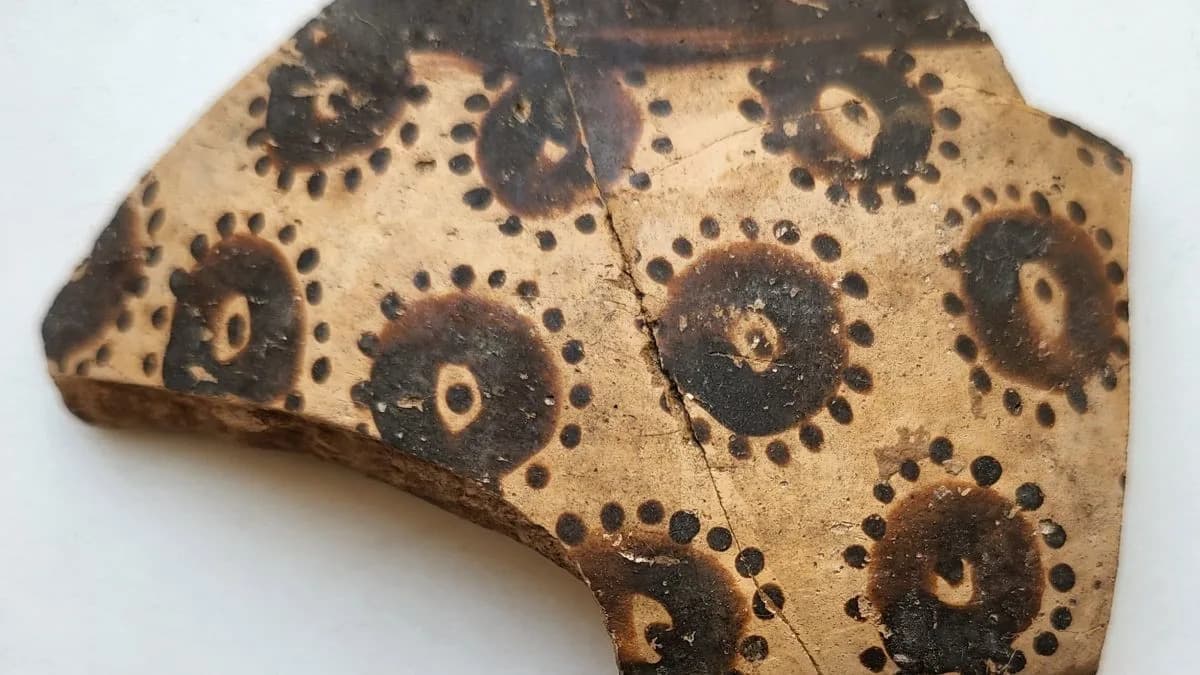
Halafian pottery from an excavation at Arpachiyah, Iraq - Yosef Garfinkel
Painted floral motifs on pottery made by the Halafian communities of northern Mesopotamia—dated to about 6200–5500 BC—may represent one of the earliest material traces of numerical reasoning, a new study suggests. Researchers from the Hebrew University of Jerusalem examined decorated ceramics and found that many blossoms are drawn with petal counts of 4, 8, 16, 32 or 64, forming a clear doubling sequence.
Study and Methods
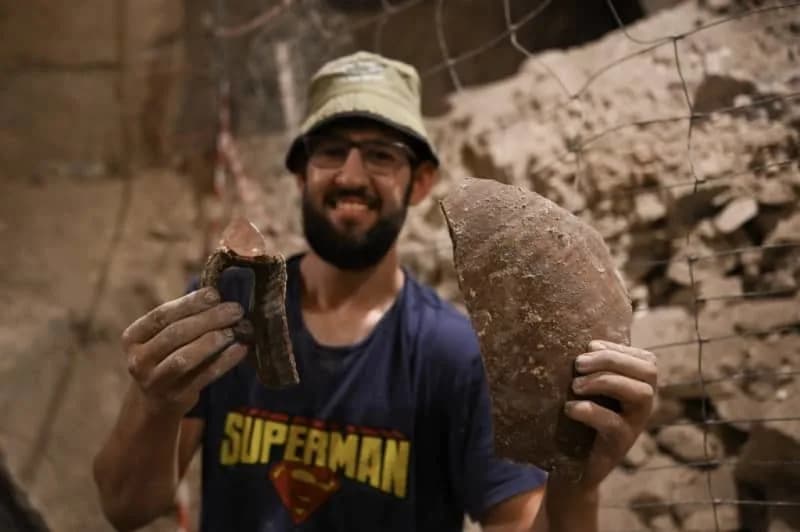
The paper, published in the Journal of World Prehistory, was led by Yosef Garfinkel (Professor of Archaeology) and Sarah Krulwich (research assistant and MA student) at the Hebrew University of Jerusalem. The authors reviewed 375 pottery fragments bearing floral imagery, recovered from 29 Halafian sites excavated in campaigns beginning in 1899 and continuing across more than a century of fieldwork.
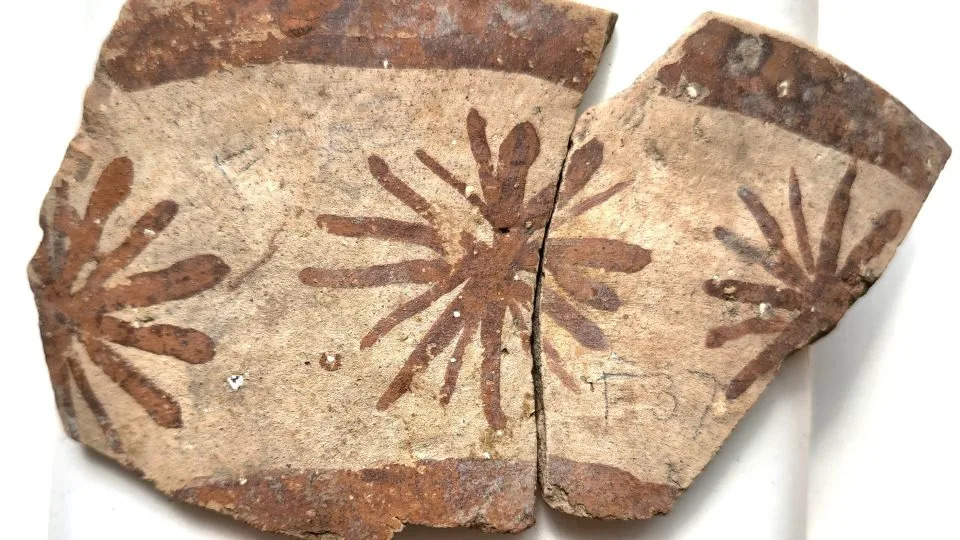
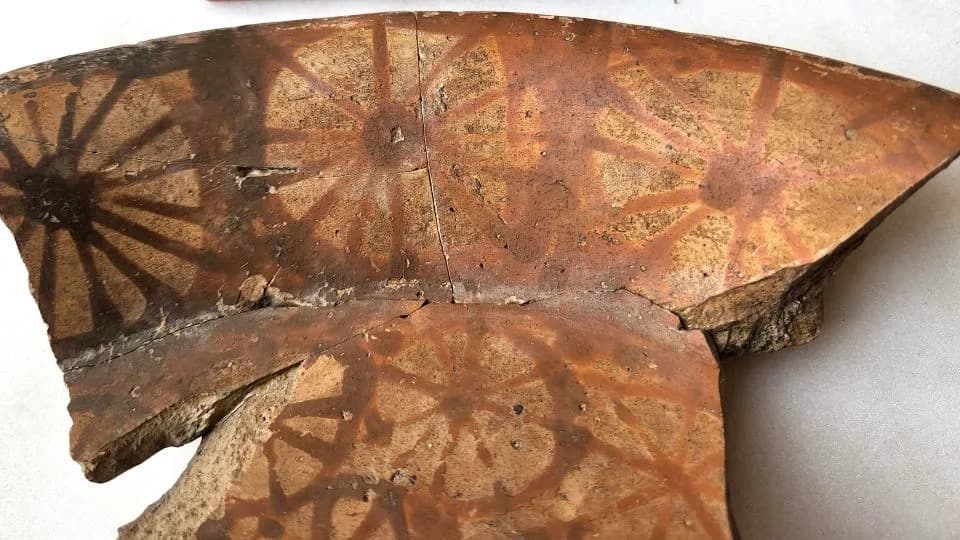
The Halafian people who made this pottery lived in northern Mesapotamia between 6200 BC and 5500 BC. - Yosef Garfinkel
Findings
Across nearly all decorated fragments, the researchers report that petal counts consistently follow a geometric doubling pattern—4, 8, 16, 32 and sometimes 64—used to divide a circle into equal, symmetrical units. The recurrence of these specific numbers across sites separated by hundreds of kilometres led the team to argue that the pattern was intentional rather than accidental.
“The strict adherence to these numbers…cannot be accidental, and indicates that it was done intentionally,” Garfinkel told CNN.
Interpretation and Significance
The authors suggest this visual use of progressive doubling reflects an early form of spatial division and symmetry—skills that could have practical origins in communal life, such as allocating fields, sharing resources, or planning space. They place the Halafian designs in the broader field of ethnomathematics, arguing that mathematical thinking could predate writing by millennia and be expressed through art.
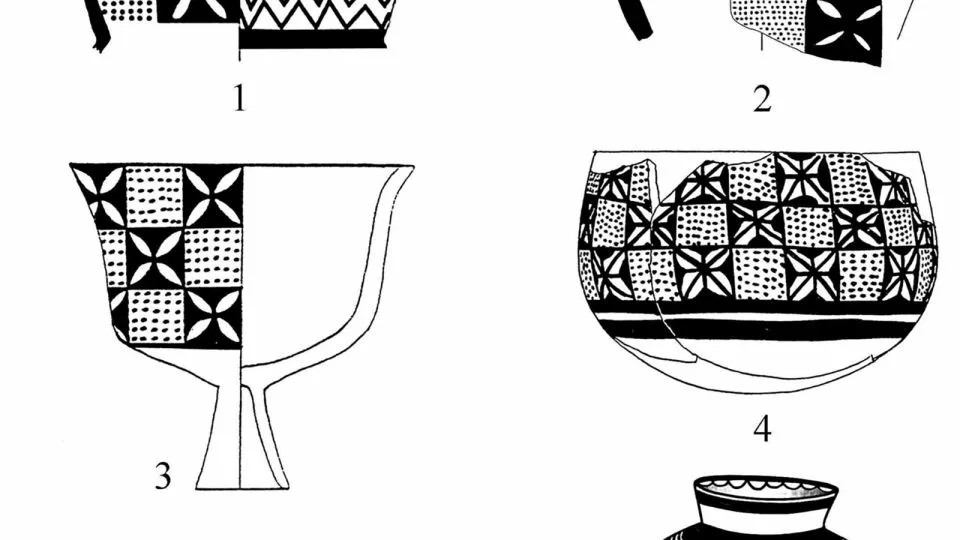
Small flowers with four petals sit inside the black squares of a checkerboard pattern. - Yosef Garfinkel
Scholarly Caution
Not all specialists accept the interpretation that the motifs show a formal mathematical system. Jens Høyrup, an expert in Mesopotamian mathematics who was not involved in the study, argues the designs may simply reflect basic symmetry and halving—first dividing a circle into two, then four—without implying an explicit search for a geometric sequence.
“It doesn’t amount to any search for a geometric ascending sequence; it’s simply halving,” Høyrup told CNN, urging caution about interpreting pictorial symmetry as systematic mathematics.
Conclusion
The Halafian pottery presents compelling evidence that prehistoric artists employed consistent rules of symmetry when depicting nature. Whether those rules constitute an early mathematical system or represent practical visual strategies (or both) remains debated. The study contributes to our understanding of how cognitive and cultural practices—art, community organization, and numeracy—may have intersected in early village societies.
Help us improve.