
Archaeologists studied 1,048 mummified individuals from Sudan and found tattoos on 27 people, with the highest concentration at Kulubnarti (A.D. 650–1000). Many tattooed individuals were children, including a youngest definite case at 18 months, and some toddlers appear to have been re-tattooed. Motifs were clusters of dots and dashes — often four dots in a diamond that may represent a stylized Christian cross — though researchers also consider protective or therapeutic reasons (for example, against fevers or malaria). Infrared microscopy revealed the faded marks, and incision patterns suggest knives, not needles, were used.
Marked at 18 Months: 1,400-Year-Old Nubian Facial Tattoos Suggest Religious Or Protective Practices

An artist's reconstruction of tattooing on the forehead of a 3-year-old girl from Kulubnarti. . | Credit: Mary Nguyen/UMSL
Archaeologists examining mummified remains from Sudan have uncovered striking evidence that children in the Nile Valley were permanently marked with facial tattoos about 1,400 years ago. The discovery — concentrated at the Christian-era cemetery complex of Kulubnarti — raises new questions about how communities in Nubia expressed identity, faith and possibly medicine for their youngest members.
Key Findings
The team, led by Anne Austin of the University of Missouri–St. Louis, analyzed 1,048 mummified individuals from three sites in modern Sudan and identified tattoo evidence in 27 people across ages and sexes. Their results, published Dec. 15 in the journal PNAS, show the most intensive tattooing occurred at Kulubnarti, a site used between A.D. 650 and 1000.
Methods
Researchers combined microscopy with infrared lighting, a technique that reveals pigment patterns beneath preserved skin that are difficult to see with the naked eye. This approach revealed 17 individuals with definite tattoos and an additional six with possible but faded markings.
Patterns And Age
Unlike many ancient tattoo records that primarily concern adults, most of the Kulubnarti individuals with tattoos were children under age 11. The youngest person with definite tattooing was just 18 months old. A 3-year-old girl showed evidence of a second tattoo inked directly over an earlier mark, suggesting toddlers were sometimes re-tattooed.
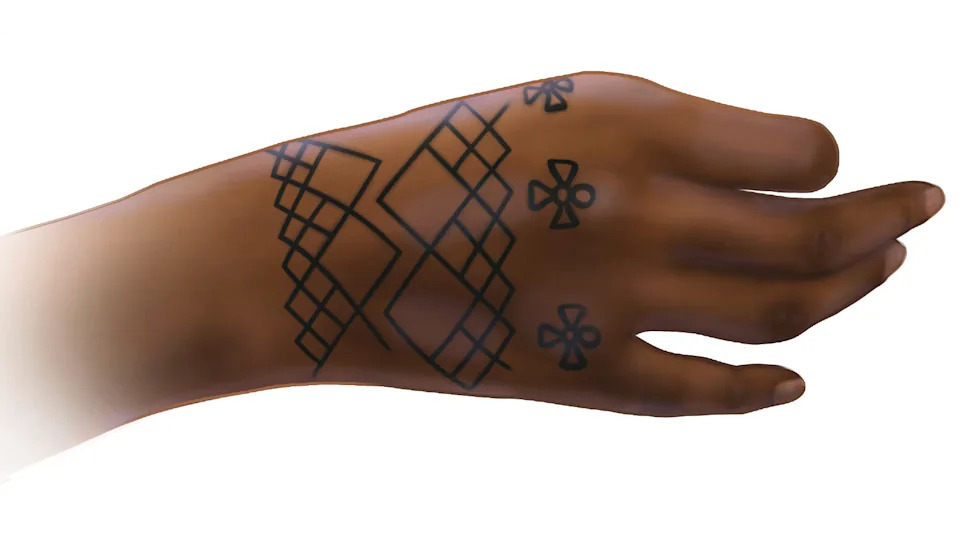
Artist's reconstruction of the geometric tattoos on the right hand of a woman buried at the archaeological site of Semna South. | Credit: Mary Nguyen/UMSL
Designs And Tools
Tattoo motifs were typically clusters of dots and short dashes. The most common pattern was four dots arranged in a diamond on the forehead; researchers propose this could be a stylized Christian cross. Based on the shape and pattern of the incisions, the team concludes the Nubians most likely used knives rather than needles to apply these markings.
Possible Meanings
Two main interpretations are considered. One is that the tattoos functioned as permanent marks of Christian identity — perhaps analogous to a form of baptismal marking — at a time when Christianity was spreading through Nubia. The alternative is that tattoos served protective or therapeutic roles: forehead marks could reflect efforts to ward off headaches or fevers or to treat ailments in communities facing significant health challenges, such as malaria, which has a long history in the Nile Valley.
Context: Tattooing is an ancient and global practice. Well-known earlier examples include Ötzi the Iceman (about 5,300 years old) and a range of Egyptian, Siberian and Peruvian mummies. However, tattooing of very young children is rare in the archaeological record, making the Kulubnarti evidence especially notable.
Interpretation And Respect
Study lead Anne Austin cautions against judging past practices by modern sensibilities. The form of tattooing at Kulubnarti — which could have been done quickly — may not have seemed extreme to contemporaries and can be compared to other culturally accepted rites involving infants and toddlers, such as ear piercing or circumcision.
Further research will be needed to confirm whether the marks were primarily religious, protective, medical, decorative, or some combination of these. For now, the Kulubnarti tattoos add a vivid human detail to our understanding of how Nubian families marked identity and health centuries ago.


