
Researchers used an engineered rabies virus to trace how a single dose of psilocybin changes brain wiring in mice. The study found stronger links between sensory regions and action-related areas alongside reduced cortical connectivity tied to rumination. Findings suggest psilocybin may weaken feedback loops that sustain depressive thinking and point to the possibility of combining psychedelics with targeted neuromodulation. Results require confirmation in humans; study published in Cell.
Psilocybin May Break Depressive Thought Loops by Rewiring Brain Circuits, Mouse Study Suggests

Psilocybin Breaks Depressive Cycles by Rewiring The Brain, Study Suggests
Scientists tracking brain changes in mice with an engineered rabies virus report new evidence that a single dose of psilocybin alters neural circuits in ways that could disrupt repetitive negative thinking associated with depression.
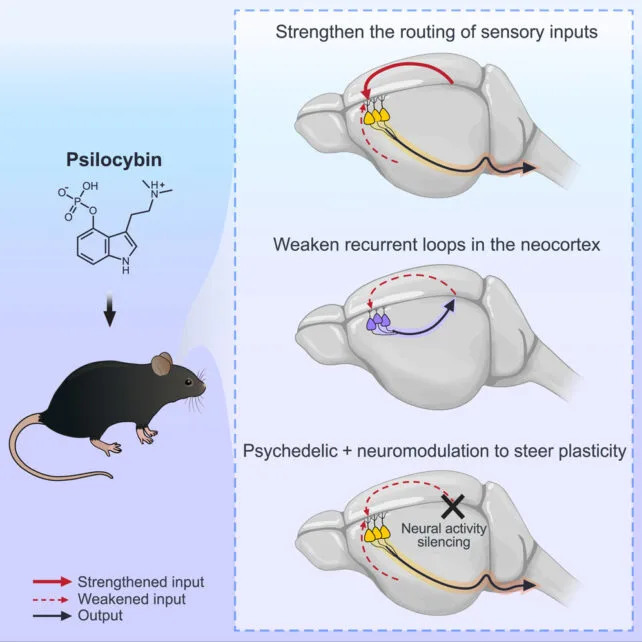
How psilocybin changes the connections between mouse neurons. (Jiang et al.,Cell, 2025)
Study Overview
Researchers at Cornell University and collaborators used a modified rabies virus as a tracer to map how connections between neurons changed after mice received either a single dose of psilocybin or a placebo. The tracer carried fluorescent markers that revealed patterns of connectivity when the animals' brains were examined a week later.

YouTube Thumbnail
Key Findings
Imaging showed strengthened connections between regions involved in sensory processing and brain areas that initiate action. At the same time, connectivity within parts of the cortex—regions implicated in rumination and self-focused negative thought in humans—was reduced. These opposing changes suggest psilocybin may shift the balance of brain networks away from repetitive internal loops and toward externally driven processing and behavior.

Subscribe to ScienceAlert's free fact-checked newsletter
"Rumination is one of the main points for depression, where people have this unhealthy focus, and they keep dwelling on the same negative thoughts," said Cornell biomedical engineer Alex Kwan. "By reducing some of these feedback loops, our findings are consistent with the interpretation that psilocybin may rewire the brain to break, or at least weaken, that cycle."
Mechanism And Potential Applications
The team also found that ongoing patterns of brain activity appear to direct where psilocybin-induced rewiring occurs, raising the possibility of combining psychedelics with targeted neuromodulation methods—such as transcranial magnetic stimulation—to steer plasticity toward specific circuits.
Context And Caveats
Depression is a leading global cause of disability, affecting more than 300 million people worldwide. Many patients do not respond to current treatments or experience intolerable side effects, which has driven interest in alternative approaches such as psilocybin. Previous work from Kwan's lab in 2021 showed long-lasting changes in neural connections after psilocybin, but it was unclear which circuits were affected; this study provides a more detailed map in mice.
Importantly, results in mice do not automatically translate to humans. The researchers caution that further studies are needed to confirm these mechanisms in people and to determine whether combined neuromodulation and psychedelic approaches are safe and effective. The study was led by biomedical engineer Quan Jiang and published in the journal Cell.


