Summary: Federal courts, Congress and communities across the U.S. have repeatedly checked recent actions by the Trump administration that were perceived as partisan overreach. Judges blocked attempts to strip clean-energy funding from Democratic states, rescind grants to the American Academy of Pediatrics, withhold election funding and freeze child-care dollars. Bipartisan congressional moves limited deep science cuts and advanced a war-powers resolution, while thousands of spontaneous protests erupted nationwide after the ICE killing of Renee Nicole Good.
From Courts to Congress to Communities: Americans Say “No” to the Trump Administration
From courts to Congress to communities across the U.S., Americans are telling Trump ‘no’
This is an adapted excerpt from the Jan. 12 episode of The Rachel Maddow Show.
Across the country, federal courts, lawmakers and everyday Americans have repeatedly blocked or protested a series of actions by the Trump administration that critics describe as partisan overreach. Last week’s decisions and demonstrations together illustrate a broad and sustained pushback against attempts to reshape federal programs and to use federal power as a political tool.
Judicial Rebukes
On Monday a federal court blocked the administration’s effort to strip billions of dollars in federally appropriated clean-energy funding from states that backed the Democratic ticket (Harris) in 2024 while preserving funding for states that supported President Trump. The administration itself acknowledged the partisan aim; the judge found the action unlawful.
The same day another court prevented the administration from shutting down a major offshore wind project serving Rhode Island and Connecticut. A separate ruling ordered reinstatement of a grant to the American Academy of Pediatrics after the academy criticized the Department of Health and Human Services—now overseen by Robert F. Kennedy Jr.—and the administration rescinded the funding; the judge ruled that cancellation constituted unlawful retaliation.
On Friday, a federal judge in Washington barred the president from withholding federal election funds as punishment for states that declined to change their election rules. The court noted that "The Constitution assigns no authority to the president over federal election administration."
Another court blocked an attempt to freeze billions in federal child-care and social-service dollars—again, funds that appeared to be targeted at Democratic-run states. Taken together, these rulings show a pattern: courts repeatedly telling the executive branch it has exceeded its legal authority.
Congressional and Political Pushback
Resistance has also come from Capitol Hill. In a 48-hour span last week, the Senate advanced a war-powers resolution designed to prevent the president from undertaking further military action in Venezuela, with five Republican senators joining Democrats to move the measure forward. The resolution will see another vote this week.
In the House, 17 Republicans crossed party lines to join Democrats in protecting parts of the Affordable Care Act—an effort to roll back provisions of the so-called "One Big Beautiful Bill" that had sharply increased insurance premiums for many Americans. President Trump has signaled he might veto any measure that undercuts those premium increases.
Congress also rejected steep proposed cuts to federal science programs. The White House requested an aggressive 56% reduction at the National Science Foundation; lawmakers limited cuts to under 1%. Proposals to slash NOAA funding were rejected entirely. Instead of gutting basic research—long a driver of American innovation—Congress moved to sustain and even modestly boost research budgets in some areas. These actions were bipartisan, originating in a Senate agreement and carried through the House.
Legal Challenges and Local Response
Legal pushback has extended beyond policy disputes. Arizona Sen. Mark Kelly filed suit against the administration and Pete Hegseth after efforts to reduce his rank and dock retirement pay—steps taken, he and supporters say, in retaliation for his public statements about disobeying illegal orders. States and cities, including Illinois with Chicago and Minnesota with Minneapolis, have filed major suits to block federal agents from actions they say target local residents.
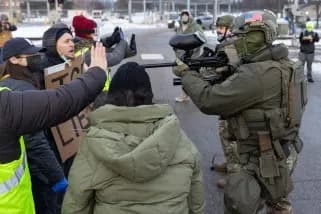
If the administration hoped aggressive federal tactics would deter public dissent, it misjudged the response. Protests erupted nationwide after Immigration and Customs Enforcement officers shot and killed Renee Nicole Good. Demonstrations took place in Minneapolis (where Good was killed) and in Colorado Springs (her hometown), and spread to New York City, Boston, San Antonio, Carson City, Huntington Beach, Fairbanks and many other communities. Many of these actions were spontaneous—organizers reported more than a thousand protests across all 50 states, including demonstrations in subzero temperatures in Alaska.
What It Means
Between the judiciary’s rebukes, bipartisan action in Congress and grassroots protests across the country, a clear pattern has emerged: multiple institutions and wide swaths of the public are actively checking the administration’s attempts to wield federal power in overtly partisan ways. Courts are frequently ruling against the administration’s actions, lawmakers are forging cross-party coalitions to block extreme budget and policy moves, and citizens are mobilizing in unprecedented numbers to say no.
Allison Detzel contributed.
The post "From courts to Congress to communities across the U.S., Americans are telling Trump ‘no’" appeared first on MS NOW. This article was originally published on ms.now.
Help us improve.