Israel will compete in the first Eurovision semi-final on May 12 in Vienna despite a boycott by five public broadcasters. The 70th Eurovision will feature just 35 entrants — the fewest since 2004 — and is marked by its largest political rift to date. Allegations of televote manipulation and concerns about media freedom prompted EBU reforms, including the return of professional juries in semi-finals and strengthened fraud detection. Austria hosts after JJ’s win in Basel; the final is set for May 16.
Israel Drawn Into First Eurovision Semi-Final on May 12 as Five Broadcasters Boycott
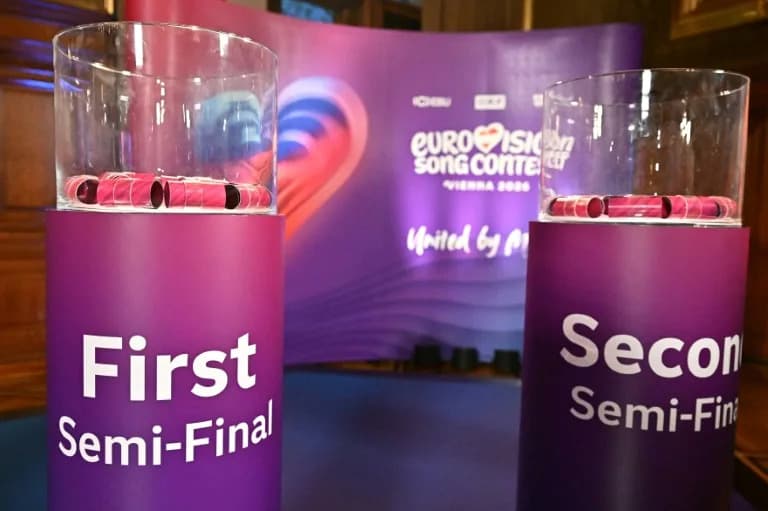
Israel will compete against 14 other countries in the first semi-final (Joe Klamar)(Joe Klamar/AFP/AFP)
Israel has been drawn into the first semi-final of the Eurovision Song Contest, scheduled for May 12 in Vienna, organisers confirmed following Monday's official draw. The 70th edition of the contest will open amid an unprecedented political boycott: five public broadcasters are staying away and only 35 countries will compete — the fewest since the field was expanded in 2004.
Semi-Final Lineups and Key Dates
The draw at Vienna’s City Hall placed Israel in a 15-country first semi-final, where it will compete against 14 other acts — including past winners Estonia, Finland, Greece, Portugal, Serbia and Sweden — for a place in the final on May 16.
The second semi-final takes place on May 14 and also features 15 countries, among them former champions Azerbaijan, Denmark, Latvia, Norway, Ukraine and Switzerland. From each semi-final, the 10 entries that earn the most points from a combined professional jury and public televote will advance to the final.
Who’s Automatically In
Host nation Austria and the contest’s biggest financial contributors — France, Germany, Italy and the United Kingdom — automatically qualify for the final.
Boycott and Reasons Cited
Public broadcasters in Iceland, Ireland, the Netherlands, Slovenia and Spain have announced they will boycott the 2026 contest. Broadcasters cited concerns about Israel’s conduct in its two-year war in Gaza, issues relating to media freedom and restrictions on journalists’ access to the territory, and reports of journalists being harmed while reporting in Gaza.
Additionally, there were allegations that the televoting system had been susceptible to manipulation after Israel topped the public vote at Eurovision 2025 in Basel, where unusually frequent maximum-point scores were recorded from multiple countries.
EBU Reforms and Responses
In response to these concerns, European Broadcasting Union (EBU) members have adopted measures to strengthen the voting system, improve fraud detection and limit government-backed promotional campaigns. Professional juries — abolished in 2022 — will return for the semi-finals with expanded, more diverse panels that include younger jurors aged 18 to 25.
Hosting Details
Austria is hosting the contest in Vienna after Austrian artist JJ won the previous year’s contest in Basel, Switzerland. National broadcaster ORF will present the 2026 edition.
What to Watch: Semi-finals on May 12 and May 14; final on May 16. The contest’s reduced line-up and new voting safeguards will be in focus as the EBU seeks to preserve the event’s musical competition while addressing political and technical concerns.
Help us improve.