
Israel announced it will suspend several international aid groups in Gaza for failing to meet new registration requirements that include staff lists. Ten foreign ministers warned the enclave’s humanitarian situation is worsening amid heavy rain and winter cold. Aid organizations and the UN say the move risks lives by reducing access to medical care, water and shelter; Israel says the rules aim to prevent aid diversion to Hamas. Calls continue for urgent steps to keep NGOs operating and to increase humanitarian flows.
Israel to Suspend Several International Aid Groups in Gaza as Officials Warn of ‘Catastrophic’ Humanitarian Deterioration

Palestinians live in makeshift tents amid harsh conditions in Nuseirat, Gaza on December 28, 2025. - Hassan Jedi/Anadolu/Getty Images
Israel has announced it will suspend the operations of several international humanitarian organizations in Gaza after they failed to comply with newly imposed registration requirements, officials said Tuesday. The rules require NGOs working in the enclave to renew registration and provide personal details for staff members — a condition many groups say endangers employees and undermines humanitarian principles.
International Alarm Over Winter Emergency
Foreign ministers from 10 countries — Canada, the United Kingdom, Denmark, Finland, France, Iceland, Japan, Norway, Sweden and Switzerland — issued a joint warning that Gaza’s humanitarian situation is again deteriorating and remains "catastrophic." The ministers said heavy rain and plunging temperatures are compounding already dire conditions for displaced civilians.
According to the Hamas-run Government Media Office (GMO), fierce storms destroyed waterlogged makeshift tents and at least 20 people were killed when homes and buildings collapsed as people sought shelter. Aid groups report that widespread damage to fragile shelters and infrastructure is increasing exposure to illness and death.
Humanitarian Groups Decry Rules That Threaten Staff Safety
Relief organizations warned that suspending more than two dozen aid groups will cost lives by reducing access to medical care, clean water and shelter. "Removing these humanitarian organizations now will deepen exposure, illness, and preventable deaths," said Refugees International.
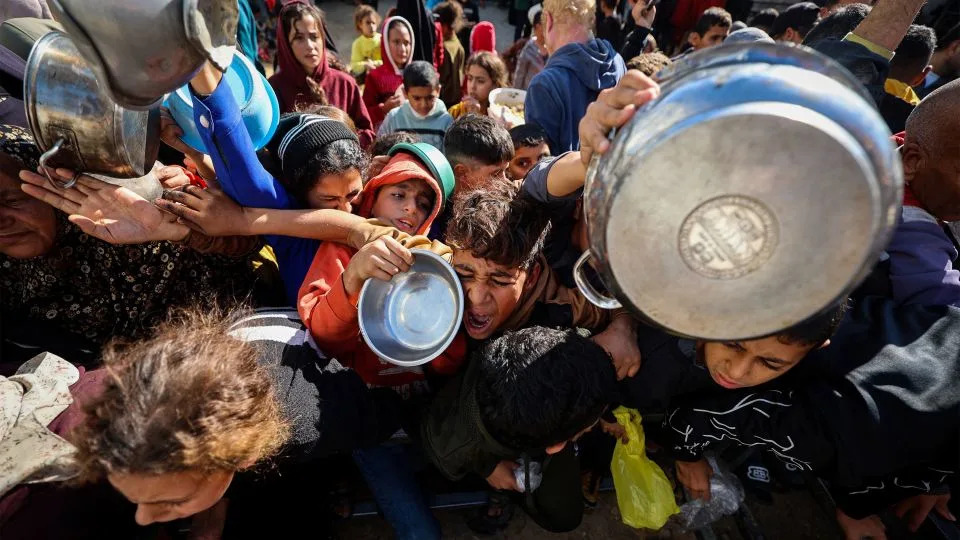
Displaced Palestinians gather to receive food portions at a charity kitchen in the Nuseirat refugee camp in the central Gaza Strip on December 20, 2025. - Eyad Baba/AFP/Getty Images
The UN human rights chief, Volker Türk, called Israel’s suspension "outrageous," describing it as part of a pattern of "unlawful restrictions on humanitarian access." The European Union’s humanitarian chief Hadja Lahbib warned that the NGO registration law, in its current form, risks blocking life-saving aid.
Protection and Legal Concerns
Many agencies — including Doctors Without Borders (MSF) and Oxfam — oppose the requirement to submit lists of staff and family details, arguing it poses serious protection risks in a context where aid and health workers have faced harassment, detention and attacks. The Humanitarian Country Team for the Occupied Palestinian Territory said the system uses "vague, arbitrary and highly politicized criteria" that could force organizations to breach international legal obligations or humanitarian principles.
“In a context where humanitarian and healthcare workers are routinely subject to harassment, detention, and direct attacks, this raises serious protection concerns.” — Oxfam
Israel’s Rationale and Disputed Claims
Israeli authorities say the registration requirements are meant to prevent Hamas or other terrorist elements from exploiting international aid. An Israeli foreign ministry statement described the rule as designed to "safeguard the integrity of humanitarian activity." The Coordination of Government Activities in the Territories (COGAT) said organizations that did not renew their registration were notified in March that authorizations would end on January 1, with a withdrawal requirement two months later.
COGAT also asserted that some targeted groups had not been delivering aid during the current ceasefire and that the decision would not reduce the overall volume of aid entering Gaza. It said around 4,200 trucks per week would continue to enter via the UN, donor states, the private sector and more than 20 registered international organizations.

US President Donald Trump shakes hands with Israeli Prime Minister Benjamin Netanyahu during a press conference at his Mar-a-Lago club in Palm Beach, Florida on December 29, 2025. - Joe Raedle/Getty Images
MSF disputed COGAT’s account, telling CNN it had been "fully engaged since July 2025 and submitted most of the required information," and that it continues to seek dialogue with Israeli authorities to deliver critical health services. An Australian government review earlier this year also found no evidence of widespread diversion of aid by Hamas, contradicting some claims about systemic theft.
Scale of Need and Calls for Action
Foreign ministers urged Israel to take "urgent and essential steps," including guaranteeing that international NGOs can continue operating in Gaza and allowing the UN and partners to carry out humanitarian work. The joint statement noted at least 1.3 million people still need urgent shelter, more than half of Gaza’s health facilities are only partially functioning due to critical shortages, and roughly 740,000 people are vulnerable to toxic flooding after sanitation collapse.
The decision and international criticism come as Israeli Prime Minister Benjamin Netanyahu continued a visit to the United States and met President Donald Trump. Netanyahu has said a new government in Gaza would depend on the disarmament of Hamas; Hamas has rejected calls to give up weapons while it says the occupation persists.
More than 40 organizations, including MSF and Oxfam, have previously accused Israeli authorities of "arbitrarily rejecting shipments of life-saving assistance" since the ceasefire, citing denied entries of urgent consignments of water, food, tents and medical supplies.
The suspension decision, the intense winter weather and the already devastated infrastructure together risk a rapid worsening of humanitarian conditions unless barriers to aid are removed and safe access for agencies is restored.


