
The nearly complete South African skeleton known as Little Foot (StW 573), excavated from Sterkfontein in 1998, has been reexamined and may not belong to Australopithecus prometheus or A. africanus. A new study in the American Journal of Biological Anthropology finds StW 573 lacks the distinctive trait suite shared with the A. prometheus type specimen (MLD 1) and suggests it could represent a previously unidentified hominin. Authors Jesse Martin and Andy Herries call for further analyses to confirm its placement and decide whether it should be named as a new species.
‘Little Foot’ May Be a Previously Unknown Human Ancestor, New Study Finds

Iconic ‘Little Foot’ may actually be new human species, scientists say
One of the most complete hominin skeletons ever recovered — nicknamed Little Foot (StW 573) — may not belong to any previously assigned species and could represent a previously unidentified human relative, researchers report.
The specimen was excavated in 1998 from the Sterkfontein Caves in South Africa and has long been placed within the genus Australopithecus, a group of ape-like, bipedal hominins that lived roughly between 3 million and 1.95 million years ago. When the skeleton was publicly unveiled in 2017 it was attributed to Australopithecus prometheus, though some specialists argued it fits better with A. africanus.
New Analysis Questions Earlier Assignments
A new morphological study, published in the American Journal of Biological Anthropology, finds that StW 573 does not share the distinctive combination of primitive and derived traits that characterize the A. prometheus type specimen (MLD 1), nor does it align cleanly with A. africanus. Lead author Jesse Martin (La Trobe University) said the results make it "more likely a previously unidentified human relative."
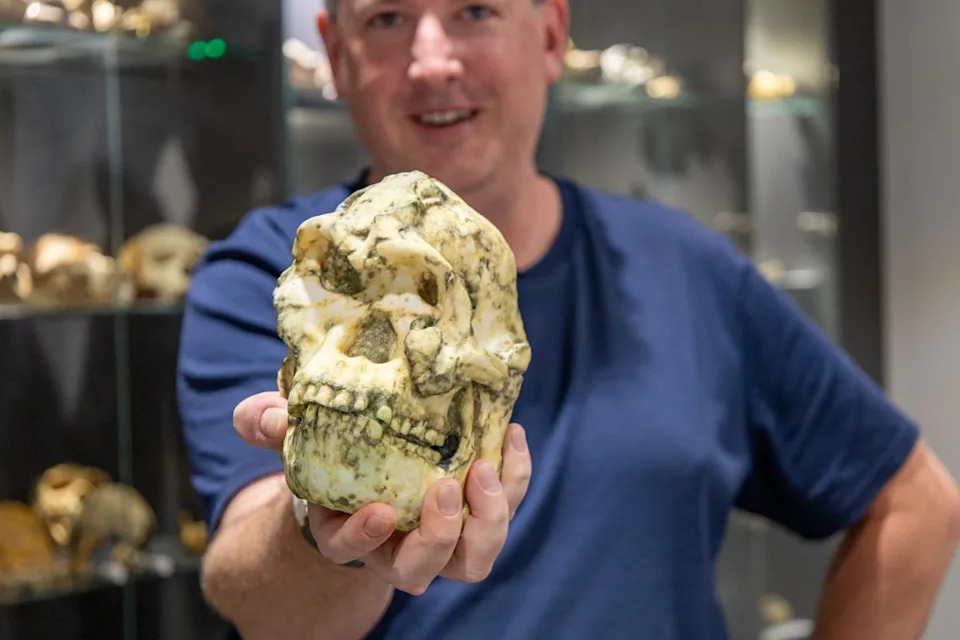
Jesse Martin holding a 3D print of the Little Foot skull (La Trobe University)
'This fossil remains one of the most important discoveries in the hominin record, and its true identity is key to understanding our evolutionary past,' said Dr. Jesse Martin.
The authors write that the morphology preserved in StW 573 does not support assigning the specimen to A. prometheus because it "does not share a unique suite of primitive and derived traits in common with the A. prometheus type specimen MLD 1." Their assessment challenges the current classification and highlights the need for careful, evidence-based taxonomy in human evolution.
What Comes Next?
Future research will test these conclusions with additional comparative analyses, new imaging and measurements, and possibly revised phylogenetic models to determine where StW 573 sits on the human family tree — and whether it should be formally described as a new species.
'It is clearly different from the type specimen of Australopithecus prometheus, which was a name previously linked to now-discounted ideas about early fire use,' said co-author Andy Herries. 'Its importance and differences to other contemporary fossils support defining it as its own unique species.'
Whatever the final taxonomic decision, StW 573 remains a cornerstone discovery for understanding early hominin diversity, locomotion and morphology.


