
New fossil evidence from Ethiopia’s Afar Rift identifies Australopithecus deyiremeda, a hominin that lived alongside Lucy about 3.4 million years ago. Jaw, tooth and the so‑called Burtele foot indicate A. deyiremeda retained climbing adaptations while A. afarensis was more specialized for bipedal walking. Chemical and microwear tooth analyses show dietary differences, supporting a branching model of early human evolution with multiple contemporaneous species.
New Hominin Species Discovered in Ethiopia Challenges Lucy’s Uniqueness

A REPLICA of the remains of a more than 3-million-year-old female hominid known as "Lucy" at the National Museum in Addis Ababa August 7, 2007. (photo credit: REUTERS/Barry Malone)
Researchers working in Ethiopia’s Afar Rift have identified fossil evidence for a previously undescribed hominin, Australopithecus deyiremeda, that lived alongside the famous specimen known as Lucy roughly 3.4 million years ago. The finds—new jaw and tooth material linked to a partial foot nicknamed the “Burtele foot”—reveal anatomical and dietary differences that complicate the long‑standing view of a single dominant early human species in the region.
What Was Found
The study connects recently discovered mandibular and dental remains to the Burtele foot, first recovered more than a decade ago. Taken together, these elements support recognition of A. deyiremeda as distinct from Australopithecus afarensis, the species represented by Lucy.
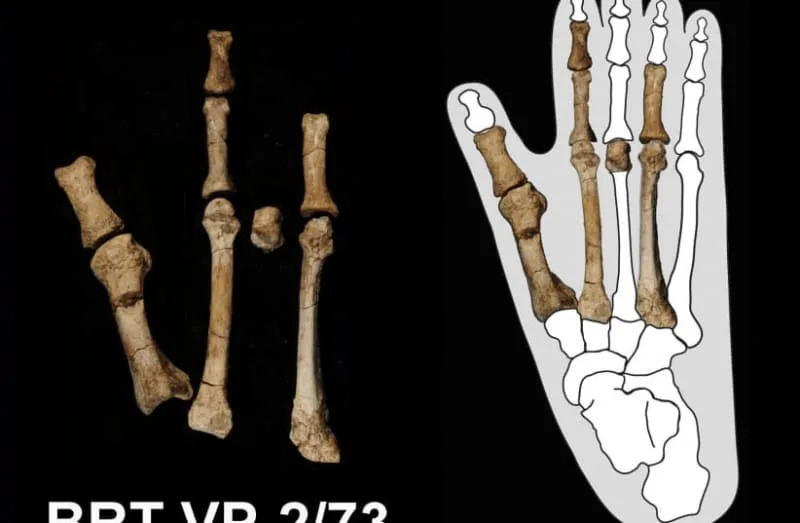
AN UNDATED illustration shows the 3.4 million-year-old bones of the ''Burtele foot'', which belonged to the ancient human relative Australopithecus deyiremeda and were discovered in the Afar Rift region of Ethiopia, in their anatomical position and with the foot bones embedded in an outline of a goril (credit: Yohannes Haile-Selassie/Handout via REUTERS)
Locomotion: Two Different Ways of Moving
Comparative anatomy indicates important locomotor differences. A. afarensis (Lucy’s species) shows skeletal traits consistent with habitual bipedal walking. By contrast, the Burtele foot associated with A. deyiremeda preserves features that suggest the species retained adaptations for climbing—implying a continued reliance on trees for at least part of its locomotor repertoire.
Dietary Evidence
Tooth chemistry and microwear analyses further separate the species. Isotope ratios and surface wear patterns indicate A. deyiremeda consumed more fruits and leaves, while A. afarensis had a broader diet that included a wider mix of plant foods and possibly harder items. These dietary differences imply niche partitioning that could have allowed multiple hominin species to coexist in the same landscape.
Evolutionary Implications
Researchers propose that A. deyiremeda may be closely related to the older Australopithecus anamensis. If confirmed, this relationship supports a branching, mosaic model of early hominin evolution—sometimes described as a bush—rather than a single, linear progression toward genus Homo. Around 3.4–3.5 million years ago eastern Africa may have hosted several contemporaneous hominins, each exploiting different ecological niches.
Bottom line: The discovery of A. deyiremeda highlights a more complex and crowded early human landscape than previously imagined, and it underscores how new fossils can reshape our understanding of human origins.


