
Belarusian President Alexander Lukashenko said Russia has deployed the nuclear-capable Oreshnik missile system to Belarus and that it is entering combat duty, though he gave no deployment details. Russia claims the missile is hard to intercept and can deliver multiple high-speed warheads, raising European security concerns. The move comes amid tense peace talks over Ukraine and a revised Russian nuclear doctrine that extends a nuclear umbrella over Belarus.
Belarus Says Russia Has Deployed New Nuclear-Capable Oreshnik Missile System

In this photo provided by Belarusian Presidential Press Service, Belarusian President Alexander Lukashenko addresses the meeting of the All-Belarusian People's Assembly in Minsk, Belarus, Thursday, Dec. 18, 2025.(Belarusian Presidential Press Service via AP)(ASSOCIATED PRESS)
Belarusian President Alexander Lukashenko announced Thursday that Russia has moved its latest nuclear-capable Oreshnik missile system into Belarus, saying the weapons arrived Wednesday and are now entering combat duty. He provided no details on numbers, locations or launch timelines.
What Officials Have Said
Russian President Vladimir Putin told military leaders that the Oreshnik would enter combat duty this month but gave no further specifics. At the same meeting he warned that Moscow would seek to expand its gains in Ukraine if Kyiv and Western mediators reject Kremlin demands in ongoing peace talks.
Capabilities And Verification
Russia first used a conventionally armed variant of the Oreshnik — whose name means "hazelnut tree" — in a strike on a Ukrainian factory in November 2024. Russian officials claim the missile’s multiple warheads descend at speeds up to Mach 10 and are very difficult to intercept; state media said the missile could reach targets in Poland or Brussels within minutes. Independent verification of those performance claims is limited, and there is no practical way to determine whether a given warhead is conventional or nuclear prior to impact.
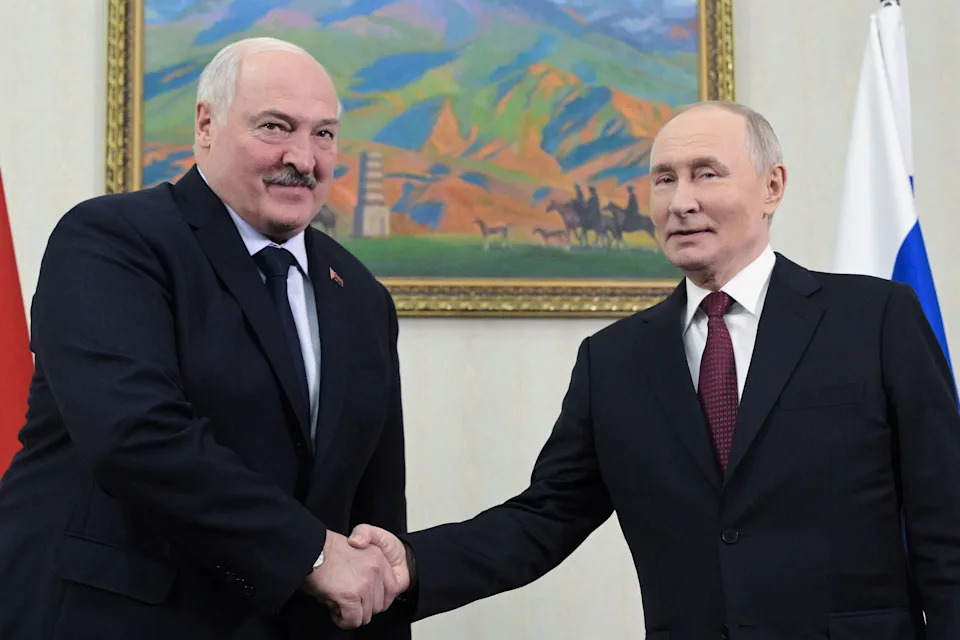
FILE - Belarusian President Alexander Lukashenko, left, and Russian President Vladimir Putin pose for a photo prior to the talks in Bishkek, Kyrgyzstan, on Wednesday, Nov. 26, 2025. (Alexei Nikolsky, Sputnik, Kremlin Pool Photo via AP, File)(ASSOCIATED PRESS)
Range And Arms-Control Context
Intermediate-range missiles generally have ranges between about 500 and 5,500 kilometers (310 to 3,400 miles). Such systems were banned under the Intermediate-Range Nuclear Forces (INF) treaty, which the United States and Russia abandoned in 2019.
Command, Control And Regional Implications
Putin and Lukashenko have said Russia will retain control of the Oreshnik systems while allowing Belarus a role in target selection; during a December 2024 security pact signing Putin suggested missiles used against nearer targets could carry heavier payloads. The Kremlin’s 2024 revised nuclear doctrine also states that a conventional attack on Russia supported by a nuclear power could be treated as a joint attack — language that lowers the apparent threshold for nuclear response and extends a Russian nuclear umbrella over Belarus.
Political Context In Minsk
Lukashenko, who has ruled Belarus for more than 30 years, has faced repeated Western sanctions for rights abuses and for permitting Russian use of Belarusian territory in the 2022 invasion of Ukraine. At the same time he has sought limited rapprochement with the U.S.: last weekend he released 123 political prisoners, including Nobel laureate Ales Bialiatski, as part of a deal that led Washington to lift sanctions on Belarus's potash industry.
Note: Putin and Lukashenko previously said the Oreshnik missile system would be deployed to Belarus, not Ukraine, by the end of the year; this corrects earlier reporting that misstated the planned destination.


