The NTSB’s preliminary report says Boeing warned MD-11 operators in 2011 about failures of a "spherical bearing race" used to mount engines but did not call for immediate fixes. Investigators found prior occurrences of that part failing on three aircraft and discovered cracks at the engine mount of the MD-11F that crashed in Louisville on 4 November 2025, killing 15 people. UPS and FedEx briefly grounded MD-11 freighters, and the crash has prompted lawsuits and renewed scrutiny of maintenance and inspection practices.
NTSB: Boeing Warned Of Engine-Mount Defect Linked To Fatal Louisville UPS Crash — 2011 Letter Didn’t Require Immediate Fixes
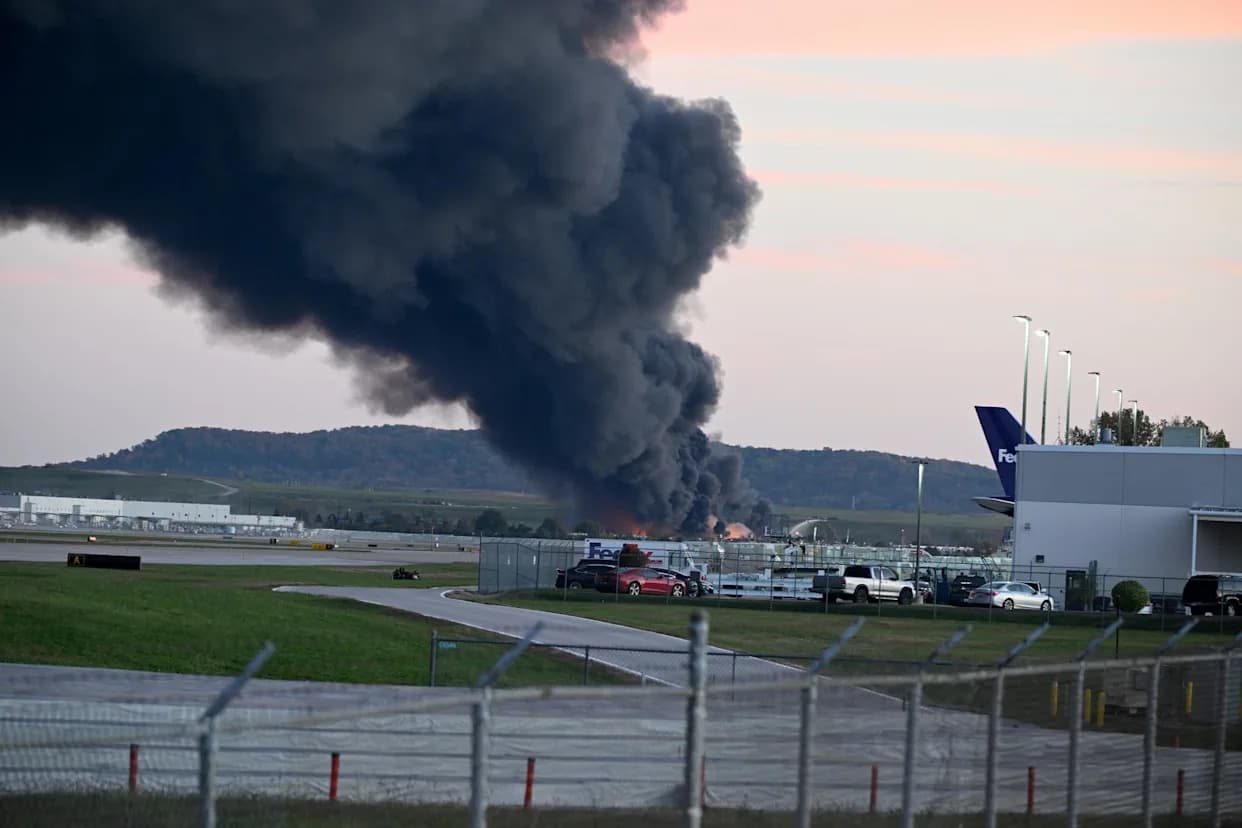
Fire and smoke mark where a UPS cargo plane crashed near Louisville Muhammad Ali international airport on 4 November 2025 in Louisville, Kentucky.Photograph: Stephen Cohen/Getty Images
A preliminary National Transportation Safety Board (NTSB) report released Wednesday says Boeing alerted MD-11 operators in 2011 about failures of a "spherical bearing race" used in engine mounts, but did not classify the issue as an immediate flight-safety hazard. Investigators found that the same component had failed at least four times previously across three aircraft, and cracks were discovered where the engine attaches to the left wing of the UPS freighter that crashed in Louisville on 4 November 2025.
What the Report Found
The NTSB update says Boeing issued a service letter in February 2011 describing prior failures of the spherical bearing race assembly — a part that helps secure engines to wings — but recommended inspection only during routine general checks (typically every 60 months) rather than urgent corrective action. The agency’s investigators discovered evidence of cracks in the engine mount on the downed MD-11F, which lost an engine and caught fire shortly after takeoff from Muhammad Ali International Airport.
Crash, Casualties and Immediate Response
The MD-11F, a three-engine freighter derived from the McDonnell Douglas DC-10, crashed into an industrial complex near the airport at about 5:15 p.m. on 4 November 2025, producing a massive fireball. All three crew members on board were killed, and 12 people on the ground later died from injuries sustained in the crash; the most recent ground victim died on Christmas Day. Footage aired by WLKY showed the impact and the resulting fires and thick smoke.
Industry and Legal Consequences
Following the accident, UPS and FedEx temporarily grounded their MD-11 freighter fleets while investigators examined the cause. The crash has also prompted at least one lawsuit alleging UPS was negligent for continuing to operate MD-11 aircraft despite known maintenance concerns.
Maintenance History and Previous Alerts
The Associated Press reported that the cracks in the engine mount were not detected during the aircraft’s most recent maintenance inspection. AP noted that the last close inspection of the relevant engine-mount parts was in October 2021 and that the next such inspection would not have been due until roughly another 7,000 cycles (takeoffs and landings).
Jeff Guzzetti, a former investigator with the Federal Aviation Administration and the NTSB, told the AP that McDonnell Douglas issued a bulletin in 1980 identifying failures of the spherical bearing race as a “safety of flight condition.” Guzzetti said that history raises questions both about the adequacy of Boeing’s 2011 service letter and about how operators, including UPS, interpreted and acted on the guidance.
Boeing: “We continue to support the investigation led by the NTSB. Our deepest condolences go out to the families who lost loved ones and our thoughts remain with all those affected.”
UPS: “We remain profoundly saddened by the Flight 2976 accident. Our thoughts continue to be with the families and Louisville community who are grieving, and we remain focused on the recovery effort.” UPS has declined to comment on pending or existing legislation related to the crash.
Broader Context
Analysts and aviation safety experts note parallels to past tragedies involving older widebody designs, including the 1979 Chicago crash of an American Airlines DC-10 that killed 271 people and led to a worldwide grounding until investigators identified maintenance damage as a primary cause. The NTSB’s continuing investigation will determine whether design, maintenance guidance, inspection intervals or operator practices were decisive factors in the Louisville accident.
What Happens Next: The NTSB investigation will continue to analyze metallurgical evidence, maintenance records and communications between manufacturers and operators. Regulators and operators worldwide are watching the findings closely; any safety recommendations from the NTSB could prompt fleet inspections, service directives, or regulatory actions.
Help us improve.