About 250–300 million Christians—mainly Orthodox and Coptic communities—celebrate Christmas on January 7 because they use the Julian calendar for church dates. The Julian calendar is currently 13 days behind the Gregorian calendar, so Julian December 25 falls on January 7 in the modern civil calendar. That gap will widen to 14 days in 2100 because of differing leap-year rules. The split is calendrical, not a dispute over Jesus’s birthdate.
Why About 250 Million Christians Celebrate Christmas On January 7
(Al Jazeera)
Millions of Christians across Eastern Europe, the Middle East and parts of Africa observe Christmas on January 7. The day commemorates the birth of Jesus Christ in Bethlehem, but for roughly 250–300 million believers the feast falls on January 7 because their churches continue to use the older Julian calendar for liturgical dates.
How A Calendar Difference Created Two Christmas Days
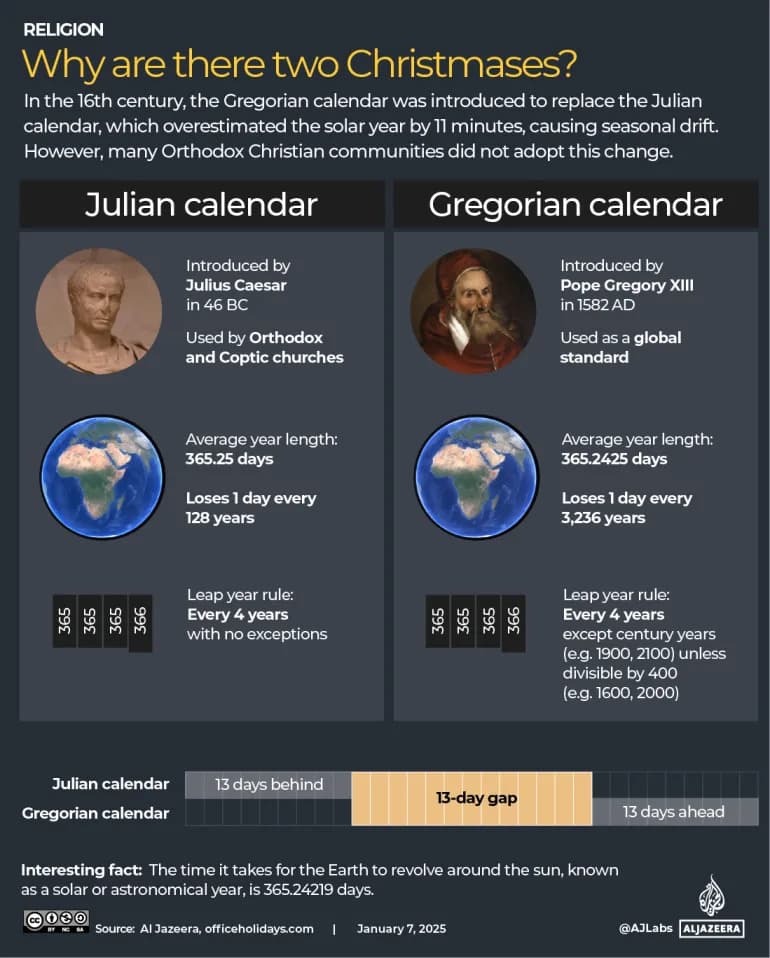
The split is not about a different belief in Jesus’ birthdate, but about which calendar is used to mark the date. In 1582 Pope Gregory XIII introduced the Gregorian calendar to correct small but accumulating errors in the older Julian calendar (introduced by Julius Caesar in 46 BC). The Julian calendar overestimated the solar year by about 11 minutes; over many centuries that tiny error shifted calendar dates relative to the seasons.
(Al Jazeera)
The Gregorian reform trimmed that error substantially and required skipping 10 days when adopted in 1582 so dates and seasons would realign. Most of Western Europe and later most of the world adopted the Gregorian calendar, but many Eastern and Oriental Orthodox churches retained the Julian calendar for liturgical continuity.
Why January 7?
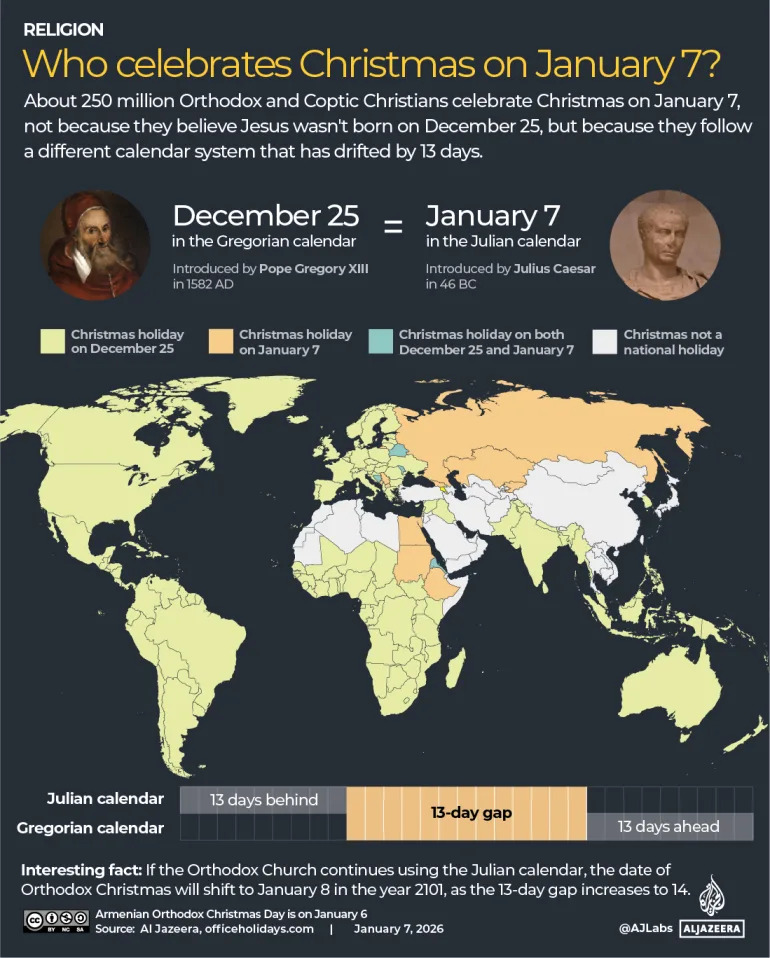
Today the Julian calendar runs 13 days behind the Gregorian calendar. That means December 25 on the Julian calendar corresponds to January 7 on the Gregorian (civil) calendar. If the Julian calendar continues unchanged, the gap will increase to 14 days in 2100 because the Gregorian calendar omits a leap day that the Julian calendar keeps; after that change, Julian December 25 will correspond to January 8 on the Gregorian calendar.
(Al Jazeera)
Who Celebrates January 7?
Communities and churches that observe January 7 include the Russian Orthodox Church (the largest group), the Serbian and Georgian Orthodox Churches, the Coptic Orthodox Church in Egypt, and the Ethiopian and Eritrean Orthodox Tewahedo Churches. Together these communities account for roughly 250–300 million Christians worldwide.
Practices vary by country. Ukraine historically celebrated on January 7, but in 2023 the government moved the official public holiday to December 25 while many people still observe the traditional date. Greece, Romania and Bulgaria shifted official celebrations to December 25 in the 20th century; Belarus and Moldova recognize both December 25 and January 7 as public holidays.
Context: Calendars And The Date Of Birth
The exact day of Jesus’s birth is unknown. The choice of December 25 as the date for Christmas developed in early Christianity from the belief that Jesus was conceived on March 25 (the Feast of the Annunciation), which, when you add nine months, gives December 25. The selection of New Year’s Day (January 1) long predates Christianity, having been used by the Romans from at least 153 BC and preserved by Julius Caesar’s reforms.
Other Calendar Systems
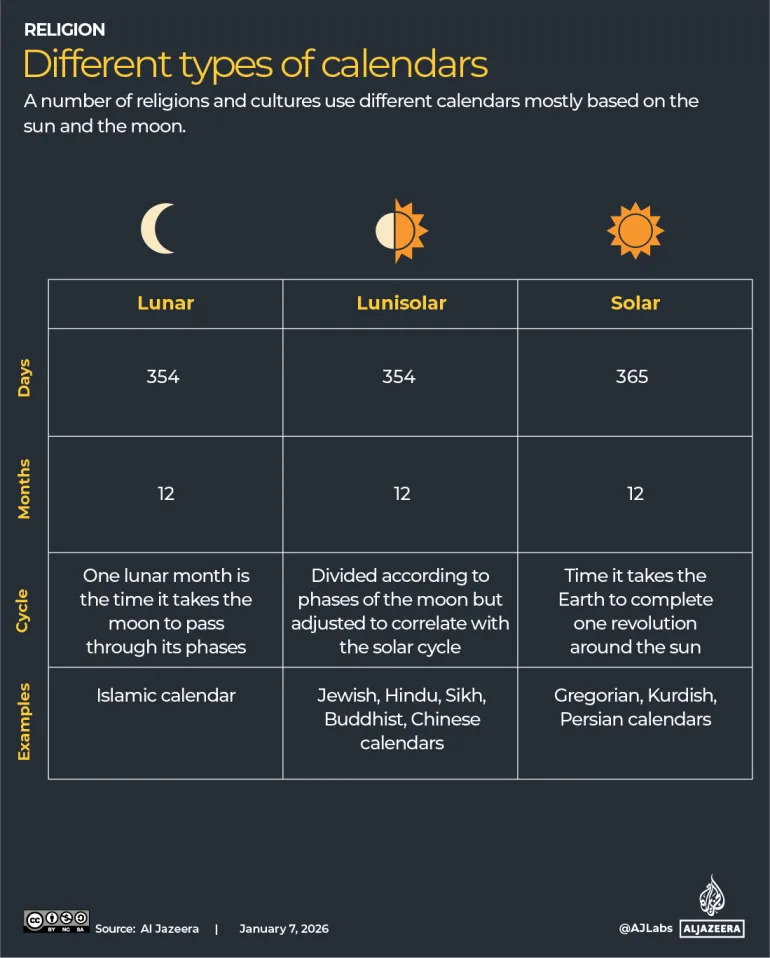
Different cultures use different calendar systems. Solar calendars—like the Gregorian and Persian calendars—track the sun and have about 365 days per year. Lunar calendars—like the Islamic calendar—track the moon, giving around 354 days and causing holidays to move through the seasons. Lunisolar calendars combine lunar months with periodic adjustments to stay aligned with the solar year; examples include traditional Jewish, Chinese and Hindu calendars.
Bottom line: The January 7 Christmas observed by many Orthodox and Coptic churches is a result of continuing to use the Julian calendar for liturgical dates; it is a calendrical difference rather than a disagreement about Jesus’s birth.
Help us improve.