
Palestinian Christians returned to Bethlehem’s Church of the Nativity for Christmas for the first time since the outbreak of the 2023 Gaza war, as the city attempts to restore public festivities. Longstanding Christian communities across the West Bank, East Jerusalem and Gaza have dwindled to under 50,000 people, with many leaving due to movement restrictions and economic pressures tied to the occupation. Rights groups report a surge in attacks on Christian sites — RFDC documented at least 201 incidents from January 2024 to September 2025 — and several high-profile strikes on Gaza churches caused civilian deaths and extensive damage.
Christmas Under Occupation: Bethlehem’s Christians Return to the Nativity Amid Ongoing Violence

INTERACTIVE - Christmas Could Mary and Joseph travel from Nazareth to Bethlehem today-1766598851
Palestinian Christians gathered at the Church of the Nativity in Bethlehem this Christmas — the first time since the outbreak of the 2023 war in Gaza that many in the community describe as genocidal — as the city seeks to revive public celebrations after a prolonged period of grief and disruption.
A City Trying To Reclaim Joy
Bethlehem’s mayor said the municipality has worked to restore festive life after a long season of darkness and silence. At a local Christmas market, Safaa Thalgieh, a mother from Bethlehem, told Al Jazeera reporter Nida Ibrahim:
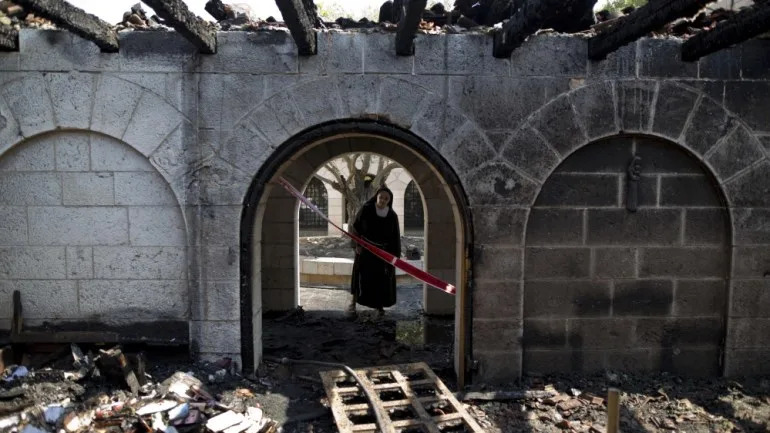
A nun surveys heavy damage caused to the Church of the Multiplication at Tabgha, on the Sea of Galilee, in northern Israel, which was set on fire by Yinon Reuveni, on June 18, 2015 [Ariel Schalit/AP Photo]
“Our joy doesn’t mean people are not suffering, have lost their loved ones, or are desperate, but we can only pray that things get better.”
Ancient Roots, Shrinking Community
Palestinian Christians are among the world’s oldest continuous Christian communities. According to Christian tradition, Mary and Joseph travelled from Nazareth to Bethlehem where Jesus was born; the Church of the Nativity and its grotto remain focal points for pilgrims each Christmas.
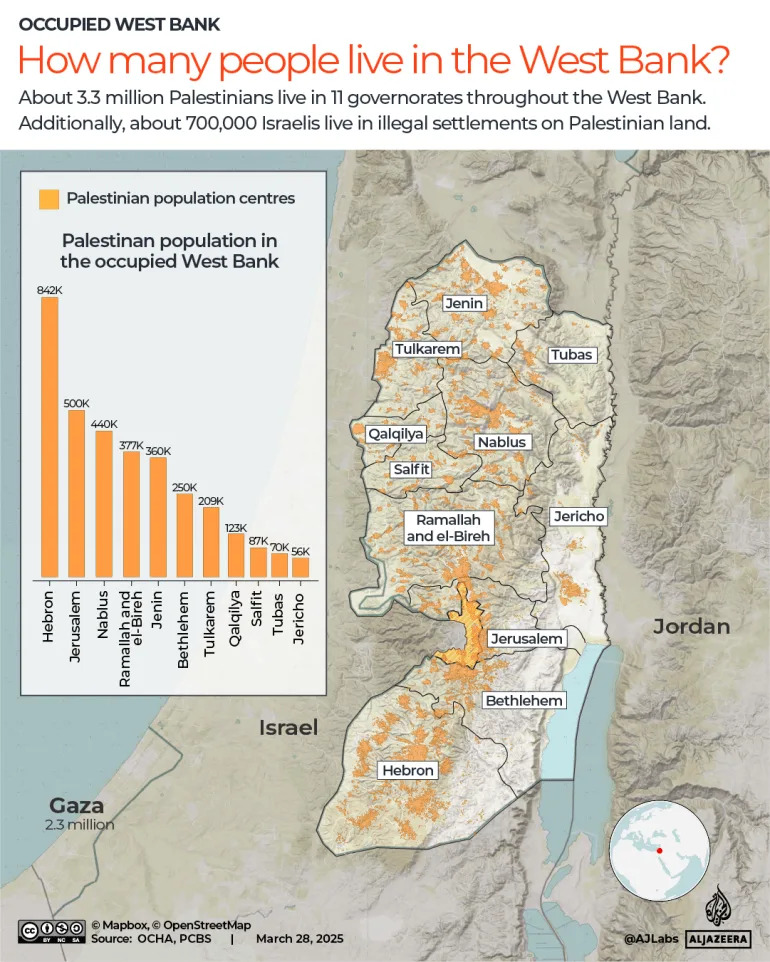
Yet travel and daily life are heavily constrained by checkpoints, settlements and the separation barrier, which affect both pilgrims and residents. According to the 2017 Palestinian census, fewer than 50,000 Christians now live across the occupied West Bank, East Jerusalem and Gaza — about 1 percent of the population, down from roughly 12 percent in the early 20th century. Many observers attribute this decline to restrictions on movement, economic hardship and pressures associated with the occupation, prompting emigration.
INTERACTIVE - Occupied West Bank population-1743158487
Where Christians Live Today
Most Palestinian Christians are concentrated in three urban areas: the Bethlehem governorate (about 22,000–25,000, including Beit Jala and Beit Sahour), Ramallah and al-Bireh (around 10,000, including Taybeh, Birzeit and Jifna), and East Jerusalem (approximately 8,000–10,000, mainly in the Old City’s Christian Quarter and neighbourhoods like Beit Hanina).
Rising Violence and Attacks on Churches
Like other Palestinians, Christians live under Israeli military control and face settler violence and legal constraints that rights groups say are discriminatory. Across the occupied territories, churches and Christian communities have been affected by attacks and harassment attributed to a mix of actors.
INTERACTIVE - Attacks on Christians in Jerusalem-1766601642
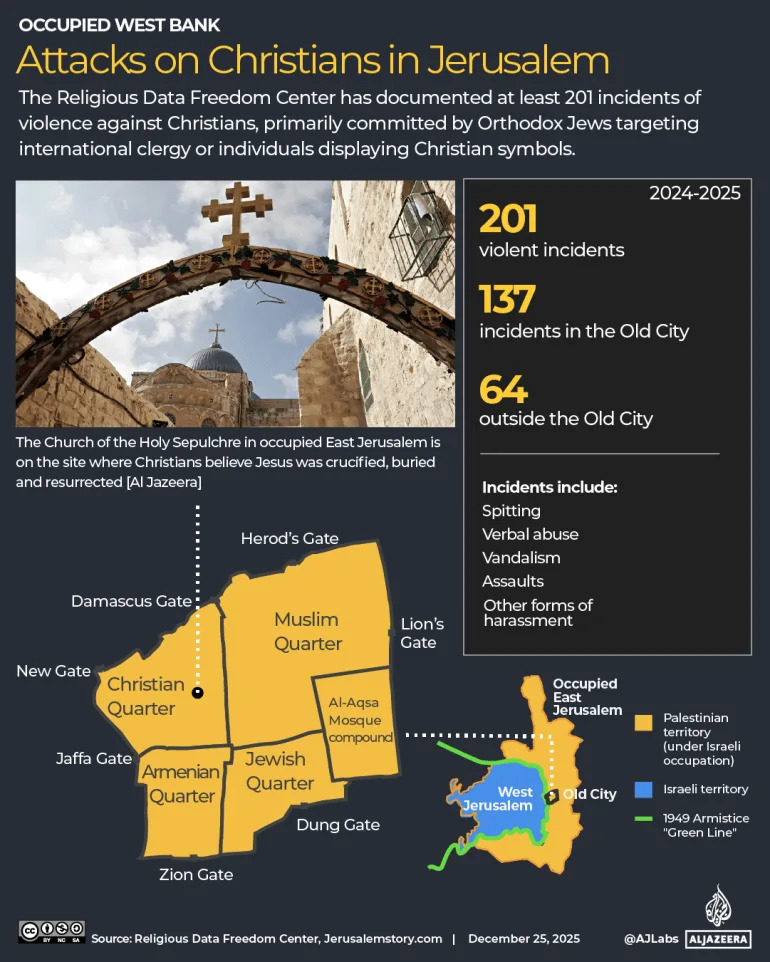
The Religious Freedom Data Center (RFDC) documented at least 201 incidents of violence against Christians between January 2024 and September 2025, reporting that many incidents involved Orthodox Jewish individuals targeting clergy or people displaying Christian symbols. These incidents — which included spitting, verbal abuse, vandalism and physical assault — were concentrated in Jerusalem’s Old City, where RFDC logged 137 cases.
Notable Incidents And Losses
In 2025, Palestinian Christian communities in the West Bank reported a sharp rise in targeted violence and land seizures. In Beit Sahour, Israeli settlers, supported by military forces, bulldozed the Ush al-Ghurab hilltop in November to establish a new outpost. In July, arsonists attacked the ancient St. George Church in Taybeh. Footage from June showed assaults on the Armenian Monastery and other Christian sites during a raid on the Armenian Quarter of East Jerusalem.

Father Aghan Gogchyan, chancellor of the Armenian Patriarchate of Jerusalem, stands outside St James Cathedral in the Armenian Quarter of occupied East Jerusalem [File: Francisco Seco/AP Photo]
Gaza’s Christian community has also suffered significant damage. An Open Doors report from early 2025 estimated that roughly 75 percent of Christian-owned homes in Gaza were damaged or destroyed since the war began. One of the most devastating incidents occurred on October 19, 2023, when an attack on Gaza’s Greek Orthodox Church of Saint Porphyrius killed at least 18 displaced civilians sheltering there. Survivors described the church as a last refuge.
“We sought refuge here, thinking it was a safe haven — our last safe haven, in a church. The house of God,” said a father who lost three children in the blast.
Gaza’s Holy Family Church, the territory’s only Roman Catholic parish, also sustained damage: an airstrike on November 4, 2023 partially destroyed a school within the compound, and subsequent shelling in 2025 killed and wounded civilians. The late Pope Francis frequently called the parish during the war, underscoring its symbolic and pastoral importance.
Looking Ahead
For many Palestinian Christians, churches remain both spiritual anchors and physical shelters amid ongoing instability. The return of congregations to Bethlehem’s Nativity this Christmas reflects resilience, even as communities continue to mourn losses and confront uncertainty about their future in the region.
Sources: Palestinian census (2017), Religious Freedom Data Center (RFDC), Open Doors, Al Jazeera reporting and local testimonies.


