
The winter solstice (this year on Dec. 21) brings the Northern Hemisphere’s shortest day and the Southern Hemisphere’s longest. Solstice — from Latin roots meaning the sun and "to stand still" — marks when the sun’s apparent motion pauses and reverses, and daylight begins to increase thereafter. Equinoxes occur when both hemispheres receive nearly equal sunlight, while meteorological seasons follow fixed three-month blocks based on temperature.
Shortest Day Of The Year: What The Winter Solstice Means — And Why Brighter Days Are Coming

The shortest day of the year has arrived. Here’s what to know
Yes, the darkest day of the year has arrived in the Northern Hemisphere — but it also marks the turnaround point: daylight will begin to lengthen each day, bringing steadily brighter skies through spring and into summer.
What Is Happening?
The winter solstice — observed this year on Dec. 21 — is the moment when the Northern Hemisphere experiences its shortest day and longest night. At the same time, the Southern Hemisphere enjoys its longest day and the start of astronomical summer.
What Does "Solstice" Mean?
The word solstice comes from the Latin roots sol (sun) and a form of sistere (to stand still), via the Latin solstitium. It refers to the point when the sun’s apparent annual movement in the sky pauses and then reverses direction. At the winter solstice the sun traces its lowest, shortest arc above the horizon.
Why Days Change
As Earth orbits the sun, its axis is tilted relative to its orbital plane. That tilt causes sunlight to hit the two hemispheres unevenly throughout the year. Solstices occur when that tilt is at its maximum toward or away from the sun, producing the biggest differences in day length between the hemispheres.
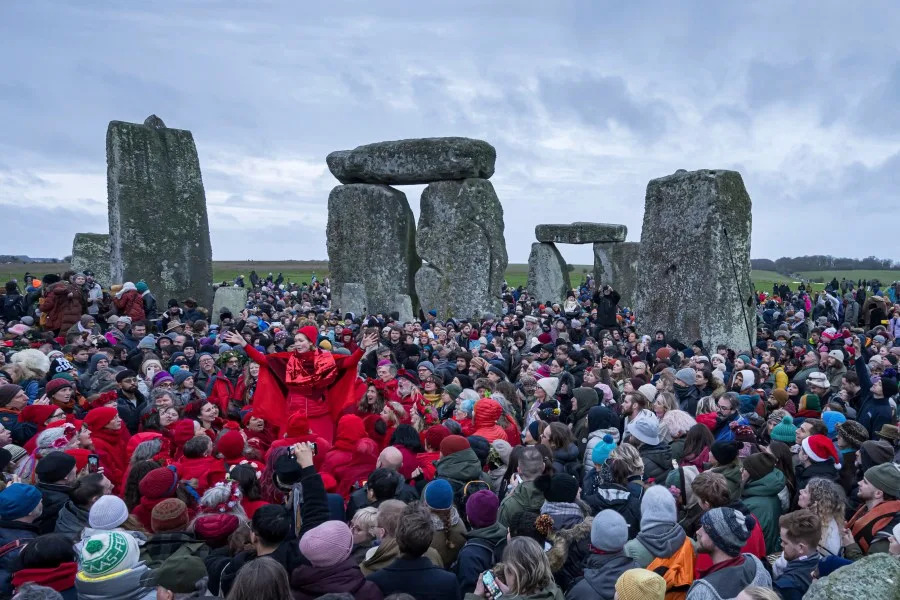
People celebrate the Winter Solstice sunrise celebrations at Stonehenge, England, Saturday, Dec. 21, 2024. (AP Photo/Anthony Upton, file)
Timing
Winter solstices can fall between Dec. 20 and Dec. 23; this year the Northern Hemisphere’s winter solstice occurs on Dec. 21. The Northern Hemisphere’s summer solstice typically falls between June 20 and June 22. Exact times vary slightly each year because of the way our calendar aligns with Earth’s orbit.
Equinoxes And Seasons
Equinoxes — the vernal (spring) and autumnal (fall) equinoxes — occur when Earth’s axis and orbit align so both hemispheres receive nearly equal sunlight. The word equinox comes from Latin words meaning “equal” and “night.” Equinoxes usually fall between March 19–21 (spring) and Sept. 21–24 (fall), with small minute-level differences depending on your location.
Astronomical Versus Meteorological Seasons
Astronomical seasons are defined by Earth’s position in its orbit (solstices and equinoxes). Meteorological seasons are based on the annual temperature cycle and group months into convenient three-month blocks: spring begins March 1, summer June 1, fall Sept. 1 and winter Dec. 1.
Cultural Notes
Humans have observed solstices for millennia with ceremonies, festivals and constructions aligned to the sun’s path — Stonehenge is a famous example of a monument built to mark solstice sunrises and sunsets.
Bottom line: The winter solstice is a natural turning point in the year. Even though it brings the shortest day and longest night in the Northern Hemisphere, it also signals that daylight will grow longer each day until the long days of June.


