Christmas returned to both Bethlehem and Nazareth this year, but under very different circumstances. Nazareth celebrated amid a growing and visible Christian community in Israel, while Bethlehem’s festivities took place against a long-term decline in its Christian population and recent security incidents. Officials and analysts disagree on causes and solutions, highlighting tensions over governance, protection and demographic change.
Christmas Returns To Bethlehem And Nazareth — Two Cities, Two Very Different Realities

People gather next to the Christmas tree at Manger Square on the day of Christmas events with Cardinal Pierbattista Pizzaballa, Latin Patriarch of Jerusalem, on Christmas Eve, in the Old City of Bethlehem in the West Bank, Dec. 24, 2025.
Christmas observances resumed this year in both Bethlehem and Nazareth — two cities central to Christian history — but the holiday unfolded against sharply different social and political backdrops. Nazareth celebrated with visible confidence and expanding local Christian life, while Bethlehem’s festivities took place amid long-term population decline and renewed security concerns.
Nazareth: Visible Growth And Relative Stability
In Nazareth, celebrations were broad and public, reflecting what some local and international observers describe as a growing and increasingly prosperous Christian community inside Israel. Josh Reinstein, director of the Knesset Christian Allies Caucus, noted economic and social indicators to illustrate that trend.
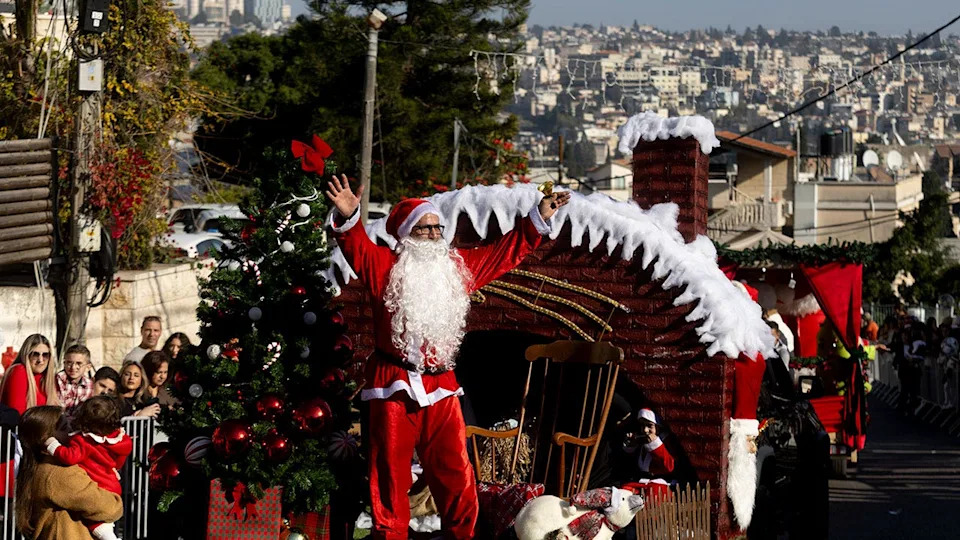
A man wearing a Santa Claus costume takes part in the 40th annual Christmas parade heading towards the Basilica of the Annunciation on December 24, 2025, in Nazareth, Israel. Nazareth, the home of Jesus, according to the New Testament, has seen a return of Christmastime tourism this year after two years in which celebrations were muted amid the war in Gaza. Nazareth, in Israel's Galilee region, is a predominately Arab town, about one-third of whom are Christian, with the majority being Muslim.
"Nazareth is a completely different situation. It’s an indigenous Christian community under the authority of Israel, and it grows every year. It prospers," Reinstein said, adding that Christian communities in Israel tend to have high GDP per capita and strong civic protections.
Bethlehem: Tradition Amid Decline And Concern
Bethlehem — long celebrated as the birthplace of Jesus — marked Christmas with crowds in Manger Square, a tree-lighting and ceremonies at the Church of the Nativity. Yet many residents and analysts described these gestures as attempts to project normalcy amid a longer-term demographic decline and recent incidents that have heightened anxiety in the local Christian community.
Elias Zarina, a senior researcher at the Jerusalem Center for Applied Policy, pointed to a steep drop in Bethlehem’s Christian share: from about 86% of the town’s population in 1950 to roughly 10% in the Palestinian Authority’s 2017 census. He also said at least 142 Christian families have left the Bethlehem area since the Oct. 7, 2023 Hamas attack on Israel.
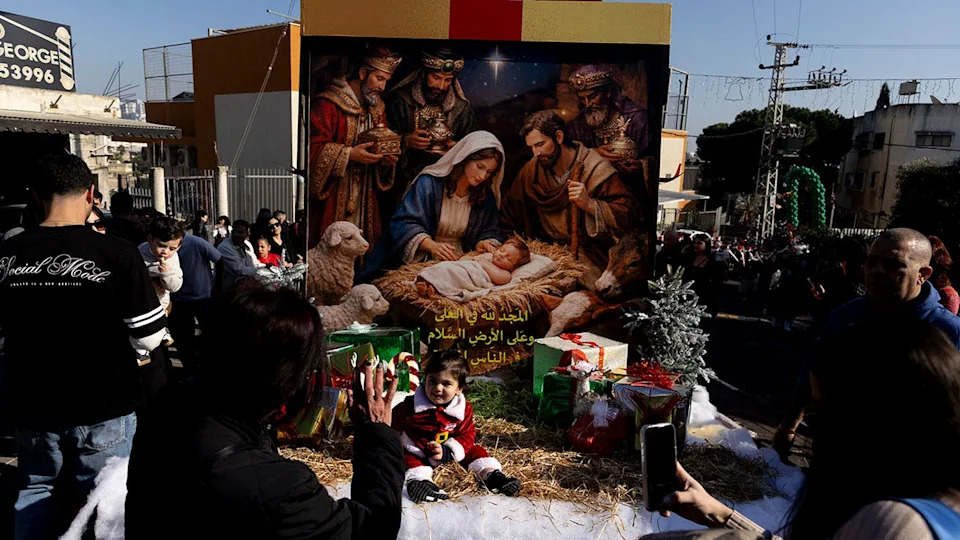
People take part in the 40th annual Christmas parade on December 24, 2025, in Nazareth, Israel. Nazareth, the home of Jesus, according to the New Testament, has seen a return of Christmas tourism this year after two years in which celebrations were muted amid the war in Gaza. Nazareth, in Israel's Galilee region, is a predominately Arab town, about one-third of whom are Christian with the majority being Muslim.
"They saw what happened on Oct. 7 and understood that minorities in this region have no future without real protection," Zarina said.
Incidents, Claims And Official Reactions
Concerns were heightened by several incidents ahead of Christmas, including reports of a church in Jenin being firebombed and a Christmas tree set on fire outside another church in areas under Palestinian Authority control. Israel’s Foreign Ministry warned of a "growing hostility toward Christians" in those areas.
Zarina alleged a pattern of harassment and forced displacement carried out by extremist actors and claimed outside moral and financial support for some hardline groups — a point he presented as part of his broader critique of local law-enforcement and governance. Those claims are contested by other observers and community leaders.
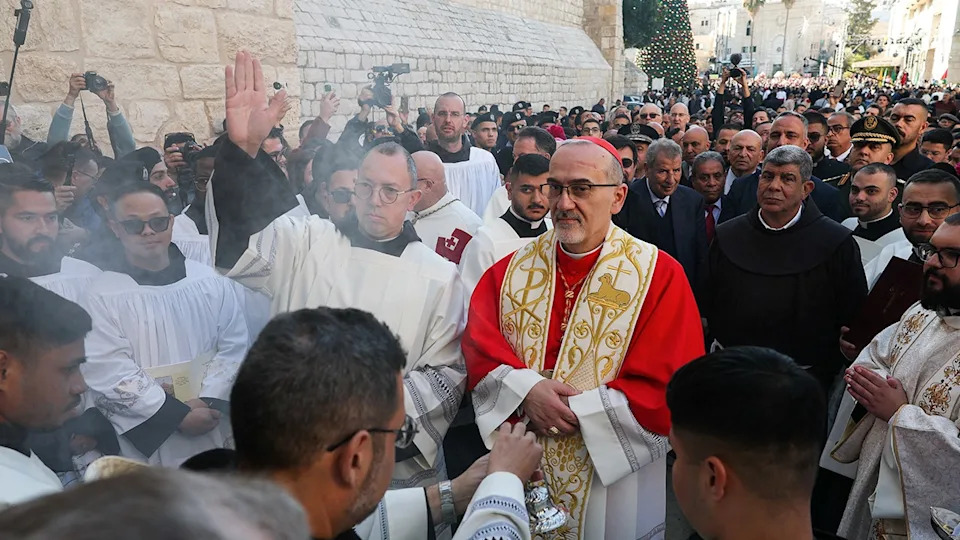
Latin Patriarch of Jerusalem, Cardinal Pierbattista Pizzaballa, attends Christmas celebrations in Bethlehem, in the West Bank, on Christmas Eve, Dec. 24, 2025.
Pastor Naim Khoury, a Bethlehem cleric, said conditions in Bethlehem improved this year and that he had not seen holiday-related attacks so far, while other local activists said fear limits public criticism by Christians in the area.
Demographics And Divergent Trends
Official Israeli statistics provide a contrasting national snapshot. Figures released by Israel’s Central Bureau of Statistics and reported by TPS-IL place the Christian population in Israel at roughly 184,200 as of Christmas Eve 2025 — about 1.9% of the population — with a modest growth rate of 0.7% in 2024. Nazareth remains the city with the largest Arab Christian population in Israel, at about 18,900 residents.
What The Holiday Spotlight Reveals
The seasonal celebrations in both cities showcased enduring religious traditions and civic pageantry. At the same time, they highlighted profound questions about governance, security and community survival. Observers differ on causes and remedies: some blame local governance and economic decline in parts of the West Bank, while others point to specific extremist incidents and contested law-enforcement responses.
Whether international attention generated by the Christmas season will translate into sustained protections for threatened communities — or will fade when the decorations come down — remains an open and pressing question for Bethlehem’s Christians and for those following the region’s ancient religious communities.
Help us improve.