Interstellar comet 3I/Atlas will make its closest (and harmless) pass by Earth on Friday at about 170 million miles. The object, only the third confirmed interstellar visitor, currently lies in the constellation Leo and appears as a faint green smudge visible with modest telescopes. NASA, ESA and 21 countries are using the event for a coordinated planetary-defence exercise led by the International Asteroid Warning Network.
Interstellar Comet 3I/Atlas Makes Close, Harmless Pass — Amateur Astronomers Urged To Look Up

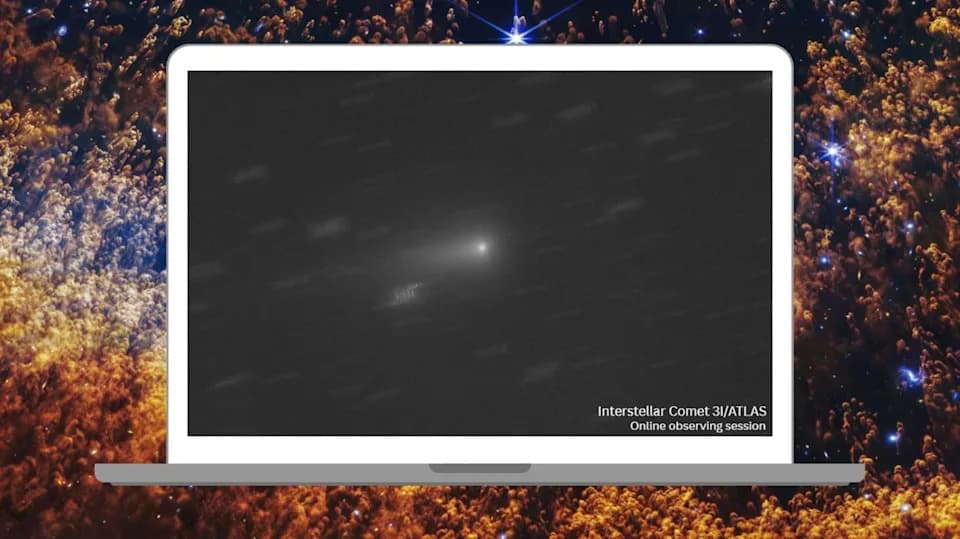
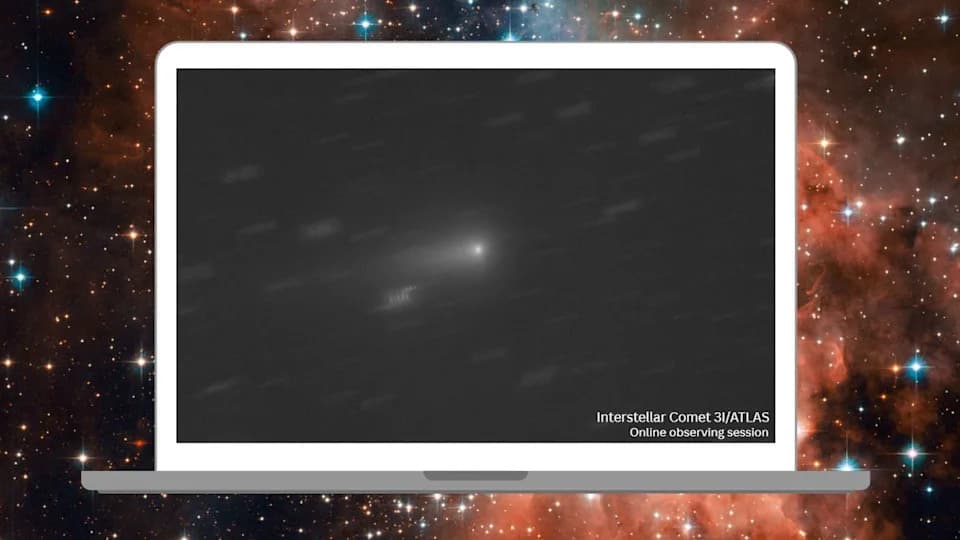
The interstellar comet 3I/Atlas streaks through space - Gianluca Masi/AP
An interstellar comet designated 3I/Atlas will make its closest approach to Earth on Friday, passing at a safe distance of about 170 million miles. Although it poses no threat, the fly-by is a rare chance for observers and researchers to study material from beyond our Solar System and to run a multinational planetary-defence exercise.
What Observers Can Expect
3I/Atlas currently lies in the constellation Leo. It cannot be seen with the naked eye, but observers using modest amateur telescopes should be able to spot a faint, green-tinged smudge in the night sky as it moves. The object has brightened somewhat as it approached, but it remains roughly 100 times too faint for unaided human vision and will continue to fade as it recedes from the Sun.

1712 Comet 3I/Atlas
“Around the time of closest approach, it will appear just beneath the Lion’s belly,” said Dr Mark Norris, senior lecturer in astronomy at the University of Lancashire. “It won’t climb high in the sky until roughly midnight and reaches its highest point a few hours before dawn. It’s still within reach of astronomy enthusiasts with small telescopes.”
Discovery And Trajectory
The comet was discovered by the ATLAS network (Asteroid Terrestrial-impact Last Alert System), a set of four survey telescopes in Hawaii, Chile and South Africa that search for potentially hazardous asteroids. Astronomers identified 3I/Atlas as interstellar because its orbit is strongly hyperbolic — the path is far too elongated and steep to have originated inside our Solar System. Current estimates indicate the comet will travel to a point about 40% farther from the Sun than Earth before heading back out into interstellar space.
Planetary Defence Exercise
Space agencies including NASA and the European Space Agency (ESA) are among the participants in a global exercise coordinated by the International Asteroid Warning Network (IAWN). The drill, involving representatives from 21 countries, focuses on improving coordination, modelling impact probabilities, refining communications with the public, and sharpening techniques for precisely measuring the positions of comets — a challenge because comets often appear as fuzzy, extended objects in telescopes.

Interstellar comet 3I/Atlas will pass by Earth on Dec 19
Why This Matters
3I/Atlas is only the third confirmed interstellar object observed in our Solar System. The first, ʻOumuamua (2017), was an elongated object whose behaviour briefly sparked intense debate; the second, 2I/Borisov (2019), was a more typical comet likely formed near a red-dwarf star. Interstellar visitors like 3I/Atlas offer one of the best short-term opportunities to sample material from other star systems without mounting an interstellar mission.
While spacecraft such as Voyager took decades to reach interstellar space and would need tens of thousands of years to reach nearby stars, astronomers hope improving detection and rapid-response technologies will make it possible to study future interstellar objects in greater detail — and perhaps even send probes to intercept them.
Help us improve.