Topologists define a hole as a through‑passage (like a doughnut), not a blind pit. Many surface openings — pores, most gland ducts and ear canals — do not qualify because they terminate internally. Counting connected external openings gives seven topological holes in humans; in people with a reproductive tract that connects via the fallopian tubes to the peritoneal cavity, a plausible eighth hole exists. The result highlights topology’s focus on connectivity rather than raw orifice counts.
How Many Holes Does the Human Body Have? A Topologist’s Answer

How do you define a hole? . | Credit: Getty Images
The human body has many surface openings, but which of them count as true "holes" depends on how you define a hole. Using the topological definition — a through‑passage that goes all the way through an object — we can arrive at a surprising but tidy answer.
What Is a Hole — Topologically?
In everyday language a "hole" can mean a dent, a pit or an opening. Topologists, however, mean something specific: a through‑hole, like the hole in a doughnut, that you could push a finger or a thread through and come out the other side. Blind pits that end inside tissue — such as many skin pores or gland ducts — do not qualify.

The words 'Life Little Mysteries' over a blue background
Why A Straw Is A Doughnut
Consider a straw with two open ends. If it were made of play‑dough and you squashed it, you could deform it into a doughnut without cutting or sealing anything. Topologists call such objects homeomorphic — they share the same fundamental connectivity. The straw's two openings are simply the two ends of one continuous through‑hole.
Which Human Openings Count?
Start by listing external openings: mouth, two nostrils, two tear‑drain openings in the corners of the eyelids (the lacrimal puncta — one upper and one lower for each eye, giving four in total), the two ear canals, the anus, the urethral opening and, for many people, the vaginal opening and nipple ducts. At microscopic scale there are millions of skin pores and sweat gland openings.

This delicious pretzel has three holes. | Credit: Getty Images
Many of these do not qualify as topological through‑holes. Skin pores and most gland ducts are blind pits that terminate in tissue. Ear canals are sealed off from internal sinuses by the eardrum. That rules out millions of tiny openings and many ducts.
Counting the Through‑Holes
Using the through‑hole criterion and accounting for internal connections, the holes that matter are those you can, in principle, thread through from outside to outside via continuous internal passages. The main contributors are:
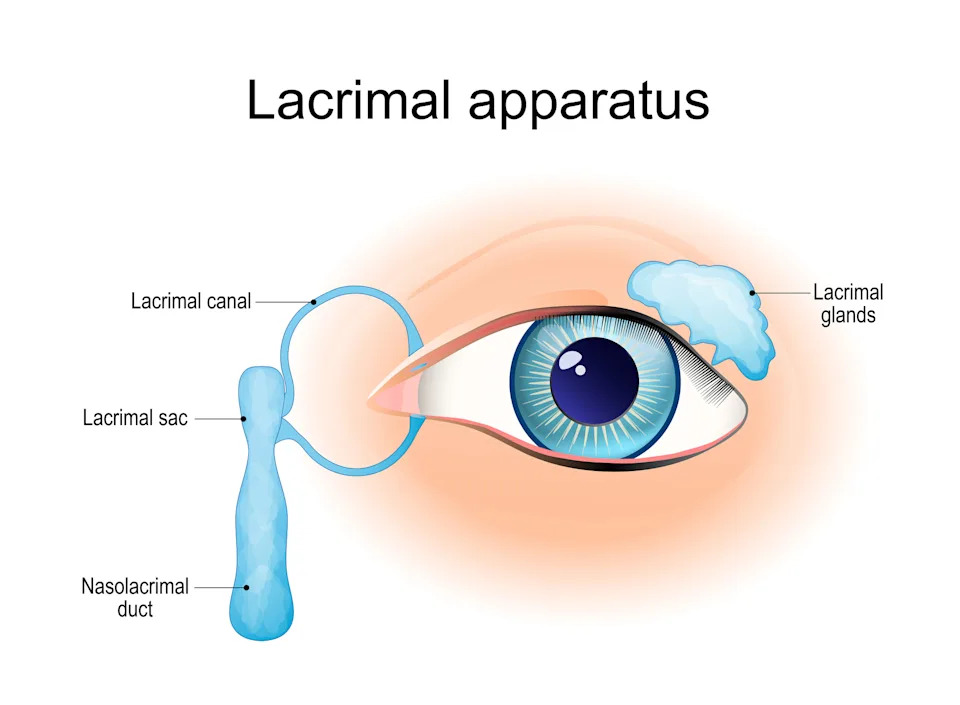
The two lacrimal puncta drain tears from the eye down the lacrimal canals and through to the nasolacrimal duct which connects to the nasal cavity. | Credit: Getty Images
- The mouth (connected through the throat to the gastrointestinal tract and ultimately to the anus)
- The two nostrils (both connect to the nasal cavity and on to the throat)
- The four lacrimal puncta (the tiny tear drains) which connect via the nasolacrimal ducts into the nasal cavity
- The anus
Because some of these openings join together internally, the raw count of openings is not the same as the topological count of holes. When multiple external openings feed into the same internal passage, they collectively form fewer independent holes. A helpful analogy: a garment with three openings (waist and two legs) can be topologically two holes once flattened and analyzed for connectivity.
Applying that reasoning yields a common answer: humans typically have seven topological holes. This accounts for the way the mouth, nose, tear drains and anus connect through internal cavities.

Underwear has three openings but only two holes. | Credit: Getty Images
When Is There An Eighth Hole?
In people assigned female at birth, there is a plausible eighth hole. The vaginal canal connects to the uterus and the uterine cavities lead to two fallopian tubes. The fimbrial (outer) ends of the tubes open into the peritoneal cavity near the ovaries. Because the peritoneal cavity is continuous and because eggs (and fluids) can travel across to the opposite tube, there exists — at least in principle — a continuous route that could allow a very thin thread to be passed from outside, through the reproductive tract and back out. When this route is accepted as a through‑passage, the topological hole count becomes eight.
The Bottom Line
Topologically speaking, humans have seven holes by default; in individuals with a reproductive tract that provides a continuous passage as described above, there can be eight. The exercise is an elegant illustration of how topology emphasizes connectivity and continuity rather than simply tallying surface openings.
Note: This discussion uses simplified anatomical connectivity to illustrate topological ideas. It is a conceptual explanation rather than a clinical or surgical guide.
Help us improve.